Youssef Rajji Iran Warning: Stop Interfering In Lebanon
Lebanese Foreign Minister Youssef Rajji said normal relations with Iran’s mission can resume only when Tehran respects Lebanon’s sovereignty and institutions


Youssef Rajji Iran warning sharpened Lebanon’s public message to Tehran, as the Lebanese foreign minister said normal relations with Iran’s mission in Lebanon can resume only under clear conditions.
Rajji, Lebanon’s Minister of Foreign Affairs and Emigrants, said Tehran must comply with the Lebanese state’s decision and respect Lebanon’s sovereignty. He also said Iran must respect the decisions of Lebanon’s institutions, in accordance with established diplomatic rules and procedures.
Iranian officials must stop interfering in Lebanon’s internal affairs, Rajji added, pointing to the latest statements by the Speaker of the Iranian Parliament as an example.
Isaiah speaks of a people refusing to be ruled by outsiders, saying, “For the Lord is our judge, the Lord is our lawgiver, the Lord is our king.” For Lebanon, the modern political question is different but related: whether the state itself, not foreign patrons or armed factions, makes the decisions that determine war, peace, and diplomacy.
Youssef Rajji Iran Warning
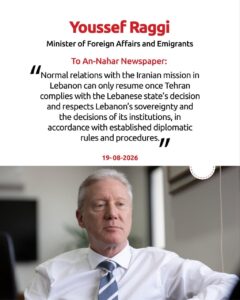
Rajji is one of Lebanon’s most important diplomatic voices. As foreign minister, he represents Beirut in dealings with regional governments, Western capitals, and international institutions.
His comments reflect a wider struggle inside Lebanon. The country faces pressure from Iran, Hezbollah’s armed role, Israeli security demands, and U.S.-brokered diplomatic efforts meant to prevent another full war on the northern border.
Rajji has repeatedly framed Lebanon’s defense as a responsibility of the Lebanese state. In earlier remarks, he said a capable state cannot exist while an armed organization operates outside its authority.
That point goes directly to Hezbollah. The group remains Iran’s central proxy in Lebanon and has long held military power beyond the control of the Lebanese government.
Lebanon’s Sovereignty Test
Rajji’s warning follows growing debate over the Israel-Lebanon framework. That diplomatic backdrop also appeared in “Lebanon Framework Concerns Raised At Vatican Meeting.” The article reported that the Vatican voiced concern over implementation of the framework after Pope Leo XIV met Lebanese President Joseph Aoun.
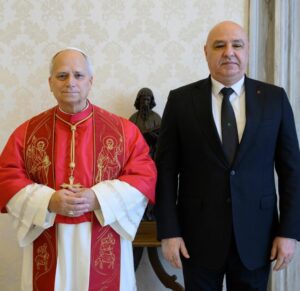
The issue is not only Israeli withdrawal or Lebanese complaints. It is whether Lebanon can restore real state authority in the south while Hezbollah keeps weapons and answers politically to Tehran.
President Joseph Aoun has also stressed that Lebanon’s future must remain in Lebanese hands. Rajji’s statement fits the same sovereignty line. Beirut wants relations with Iran, but not if Tehran treats Lebanon as a proxy arena.
For Israel, this matters because Hezbollah’s weapons have turned southern Lebanon into a direct threat to northern communities. For the United States, it matters because Washington’s mediation depends on strengthening the Lebanese state, not allowing Iran to control the outcome from behind the scenes.
A Covenant Of Sovereign Responsibility
The United States and Israel carry separate covenantal missions before God, and both meet this issue through the principle of sovereign responsibility. America’s role is to help free states resist foreign coercion and prevent Iran from using weak governments as launchpads. Israel’s role is to defend Jewish life when Iranian-backed forces build military pressure across its borders.
Lebanon’s own sovereignty is central to that equation. A Lebanon ruled by its institutions could negotiate, rebuild, and protect its citizens. A Lebanon dominated by Hezbollah remains exposed to Tehran’s wars and Israel’s necessary responses.
Rajji’s message was therefore more than a diplomatic complaint. It was a test of whether Lebanon’s foreign policy belongs to Beirut or to Iran.
Normal relations with the Iranian mission, he said, require respect for Lebanon’s state decisions. That is the dividing line: diplomacy between states, or interference by a regime that uses Lebanon as leverage.
For more stories on Israel, faith, and the values behind the headlines, follow Sinai on Facebook and Instagram.
Discussion0
No comments yet — be the first to share your thoughts.