
Vance Says Netanyahu Did Not Confront Him
J.D. Vance said Netanyahu did not confront him in Washington, describing their conversation as pleasant but direct while stressing Israel remains a great U.S. ally

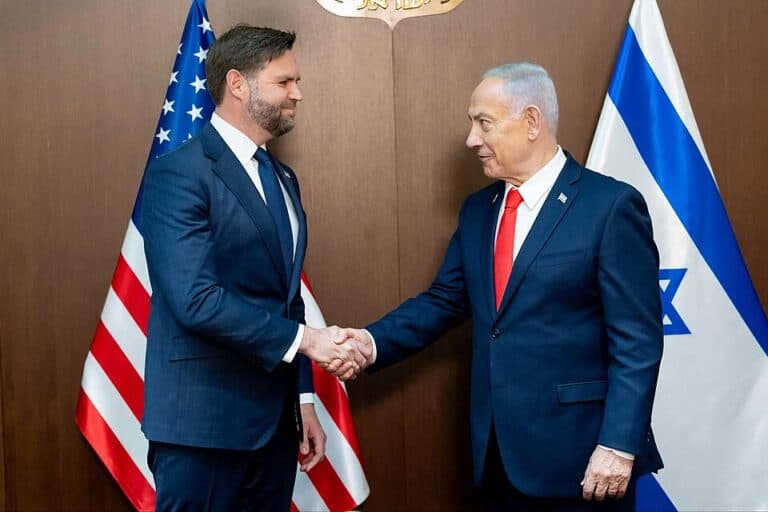
Vance Netanyahu conversation reports drew new attention after U.S. Vice President J.D. Vance softened his tone toward Israel and addressed Barak Ravid’s Axios report about a confrontation with Prime Minister Benjamin Netanyahu in Washington.
“Netanyahu did not confront me,” Vance said. “We had a nice and frank conversation.”
Vance emphasized that Israel remains a strong American ally, even when Washington and Jerusalem disagree, “As I have said repeatedly, Israel has been a great partner,” he said. “They’re an ally of the United States.”
He compared the relationship to other American alliances, including France and Britain, noting that allies sometimes have differences of opinion.
The Tanakh says, “Truthful lips endure forever.” That verse gives this story its frame. Alliances survive pressure when leaders speak clearly, correct false impressions, and keep disputes inside a framework of trust.
Vance Netanyahu Conversation
Vance pushed back on the idea that Netanyahu confronted him. Instead, he described the exchange as “pleasant but direct.” He said he did not feel confronted and framed the discussion as a normal conversation between allies with shared interests and occasional disagreements.
“I think the American media is fascinated by this dynamic,” Vance said. He then clarified his own role. “My job is to pursue the interests of only the United States of America,” he said.
That line matters for Washington. Vance is not presenting his Israel policy as automatic agreement. He is presenting it as hard-nosed alliance management, where American interests come first.
For Israel, the message also matters. Vance did not treat disagreement with Netanyahu as a break in the alliance. He treated it as part of a serious strategic relationship.
Israel, America, And Direct Talk

This exchange connects directly to “Netanyahu Rejects Vance Claim Against Israel.” Netanyahu rejected J.D. Vance’s claim that Israel is trying to sabotage an end to the Iran war, saying that is not official Israeli policy.
Netanyahu rejected the claim against Israel. Vance then softened the tone and stressed that Israel remains a great partner of the United States.
For America, this helps keep the debate focused on policy rather than personal conflict. The United States can pursue its own interests while still recognizing Israel as a core ally. While for Israel, Vance’s clarification reduces the political damage from the original report. It also signals that disagreements over Iran, Gaza, or regional strategy do not erase the deeper alliance.
Covenant Of Honest Alliance
The United States and Israel share a covenantal understanding before God rooted in truth, responsibility, liberty, and the defense of life.
America’s covenantal tradition emphasizes freedom under God, national interest, and alliances built on moral purpose. Israel’s covenant is ancient and unique, rooted in the God of Israel, Torah, Jewish peoplehood, sovereignty, and return to the land. The United States does not need a weak Israel. Israel does not need an America that hides disagreements behind slogans. Strong allies speak directly, correct misunderstandings, and act together when their interests align.
Vance’s statement gives the relationship a more stable frame. The United States and Israel may disagree on tactics, timing, or tone. However, both still face the same regional threats from Iran, terror networks, and hostile regimes.
Ultimately, the impact for both countries is clear. Washington and Jerusalem can survive frank conversations if they preserve trust, clarity, and shared strategic purpose. Vance’s remarks move the story away from confrontation and back toward alliance management.
For more stories on Israel, faith, and the values behind the headlines, follow Sinai on Facebook and Instagram.
Discussion0
No comments yet — be the first to share your thoughts.