Pezeshkian Fox News Interview Signals Nuclear Opening
Pezeshkian offered to relinquish Iran’s 60% enriched uranium and pursue talks with Washington, while his claims on the Houthis and protest rights face scrutiny

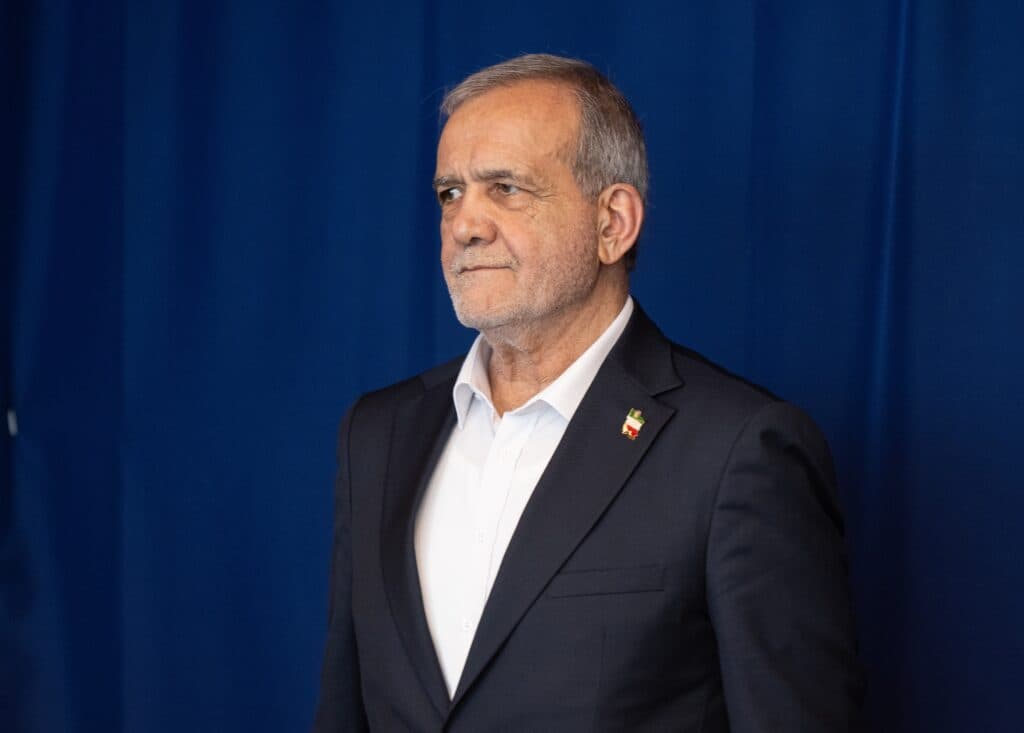
Iranian President Masoud Pezeshkian used a Fox News interview to signal possible nuclear concessions while defending Tehran’s conduct in the war. Speaking with Bret Baier, Pezeshkian said Iran would give up uranium enriched to 60% within the framework of international law and the Nuclear Non-Proliferation Treaty. He also said Tehran remains interested in an agreement with President Donald Trump if Washington negotiates under those terms.
Pezeshkian insisted that Iran does not seek a nuclear weapon. Asked about its 60% enriched uranium, he said Tehran was willing to dilute the material and called the process “not a big deal.” The offer could become significant if it leads to verifiable restrictions and renewed international inspections. However, Iran’s recent record with the International Atomic Energy Agency leaves major questions about implementation and verification.
Ecclesiastes 3:8 speaks of “a time of war, and a time of peace.” The present confrontation has reached precisely that difficult point. Diplomacy may offer a path out, but peace requires more than conciliatory language when the underlying military capabilities and regional threats remain unresolved.
Pezeshkian Fox News Interview Offers Nuclear Concession
Iran is currently under intense international scrutiny over its nuclear program. Earlier this month, the IAEA Board of Governors referred Tehran to the UN Security Council over what it described as noncompliance with safeguards obligations. The agency cited missing information about nuclear material and a lack of access to facilities.

That makes Pezeshkian’s 60% uranium statement potentially important. Uranium enriched to that level sits far above the concentration generally needed for civilian nuclear power. Iran says its program remains peaceful, while Israel and the United States have focused on preventing Tehran from reaching a nuclear-weapons capability.
The practical test would therefore come after the interview. Dilution, material accounting and renewed IAEA access would provide measurable evidence of Iranian compliance. Without verification, Washington and Jerusalem would still have to judge Tehran’s intentions through incomplete information.
The interview adds a new dimension to “Trump Iran War: Economic Pressure Raises Endgame Question.” That article examined the mounting cost of a prolonged conflict and Washington’s need for a defined end state. Pezeshkian is now publicly offering one possible component of such an agreement, although several major disputes remain unresolved.
Houthis and Protest Rights Face Scrutiny
Pezeshkian also distanced Tehran from the Houthis, saying the Yemeni group “doesn’t take directions from us.” There is an important distinction between Iranian support and direct operational control. Evidence indicates that the Houthis retain their own decision-making structure, but reporting has also documented Iranian weapons assistance and Revolutionary Guard guidance. Tehran denies directing Houthi operations.
That distinction matters greatly to both Washington and Jerusalem. Houthi attacks have threatened Saudi Arabia, international shipping and regional infrastructure. Israel has also faced repeated missile and drone attacks from Yemen. Whether Iran can actually restrain the group would therefore be an important measure of Tehran’s influence and of any wider settlement.
Pezeshkian made another striking claim about domestic politics. He said anyone wishing to protest or demonstrate in Iran has the right to do so. Yet that statement conflicts with documented events earlier this year. Iranian security forces used lethal force during nationwide protests, while authorities imposed an internet blackout and carried out mass arrests. A Reuters report cited an Iranian official who said authorities had verified at least 5,000 deaths, including roughly 500 members of the security forces.
Human Rights Watch has also documented longstanding restrictions on freedom of expression, assembly and political dissent in Iran. That does not establish Pezeshkian’s personal responsibility for every security action, but it makes his description of unrestricted protest rights difficult to reconcile with the record of the Iranian state.
Pezeshkian further dismissed the importance of the upcoming U.S. midterm elections, saying Tehran does not take them into account. His larger message was that Iran wants an agreement based on international law rather than American domestic politics. At the same time, any agreement would inevitably enter an American political system where Congress, public opinion and presidential authority all shape Iran policy.
Strength, Verification and the Covenant of Defense
For Israel, the central question is not whether Iranian leaders speak of peace. It is whether any agreement materially reduces the nuclear, missile and regional threats facing Israeli civilians. Jewish sovereignty carries a covenantal responsibility to preserve Jewish life after centuries in which Jews lacked the means to defend themselves. Diplomacy can serve that responsibility when it produces enforceable security rather than temporary reassurance.
America’s covenantal tradition is different but also connects national power with responsibility before God. The United States must protect its citizens and allies while seeking an end to a costly conflict. An agreement that verifiably limits Iran’s nuclear capabilities and reduces regional attacks could serve that purpose, while an unverifiable arrangement could simply postpone the confrontation.
Pezeshkian’s interview therefore contains both openings and contradictions. His willingness to relinquish 60% enriched uranium could support serious diplomacy. His statements about the Houthis and protest rights, however, face important factual challenges that Washington and Israel cannot ignore.
The next phase will depend less on rhetoric than verification. If Tehran restores meaningful IAEA access, accounts for enriched material and demonstrates control over commitments made in negotiations, the diplomatic opening will carry greater weight. If those steps do not follow, the Pezeshkian Fox News interview will remain an important statement of intent rather than evidence of a strategic change.
For more stories on Israel, faith, and the values behind the headlines, follow Sinai on Facebook and Instagram.
Discussion0
No comments yet — be the first to share your thoughts.