Mohammad Bagher Ghalibaf Mocks ‘Scotty’ Bessent
Iranian Parliament Speaker Mohammad Bagher Ghalibaf mocked Treasury Secretary Scott Bessent after Bessent accused Tehran of spending billions on terrorist proxies instead of its own people.

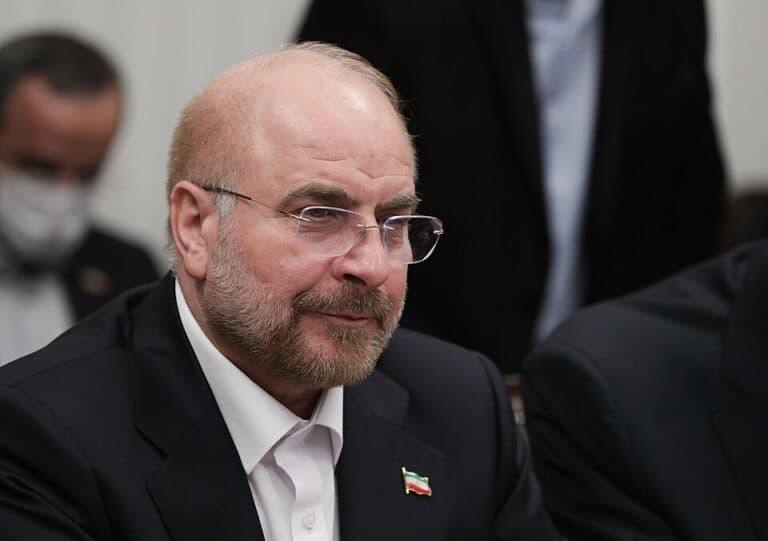
Iranian Parliament Speaker Mohammad Bagher Ghalibaf turned an American criticism of Tehran back on Washington on Thursday, mocking U.S. Treasury Secretary Scott Bessent as “Scotty” while accusing the United States of spending billions abroad instead of helping Americans at home.
Ghalibaf’s response centered on a deliberate reversal of Bessent’s language. He called Israel a U.S. “terrorist proxy,” pointed to what he described as America’s 750 overseas bases, and told Bessent that his “credibility is on the line.” The exchange invokes a warning from Isaiah about moral inversion: “Woe to those who call evil good and good evil.” In this case, the dispute is not only about money. It is also about how each side defines an ally, a proxy, and terrorism itself.
Mohammad Bagher Ghalibaf Turns Bessent’s Message Back on Washington
Bessent had written that Iranians were struggling to afford basic necessities while their government continued spending enormous sums abroad. “Instead of funneling billions of dollars to its terrorist proxies, the regime should spend that money for its people,” he said.

Ghalibaf responded by applying essentially the same argument to the United States. However, his comparison collapses two very different relationships. Israel is a sovereign democratic state and close U.S. strategic partner. By contrast, the U.S. Treasury formally describes Hezbollah as an Iran-backed terrorist organization and has documented extensive financial channels connecting Tehran to the group. Treasury has also targeted financial conduits between Iran and the Houthis.
Bessent is also a particularly obvious target for Tehran. Just days earlier, he announced Operation Economic Outcast, describing it as an “economic onslaught” intended to sever Iran’s remaining financial connections. In June, he said Treasury had frozen Iranian assets and “severely disrupted” the country’s economy.
Ghalibaf, meanwhile, has developed an unusually informal social media style for a senior Iranian official. He has mocked American strategy as “6D chess,” attacked U.S. officials over their IQ, and even posted a geography lesson aimed at Defense Secretary Pete Hegseth during arguments over Iran’s borders and the blockade.
Economic Pressure Moves Beyond the Posts
The online exchange comes as Washington explores increasingly aggressive ways to squeeze Tehran’s oil revenue. That pressure is also central to “Iranian Oil Prize Courts Plan Draws Tehran Threat,” which examined Bloomberg’s report that the Justice Department is preparing to revive long-dormant prize courts to streamline the seizure of Iranian oil tankers. Tehran responded by threatening American interests in the Gulf if Washington follows through.
That context gives the Bessent-Ghalibaf clash significance beyond social media. Washington is trying to deny Tehran the money used for its military programs and regional networks. Israel has a direct stake in whether those networks can rebuild, rearm, and continue threatening Israeli civilians. For Americans, the question is whether economic power can constrain an adversarial regime without allowing Tehran to redirect blame for its own priorities onto the United States.
Power, Responsibility, and the Nations We Choose to Be
The clash between Washington and Tehran also points to something deeper in the American-Israeli relationship. The United States and Israel were founded in different eras and carry different covenantal histories, but both have understood national freedom as something accountable to God rather than power without restraint. In both traditions, liberty carries obligations: defend life, pursue justice, confront tyranny, and use national strength in service of something greater than the state itself.
That shared understanding is especially relevant when Iran’s leadership tries to erase the distinction between an American alliance with Israel and Tehran’s sponsorship of armed proxy organizations. America and Israel are sovereign nations joined not only by strategic interests, but by a longstanding belief that freedom must be defended and that evil cannot simply be accommodated because confronting it is costly. Israel carries the ancient covenant of the Jewish people in their ancestral homeland, while America’s own national tradition repeatedly invokes liberty, human dignity, and responsibility before God. Where those missions meet is in the conviction that national power should protect life and freedom rather than finance terror and intimidation.
Ghalibaf’s rhetorical reversal may be designed to score a point against Washington. Yet the deeper question is what a nation chooses to do with its strength and resources. For both America and Israel, that question has always carried a moral dimension as well as a strategic one.
For more stories on Israel, faith, and the values behind the headlines, follow Sinai on Facebook and Instagram.
Discussion0
No comments yet — be the first to share your thoughts.