AVROTROS Eurovision Boycott Targets Israel
AVROTROS said it will boycott Eurovision 2027 over Israel’s continued participation, though another Dutch broadcaster could still represent the Netherlands


The AVROTROS Eurovision boycott will continue in 2027, after the Dutch public broadcaster announced that it will skip next year’s Eurovision Song Contest over Israel’s participation.
AVROTROS has overseen the Netherlands’ Eurovision entry for the past decade. However, the move does not necessarily mean the Netherlands will be absent from the contest. Officials have suggested in recent weeks that another Dutch broadcaster could take over the country’s participation.
The broadcaster said Monday that it would boycott Eurovision for a second consecutive year because the event “can no longer be considered neutral” while a participating country remains involved in a large-scale military conflict.
Ecclesiastes warns, “A time to love, and a time to hate; a time for war, and a time for peace.” Eurovision presents itself as a stage for peace and cultural unity. Yet the Dutch boycott shows how quickly culture can become another arena for political pressure against Israel during war.
AVROTROS Eurovision Boycott
AVROTROS said it had urged the European Broadcasting Union to address the issue. However, the broadcaster said the EBU’s recently announced changes did not provide enough confidence that Eurovision’s independent and neutral character had been restored.
AVROTROS Director-General Taco Zimmerman said the contest was originally created to bring people and countries together. He added that international conflicts are increasingly affecting Eurovision and undermining its neutral character.
“The Eurovision Song Contest has therefore become a platform for division,” Zimmerman said.
That argument places responsibility on Israel’s presence rather than on the broader campaign to isolate Israel from European cultural life. Since Hamas’ October 7 massacre and the war that followed, anti-Israel activists have increasingly pushed for Israel to be excluded from music, sports, universities, and public forums.
Europe’s Cultural Pressure On Israel
The Dutch broadcaster’s decision fits a wider European pattern. Governments and institutions are not only challenging Israeli military policy. They are also testing whether Israel can remain fully present in European cultural and diplomatic spaces while defending itself against Hamas and other terror threats.
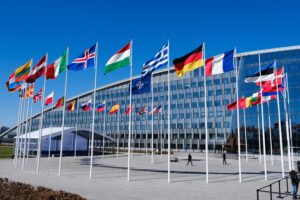
A similar pressure pattern appeared in “E1 Settlement Project Draws European Threat To Builders.” That article reported that the United Kingdom, France, Germany, Italy, and the Netherlands condemned Israeli construction tenders in the E1 area between Ma’ale Adumim and Jerusalem. They also warned construction companies about legal and reputational consequences.
The Eurovision dispute is different in form, but similar in instinct. In both cases, European actors are using access, reputation, and institutional legitimacy to pressure Israel.
For Israel, Eurovision has always carried meaning beyond entertainment. Israeli artists appear on that stage as representatives of a living, sovereign Jewish state. Calls to exclude them are therefore not neutral cultural criticism. They send a message that Jewish national presence becomes unacceptable when Israel fights back.
A Stage, A Flag And A Covenant
The United States and Israel carry separate covenantal missions before God, and this story touches both through the defense of national legitimacy. America’s mission includes protecting a public order where allies are not culturally erased for confronting terror. Israel’s mission is to keep Jewish sovereignty visible, confident, and unashamed, even when international institutions try to turn its flag into a controversy.
That does not mean every Eurovision criticism is antisemitic. It does mean that singling out Israel while ignoring other conflicts reveals a selective moral standard. Culture becomes dangerous when it stops bringing peoples together and starts deciding which nation is too politically inconvenient to appear.
AVROTROS says Eurovision has become a platform for division. But the division did not begin with Israel’s participation. It grew from the campaign to treat Israel’s presence as the problem.
The EBU now faces a clear test. It can preserve Eurovision as a cultural competition that includes Israel, or it can allow political boycotts to decide who may sing under their own flag.
For more stories on Israel, faith, and the values behind the headlines, follow Sinai on Facebook and Instagram.
Discussion0
No comments yet — be the first to share your thoughts.