Pentagon Sends USS George Washington To West Asia
The Pentagon is sending the USS George Washington to West Asia to replace the USS Abraham Lincoln, which has faced an extended deployment and crew welfare concerns

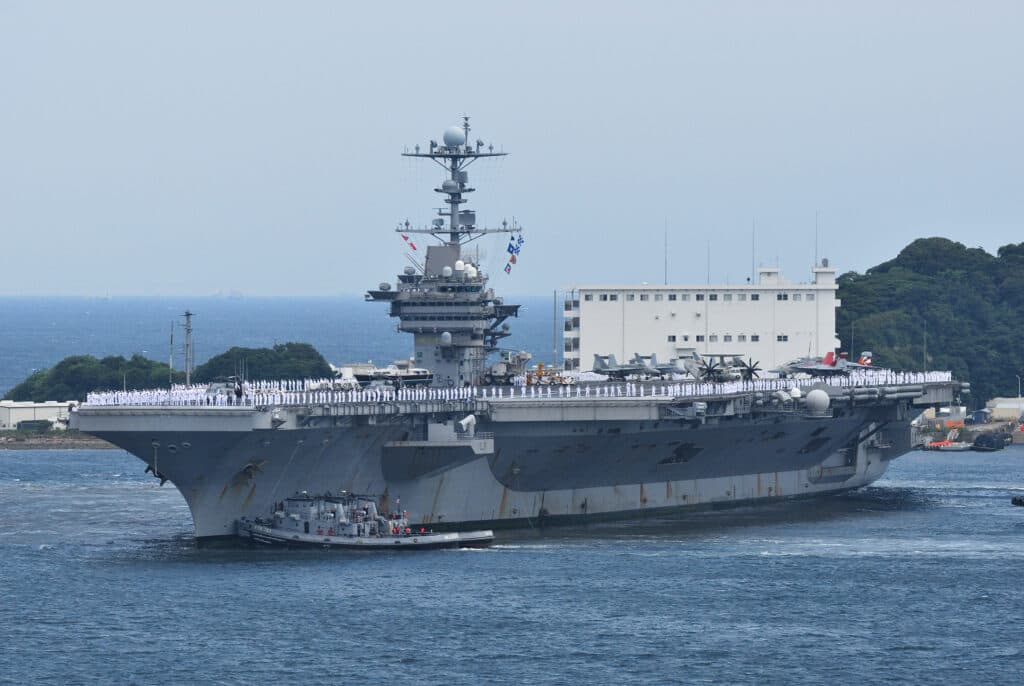
USS George Washington West Asia deployment plans are moving forward as the Pentagon prepares to send the aircraft carrier to replace the USS Abraham Lincoln, according to the Wall Street Journal.
The report cited U.S. officials who called the move a “previously scheduled rotation plan.” Still, the timing carries strategic weight. The USS Abraham Lincoln has remained on extended deployment during heavy regional tension tied to the U.S.-Israeli war against Iran.
The Lincoln left San Diego on November 21. It was first bound for the South China Sea, then redirected to West Asia ahead of the war that began on February 28.
Since then, its roughly 5,000-person crew has had only two brief periods ashore, in Guam in December and Oman in July. Commanders extended the deployment several times beyond its original May end date.
The Tanakh says, “The Lord is a man of war; the Lord is His name.” That verse gives this story its strategic frame. Peace does not survive through wishes alone. It depends on strength, readiness, and the ability to keep watch while enemies test the line.
USS George Washington Deployment
The USS George Washington is expected to replace the USS Abraham Lincoln at a critical moment. Aircraft carriers project power, reassure allies, and warn hostile regimes that Washington can sustain pressure.
That message matters in West Asia. Iran continues to threaten shipping lanes, U.S. forces, Israel, and regional partners. A scheduled carrier rotation can still send a clear signal when Tehran tries to claim control over strategic waterways.
The deployment shift also follows “Iran Claims Full Control Over Strait Of Hormuz.” Iran’s Khatam Al-Anbiyaa Central Command claimed full control over the Strait of Hormuz and threatened a severe response to any challenge.
That makes U.S. naval posture more than routine force management. Iran claims commercial ships cannot pass safely without its permission. America’s carrier presence answers that claim through visible deterrence.
Free navigation depends on more than diplomatic statements. It requires ships, crews, readiness, and the ability to hold the line at sea.
Strain Aboard The Lincoln
The USS Abraham Lincoln’s extended deployment has also drawn attention in Congress. Lawmakers have pressed the Pentagon over the carrier’s condition and the welfare of its crew.
Reports have described food shortages, broken plumbing, and mental health crises aboard the ship. Some reports also said sailors attempted to jump overboard.
Those details matter because deterrence has a human cost. Aircraft carriers symbolize American power, but they are also floating cities. They carry sailors, fatigue, maintenance problems, family strain, and pressure that builds over time.
A rotation therefore serves two purposes. It preserves U.S. military posture in the region and gives relief to a crew that has carried a long and difficult mission.
Covenant Of Readiness And Watchmen At Sea
The United States and Israel carry separate covenantal responsibilities before God in a region where sea lanes, borders, and civilians remain under threat. America’s covenantal tradition speaks through liberty, ordered strength, and the defense of open routes against coercion. Israel’s covenant is ancient and unique, rooted in the God of Israel, Torah, Jewish peoplehood, sovereignty, and the return to the land.
The carrier rotation puts those responsibilities into practical form. America must replace exhausted forces without weakening deterrence. Israel must know that its strongest ally can keep pressure on Iran while protecting its own service members.
Iran studies these signals closely. If Tehran sees fatigue, delayed rotation, or political hesitation, it may believe time is on its side. Fresh forces and clear resolve change that calculation.
The USS George Washington’s arrival will be watched across the region. Iran will read it. Israel will read it. Gulf states will read it. So will every crew that depends on open passage through contested waters.
For Israel, sustained American naval power helps hold the wider line against Iran. For the United States, the mission also begins at home: protect the force, relieve exhausted sailors, and prove that American deterrence can endure without breaking the people who carry it.
For more stories on Israel, faith, and the values behind the headlines, follow Sinai on Facebook and Instagram.
Discussion0
No comments yet — be the first to share your thoughts.