Obama Israel Remarks: Land Claim Draws Criticism
Sinai Desk
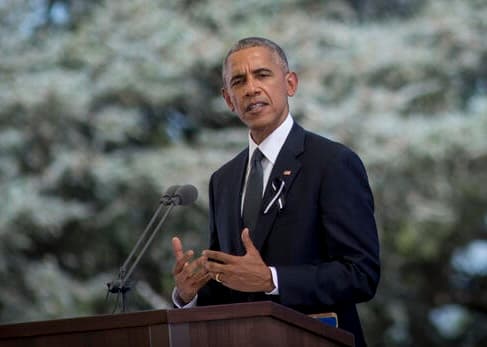
Former U.S. President Barack Obama’s latest Israel remarks are drawing criticism after he argued that Jews seeking refuge in their historic homeland also “took land” from the Arabs. Obama made the comments Tuesday in Belfast, Northern Ireland, during a discussion following his honorary doctorate from Queen’s University Belfast. He also warned that Israel could lose its moral standing if military strength becomes its primary answer to the conflict.
Obama acknowledged the long history of Jewish persecution and Europe’s role in it. He also recognized that Jews sought refuge in a land where they had historic ties. However, he added that Jews “took land off people” and “were excessive,” arguing that Arab demands to recover that land were therefore understandable.
Amos 9:14 speaks of the return of Israel’s people, saying they would “build the cities, and inhabit them.” For Jews, the modern return to the Land of Israel did not begin as an abstract European colonial project. It grew from an ancient connection preserved through prayer, continuous Jewish presence and waves of return long before the State of Israel declared independence.
Obama Israel Remarks in Belfast
Obama framed his comments within a broader argument about long-term security. He said Israel’s technological and military superiority may protect it in the short term. However, he warned against an approach built around taking whatever Israel wants while offering no concessions. He argued that such a policy would surrender what he called Israel’s “moral ground.”
His remarks were not entirely one-sided. Obama also said Arabs must recognize that they cannot defeat Israel militarily. He urged them to pursue nonviolent strategies and described Hamas’s October 7 attack as an action that could hardly have been designed to produce a worse political outcome.
That broader context matters when assessing his speech. Obama was arguing for a negotiated future in which millions of Jews and Palestinians remain in the region. Yet his description of Israel’s creation compressed a complicated historical process into the idea that Jews arrived, took another people’s land and then went too far.
The historical record is considerably more complex.
The History Behind the Land Claim
Modern Zionist settlement included substantial legal land purchases under Ottoman and British rule. Official British Mandate statistics later presented to the United Nations recorded about 1.49 million dunams in Jewish ownership by 1945. Arab ownership stood at more than 12.5 million dunams, with additional territory classified as public or otherwise held.
That means Jewish sovereignty cannot accurately be reduced to a simple story of one population arriving and seizing privately owned Arab land. Jewish communities acquired land through purchase, built towns and agricultural settlements and developed institutions that existed before independence. At the same time, those purchases represented only one part of the territory that later became Israel.
The next stage came through international partition and war. In November 1947, the United Nations recommended dividing Mandatory Palestine into separate Jewish and Arab states, with Jerusalem under an international regime. Contemporary U.S. records show that the Jewish Agency supported partition while Palestinian Arab leaders and neighboring Arab governments opposed it.
Violence followed the UN decision. When Israel declared independence in May 1948, armies from neighboring Arab states entered the former Mandate and the conflict became a regional war. U.S. State Department records from the period document both the Arab rejection of partition and preparations for military confrontation.
The Arab exodus of 1948 is also part of that history. Hundreds of thousands of Arabs became refugees during the fighting. Historians continue to debate the specific causes in individual communities, including expulsion, flight from combat and fear of advancing forces. United Nations records later documented extensive Arab property that came under Israeli control after the war.
Acknowledging that displacement does not require erasing the Jewish side of the story. Nor does acknowledging legal Jewish land purchases erase Arab loss. Obama’s formulation becomes controversial because it compresses purchase, international partition, Arab rejection, war and displacement into a single claim that Jews simply “took” the land.
The contrast with “Huckabee Praises Israeli Resilience Under Siege” is striking. U.S. Ambassador Mike Huckabee recently emphasized Israel’s determination to survive repeated threats rather than framing Jewish power primarily as a moral liability. The two American figures represent markedly different ways of interpreting the same central fact: after centuries without sovereign protection, Jews once again possess the ability to defend themselves.

That debate matters in Washington because American leaders help shape how Israel’s history is understood internationally. It also matters inside Israel, where discussions about territory and security take place against the memory of repeated wars, terrorism and the October 7 massacre.
History, Covenant and the Burden of Power
Israel’s covenantal mission before God begins long before modern diplomacy. Jewish attachment to the land appears throughout the Tanakh and survived centuries of exile. Modern sovereignty restored something Jewish communities had lacked for generations: responsibility for their own national defense and the ability to protect Jewish life without depending entirely on other governments.
America’s covenantal tradition developed differently. It rests on ideas of liberty, self-government, religious freedom and responsibility in the exercise of power. The U.S.-Israel relationship therefore brings together two nations with different histories but a shared concern for sovereignty and the right of peoples to defend their communities.
That does not make every Israeli policy beyond criticism. Obama is entitled to argue that military strength cannot substitute for a political strategy, and his call for Arabs to reject violence is equally relevant. But serious criticism should rest on a historical account that recognizes both peoples’ experiences rather than reducing Israel’s creation to a straightforward seizure of land.
The history includes Jewish persecution and return, legal land purchases, Arab national aspirations, rejected partition, regional war and large-scale Arab displacement. Removing any one of those elements makes the story easier to tell, but less accurate.
Obama went to Belfast to speak about the lessons of peace and reconciliation. Those lessons are worth debating. So is the history on which any future peace must be built.
For more stories on Israel, faith, and the values behind the headlines, follow Sinai on Facebook and Instagram.
Discussion0
No comments yet — be the first to share your thoughts.