Israel at the Center of a New American Vision for the Middle East
The White House released over the weekend its “National Security Strategy 2025” — a foundational document outlining America’s view of global threats, priorities, and policy direction in the coming years.

A Historic Shift in U.S. Policy
The White House released over the weekend its “National Security Strategy 2025” — a foundational document outlining America’s view of global threats, priorities, and policy direction in the coming years.
Beyond the strong language typical of the current administration, the document makes an unprecedented declaration:
The Oslo framework is no longer the foundation of American policy in the Middle East.
What for decades was considered unchangeable is now officially set aside.
The Middle East Is “No Longer the Central Axis”
Washington is moving away from attempts to impose diplomatic frameworks on the Israeli–Palestinian conflict and instead preparing for an era in which the Middle East functions more as a regional investment economy and less as a stage for externally dictated political solutions.
According to the document, the Middle East is no longer the top pillar of American foreign policy, as it once was when global energy markets dominated strategic thinking. With the United States now once again a leading energy exporter, priorities toward the region have officially changed.
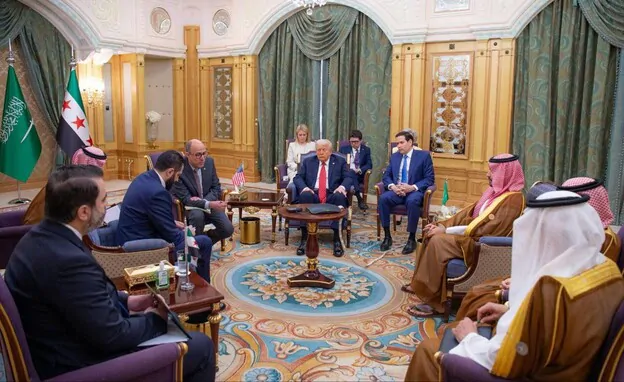
White House meeting, archive photo | Credit: The White House
Core U.S. Interests That Remain
While the strategic emphasis shifts, American commitments in the region are clearly defined. The document lists four primary priorities:
-
Preventing hostile powers from controlling energy resources and trade routes — explicitly referring to Iran.
-
Ensuring Israel’s security and preserving Israel as a strong, safe, and stable state.
-
Combating terrorism and preventing the region from becoming a threat to U.S. soil.
-
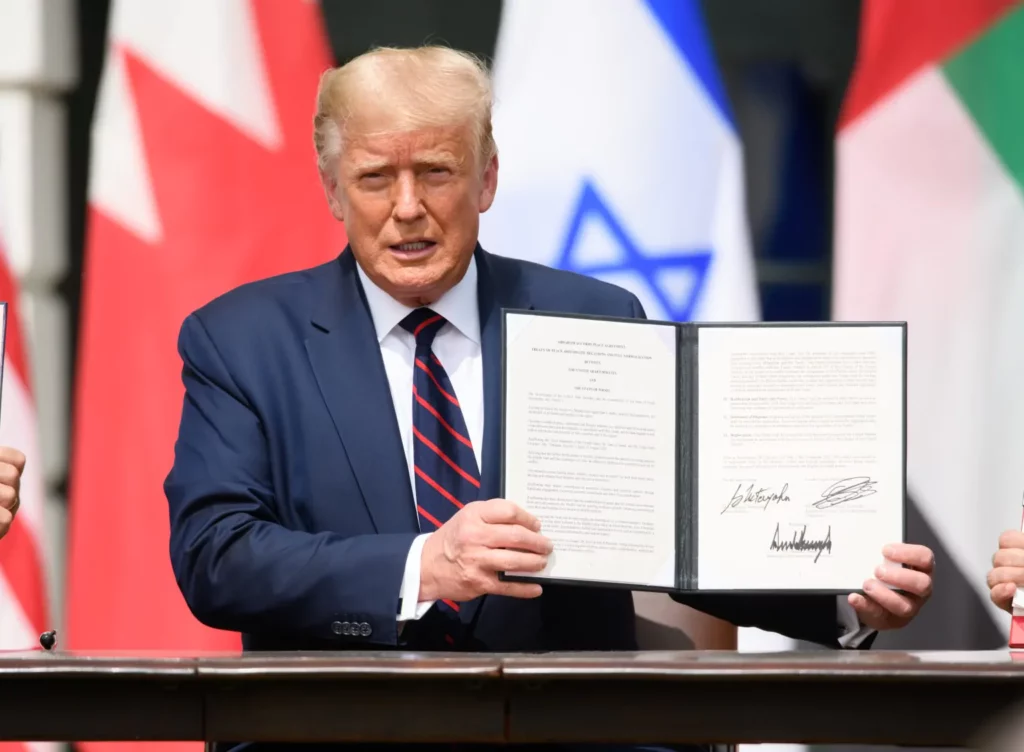
Expanding peace agreements and normalization, with special emphasis on strengthening the Abraham Accords.
Washington’s View of the Region
The strategy presents a decisive picture:
Iran is named as the chief destabilizer in the Middle East. However, the report notes that its power has weakened since October 2023 and further following Trump’s “Midnight Hammer” operation in June 2025, which severely damaged Iran’s nuclear infrastructure.
Washington also cites progress toward stability due to American-mediated ceasefires and hostage releases. Support from nations previously aligned with Hamas has diminished, creating an opening for new diplomatic realities.
Syria remains a challenge but is described as a country that “may stabilize” and transition into a constructive regional player, with support from the U.S., Arab nations, Israel, and Turkey.
“A Revolution in Political Thinking”
The document draws a sharp line under decades of failed Western social engineering in the region.
No more attempts to remake Middle Eastern societies in Washington’s image.
Instead, the new guiding principles are:
-
Mutual acceptance — engaging nations as they actually are.
-
Internal reform only — reform welcomed only if it grows from within.
-
Investment over intervention — the Middle East is now framed as a hub for:
-
Technology
-
Nuclear energy
-
Artificial intelligence
-
Defense industries
-
Israel at the Center of the New Vision
Israel appears repeatedly throughout the document, not merely as a nation in need of defense — but as a pillar of stability, economic strength, and innovation.
There is not a single reference to forced international political solutions. Instead, Washington’s model is based on:
-
Economic cooperation
-
Regional alliances
-
Shared prosperity
Israel is presented as a strategic partner, not a diplomatic problem.
Russia Responds
The Kremlin released its first official statement on the report, welcoming the change in U.S. posture.
Moscow praised Washington’s decision to remove Russia from the category of a “direct threat” to U.S. security, calling it a major step toward stabilizing global relations.
Russian officials expressed hope that this shift will open the door to renewed dialogue and reduced international tension, while emphasizing Moscow’s ongoing commitment to responsible global power balance.
Biblical Context
What is unfolding politically reflects what Scripture declared spiritually long ago.
The people of Israel have never been dependent on treaties alone – but on covenant.
“Not by might nor by power, but by My Spirit,” says the Lord of hosts.
— Zechariah 4:6
The breakdown of the Oslo framework does not represent chaos — it reflects the failure of man-made peace without divine grounding.
Scripture foresaw a future in which:
-
Nations would realign.
-
Israel would no longer rely on foreign guarantees.
-
God Himself would defend Zion.
“I will bless those who bless you, and whoever curses you I will curse.”
— Genesis 12:3
The Abraham Accords echo the ancient promise given to Abraham:
That blessing would flow through his seed and outward to the nations.
“All the families of the earth shall be blessed through you.”
— Genesis 12:3
Israel standing at the heart of regional strategy is not merely political realignment — it is prophetic convergence.
Discussion0
No comments yet — be the first to share your thoughts.