Ireland’s Chief Rabbi Refuses to Let History Be Rewritten Due to Protests
Against the backdrop of a decision to remove the name of Israel’s sixth president, Chaim Herzog, from a park in Ireland: Ireland’s Chief Rabbi, Rabbi Yoni Wieder, responds.

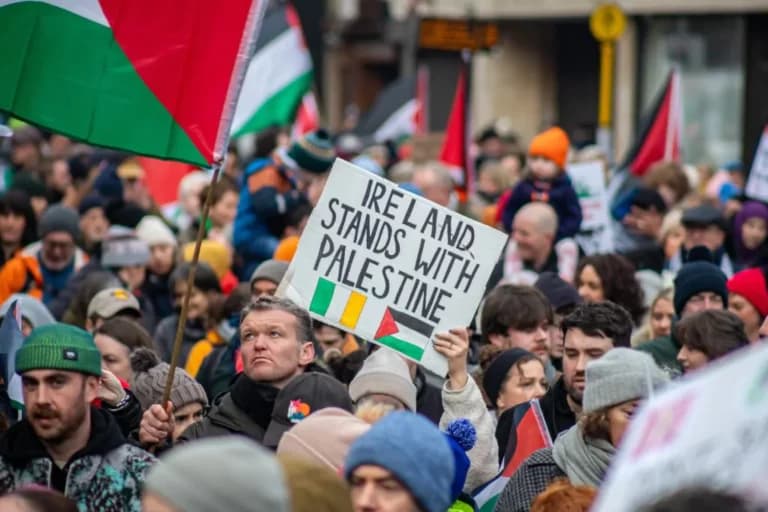
The city council of Ireland’s capital, Dublin, decided today (Saturday) to remove the name of the sixth president of Israel, Chaim Herzog — father of President Isaac Herzog — from the park located in the city’s Rathgar neighborhood, officially known as “Herzog Park.”
The decision by Dublin’s council followed pressure from pro-Palestinian activists, who proposed renaming it either “Free Palestine Park” or after Hind Rajab, who was killed in Gaza during the war.
“A Place Full of Memory”
Chief Rabbi of Ireland Rabbi Yoni Wieder responded sharply to the decision:
“Herzog Park is more than a name on a sign. For those who live nearby — and especially for the Jewish families and neighboring Jewish schools — it is a place full of memory, and an important reminder that our community has deep roots in Dublin.”
Rabbi Wieder continued:
“Chaim Herzog was shaped by this city, and he loved it in return. The people of Dublin loved him too — not only his childhood friend, former President Ceárbhall Ó Dálaigh, but everyone who saw in him a local boy who became a head of state yet never lost his connection to Ireland. When he returned here as President of Israel, he was welcomed warmly. The country took great pride in the fact that he was the only head of state who visited and spoke fluent Irish.”
“One of Ours”
“His father, Rabbi Isaac Herzog, served as Ireland’s first Chief Rabbi and embodied the link between Irish and Jewish identity. As a close friend of Éamon de Valera (former President of Ireland) and a passionate supporter of Irish nationalism, he became affectionately known as the ‘Sinn Féin Rabbi’ — ‘one of ours.’”
Rabbi Wieder emphasized:
“When Herzog Park was named in 1995, it was not only recognition of one man — it was acknowledgment of a shared chapter of history. That history has not changed, and it cannot be canceled by proposals or votes. Removing this name would erase a central piece of Irish-Jewish history and send a painful message of isolation to our small community.”
“This Change Must Not Be Advanced”
Irish Foreign Minister Helen McEntee also addressed the controversy:
“Chaim Herzog is a figure of importance to many, and especially to members of the Jewish community in Ireland. It is vital that we state this clearly. The Government of Ireland has been openly critical of the policies and actions of the Government of Israel in Gaza and the West Bank — and rightly so.”
She added:
“Renaming a park in Dublin in a way that removes the name of a Jewish-Irish figure is unrelated to that criticism and does not reflect the character of our inclusive republic. In my view, this change should not be advanced, and I urge Dublin City Council members to vote against it.”
“The Antisemitism Capital of the World”
Earlier, Israeli Foreign Minister Gideon Sa’ar wrote on X:
“There has been no decision more accurate and justified than my decision to close our embassy in Dublin shortly after I entered office as Foreign Minister. Dublin has become the antisemitism capital of the world. Ireland’s antisemitic and anti-Israel obsession is pathological.”
He noted that Chaim Herzog grew up in Dublin and that his father served as Ireland’s Chief Rabbi:
“What cannot be erased is the disgrace of Irish antisemitic and anti-Israel obsession,” he added.
What’s the significance of renaming the park?
This controversy is not merely about a park. It is about who is permitted a place in national memory.
For minority communities, especially Jews in Europe, street names, monuments, and memorials are more than symbolic. They are affirmations of belonging. They testify that Jewish life did not simply exist at the margins of history but helped build the nations of Europe from within.
Chaim Herzog was not an imported figure. He was a son of Dublin.
He spoke Irish fluently, was educated in Ireland, and maintained lifelong ties to the country even after becoming head of state in another land. His father, Rabbi Isaac Herzog, was not only a religious authority but a public figure deeply engaged with Ireland’s formative years. His connection to Éamon de Valera represented a period when Jewish and Irish identities were not in conflict — but in conversation.
Across Europe, Jewish communities have learned that when political movements begin removing names, they rarely stop with plaques. Erasure moves from stone to story, from landmark to lesson book. What is lost first is memory. What is lost next is safety.
Ireland now faces a defining test.
Will it protect its historical truth — or amend it to satisfy present-day passions?
For Ireland’s Jewish community, small in number but rich in heritage, this is not a theoretical struggle. It is the boundary between being remembered — or being slowly written out.
“Remove not the ancient landmark which your ancestors have set.”
— Proverbs 22:28
This verse is often cited as a warning across generations: when history is uprooted, identity soon follows.
Discussion0
No comments yet — be the first to share your thoughts.