Hamas Police Commander Killed In Gaza City Strike
Gazan sources report that Jamal Abu Kamil, commander of Hamas’s Gaza District Police, was killed in a strike on a jeep in southern Gaza City

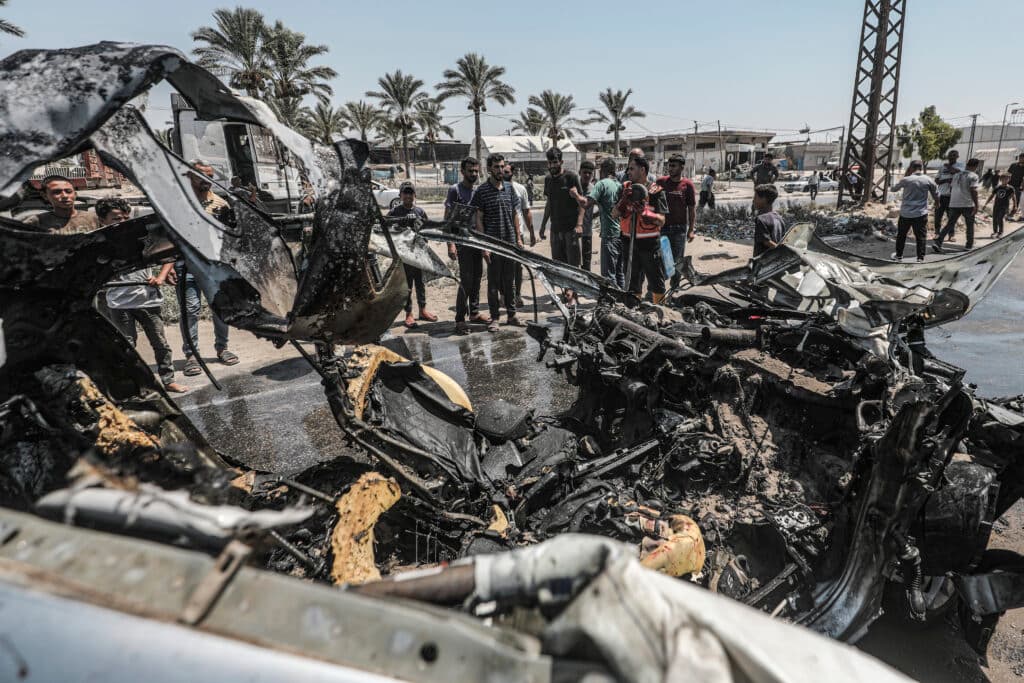
Hamas police commander Jamal Abu Kamil was killed in a strike on a jeep in the Sheikh Ajlin neighborhood of southern Gaza City, according to Gazan sources.
The sources identified Abu Kamil as the commander of the Gaza District Police in Hamas. According to testimonies from Gazans, three missiles were fired at his vehicle, apparently because he managed to get out of the vehicle and escape the first missile.
The report places the strike inside the continuing campaign against Hamas’s command structure in Gaza. Hamas’s police apparatus is not a neutral civilian institution in the normal sense. Under Hamas rule, security bodies form part of the movement’s governing and coercive system inside the Strip.
The Tanakh says, “By wise guidance you shall wage your war.” That verse fits this kind of battlefield report because wars against terror organizations are not fought only through broad movement. They are also fought through intelligence, timing, and the targeting of command nodes that keep the enemy’s structure functioning.
Hamas Police Commander Targeted
The details from Gazan sources suggest a fast-moving strike. Abu Kamil was reportedly inside the vehicle when the first missile was fired. After he apparently escaped, additional missiles were launched at the jeep, according to the same testimonies.
Those details have not been independently verified in the report provided. However, the account reflects the intensity of current operations in Gaza, where Hamas commanders and operatives continue to operate inside dense urban areas.
For Israel, the significance is clear. Hamas does not rely only on armed battalions. It also depends on internal police, administrative bodies, intelligence channels, and local enforcement structures that help preserve control over the population and the battlefield.
Removing a district police commander can therefore affect more than one individual. It can weaken Hamas’s ability to manage movement, enforce orders, protect operatives, and maintain the appearance of governance under pressure.
No Withdrawal Without Real Disarmament

The report also sharpens the relevance of “Netanyahu: No IDF Withdrawal Until Hamas Disarms.” Netanyahu said the IDF will not withdraw until Hamas is truly disarmed, while also warning Iran, addressing Lebanon operations, and rejecting a Palestinian state.
That position rests on a basic security argument: Hamas cannot be allowed to remain armed, organized, and politically entrenched after the war. A terror organization does not need to hold every neighborhood openly to remain dangerous. It needs commanders, weapons, internal control, and time to rebuild.
Jamal Abu Kamil’s reported role in Hamas’s Gaza District Police points directly to that issue. Disarmament cannot mean removing only rockets and rifles while leaving Hamas’s enforcement system in place. It must also address the structures that allow Hamas to rule, intimidate, and regenerate.
This is why Israel treats Hamas’s police and security network as part of the problem. In Gaza, governance and terror have been fused for years. The same movement that massacred Israelis on October 7 also built internal systems to preserve its rule afterward.
Covenant Of Protection And Moral Resolve
The United States and Israel carry separate covenantal responsibilities before God in the face of terror rule. America’s covenantal tradition speaks through liberty, justice, and the duty to oppose forces that enslave populations through violence. Israel’s covenant is ancient and unique, rooted in the God of Israel, Torah, Jewish peoplehood, sovereignty, and the return to the land.
This story brings those responsibilities into Gaza’s internal power structure. Israel must protect its citizens from Hamas’s military wing, but also from the governing machinery that lets Hamas survive defeat and prepare the next war. America must understand that a ceasefire without dismantling Hamas’s coercive rule will not create peace. It will create another cycle.
The reported killing of Abu Kamil therefore belongs to a larger strategic picture. Israel is not only fighting men with guns. It is fighting an entire terror-governance system that uses police, tunnels, command cells, propaganda, and civilian cover to remain alive.
That is why the demand for true Hamas disarmament matters. Without it, the war’s sacrifices could be converted into a pause that allows Hamas to rebuild. With it, Gaza may finally have a chance to move beyond rule by a movement that turned civilian life into a shield and Israeli life into a target.
For more stories on Israel, faith, and the values behind the headlines, follow Sinai on Facebook and Instagram.
Discussion0
No comments yet — be the first to share your thoughts.