What’s on the Agenda for the Trump-Netanyahu Summit?
Israeli Prime Minister Benjamin Netanyahu has departed for Washington this morning (Sunday) ahead of a critical meeting with U.S. President Donald Trump, scheduled for Tuesday. The two leaders are expected to address key issues impacting the Middle East and U.S.-Israel relations.

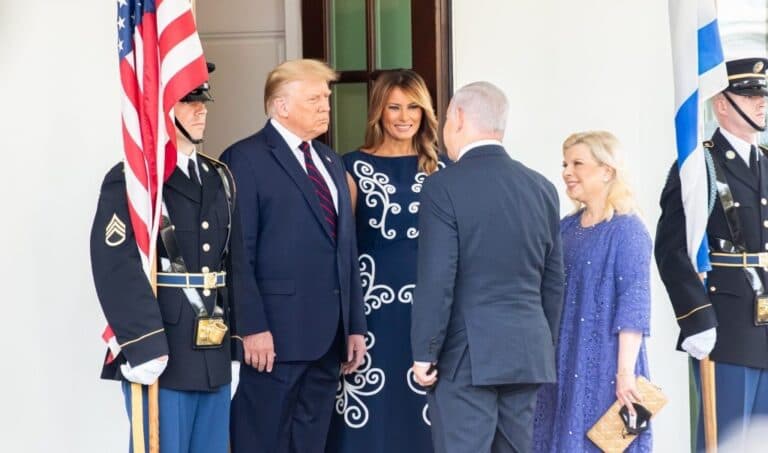
Israeli Prime Minister Benjamin Netanyahu departed for Washington this morning (Sunday) ahead of a highly anticipated meeting with U.S. President Donald Trump, scheduled for Tuesday. This will be the first meeting between President Trump and a foreign leader in his second term, signaling the administration’s firm commitment to standing with Israel in matters of national security and regional stability.
The meeting is expected to cover several pressing topics, including the Iranian nuclear threat, the expansion of the Abraham Accords, the future of Gaza, and the next phase of the hostage negotiations.
Addressing the Iranian Threat and Its Nuclear Ambitions
One of the most urgent items on the agenda is Iran’s nuclear program and its continued aggression in the region. While Tehran’s pursuit of nuclear weapons poses a direct threat to Israel, it is also a global concern. Iran has steadily expanded its influence in Lebanon, Syria, Iraq, and Yemen through its proxy terror organizations, threatening regional security and targeting American and Israeli interests.
Netanyahu is expected to push for increased U.S. pressure on Iran, urging tougher sanctions and potential military deterrents to halt its nuclear ambitions. Israel seeks stronger cooperation with the U.S. and its allies to prevent Iran from obtaining nuclear weapons and to dismantle its regional terror networks.
Expanding the Abraham Accords and Strengthening Regional Alliances
Another key topic for discussion will be expanding the historic Abraham Accords, with Saudi Arabia at the forefront. The U.S. and Israel are working toward diplomatic breakthroughs that would see additional Arab nations join in normalizing relations with Israel, following in the footsteps of the UAE, Bahrain, and Morocco.
A potential normalization deal with Saudi Arabia would be a monumental shift in Middle Eastern geopolitics. Such an agreement would not only enhance security cooperation but also foster economic partnerships in energy, technology, and tourism, benefiting all parties involved.
The Future of Gaza: Migration and Governance
Following Israel’s military campaign against Hamas, discussions will focus on the future governance of Gaza. The Trump administration has proposed facilitating voluntary migration from Gaza to other Arab nations, an idea that has been met with mixed reactions in the region.
The primary objective remains eliminating Hamas’ control and replacing it with a governing authority that will not pose a threat to Israel. This requires coordinated military and humanitarian efforts, ensuring long-term security while providing solutions for displaced civilians.
While some Arab nations, particularly Egypt and Jordan, have voiced opposition to large-scale migration, Israel and the U.S. continue to explore ways to alleviate the crisis and ensure that Gaza does not remain a base for terrorism.
Hostage Negotiations: The Next Phase
The fragile ceasefire agreement in Gaza remains a critical point of discussion, as Israel continues efforts to secure the release of hostages held by Hamas. While the recent phases of hostage exchanges have led to the return of several Israeli civilians, many remain in captivity.
If the next round of negotiations collapses, Israel may be forced to resume military operations in Gaza. President Trump is expected to urge Netanyahu to consider all measures to prevent escalation while maintaining pressure on Hamas to secure the hostages’ release.

A Meeting of Great Importance
This meeting between Netanyahu and Trump is expected to reaffirm the deep-rooted ties between the United States and Israel. As both nations face unprecedented challenges, the cooperation between their leaders remains crucial to ensuring security, stability, and the pursuit of lasting peace in the Middle East.
Even the greatest leaders need support and cooperation to fulfill their mission. Just as Moses and Aaron worked together to serve the people—each complementing the other’s strengths—leaders today must rely on collaboration to achieve their goals. As the Bible states, “You shall speak to him and put words in his mouth; I [God] will help both of you speak and will teach you what to do.” – Exodus 4:15. This passage reminds us that no leader stands alone; success is often found through unity, wisdom, and shared responsibility.
Discussion0
No comments yet — be the first to share your thoughts.