Iran Economic Blockade Targets Airlines and Oil
Scott Bessent says Washington plans to target Iranian aviation and squeeze remaining oil exports as the U.S. works to cut Tehran’s foreign lifelines


The Iran economic blockade is moving toward Iranian airlines and the country’s remaining oil exports, according to U.S. Treasury Secretary Scott Bessent. Bessent said Washington intends to restrict aviation links that bring supplies into Iran while squeezing the oil trade that provides Tehran with critical revenue. China remains the most important buyer, but the amount of Iranian crude already positioned at sea is rapidly shrinking.
Bessent said Iran receives some supplies from Russia but does not receive substantial direct Russian financial support. “If we shut down the Iranian airlines, which we will, then much less [is] coming in,” he said. Reuters separately reported that aviation, shipping, and digital assets are among the sectors Washington is considering for additional action.
Proverbs 21:22 says, “A wise man scales the city of the mighty and brings down the stronghold in which they trust.” The current American strategy follows that logic economically. Instead of focusing only on what Iran can launch or fire, Washington is targeting the financial, logistical, and commercial systems that allow the regime to replenish what it loses.
Iran Economic Blockade Targets the Supply Chain
The campaign is part of Operation Economic Outcast, which President Donald Trump ordered the Treasury Department to launch on August 24. Treasury says its objective is to sever the economic lifelines supporting Iran and the Islamic Revolutionary Guard Corps. Its expanded sanctions authorities cover aviation, shipping, technology, digital assets, and gold.
Bessent’s comments indicate that aviation could become an increasingly important target. Iranian airlines do more than transport ordinary passengers. From Washington’s perspective, access to aircraft, leasing, maintenance, parts, and international routes can also form part of the logistics network keeping Iran connected to suppliers abroad.
Reuters reported Wednesday that the administration is considering action against airline leasing companies. Bessent also warned governments and companies against assisting Tehran. “The fastest way for the conflict to end is for no one to provide any support to this regime,” he said.
The same pressure is being applied to Iran’s banking system. Bessent told AP that another bank could face U.S. sanctions this week. Treasury has already warned foreign institutions that facilitating Iranian sanctions evasion could result in exclusion from the American financial system.
China and Iran’s Shrinking Oil Lifeline
Oil remains the more consequential target. China has long been Iran’s largest crude customer, purchasing more than 80% of Iran’s shipped oil based on 2025 data. Yet the U.S. blockade has sharply reduced the flow of fresh Iranian crude through the Strait of Hormuz.
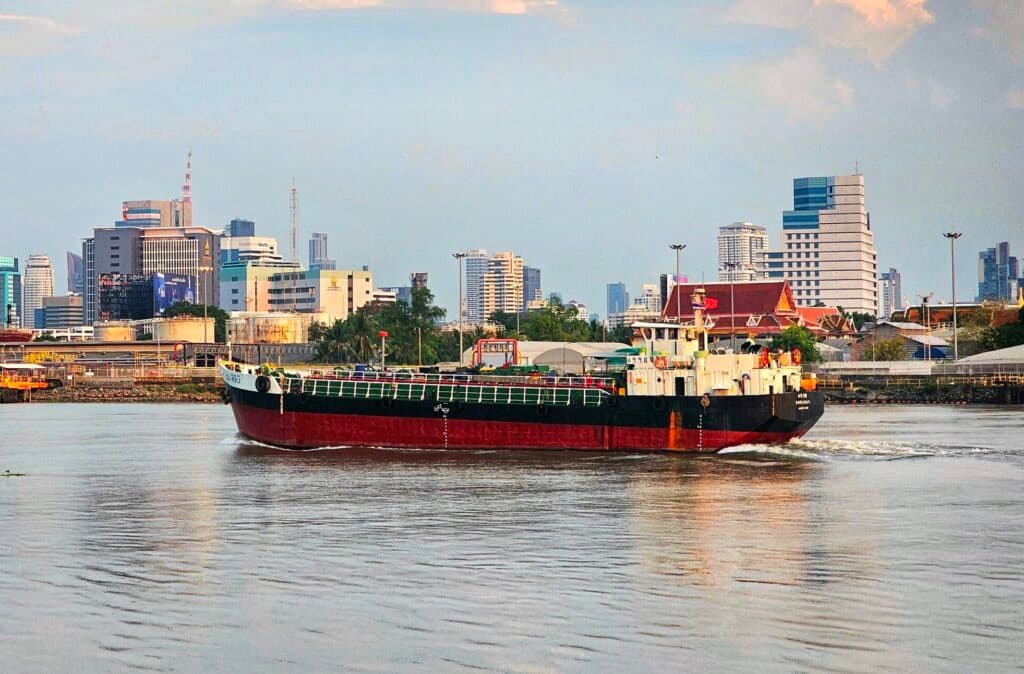
Bessent said Chinese buyers are still purchasing Iranian oil, but warned that the remaining supply already at sea will eventually run out. Trade sources recently estimated that only about 30 million barrels of Iranian crude remained in Asian waters, roughly half the normal amount. Kpler put broader Iranian floating storage outside the blockade zone at about 80 million barrels, down from roughly 105 million before the blockade resumed.

That distinction is important. China has not publicly agreed to stop purchasing Iranian oil. Rather, Washington is attempting to make continued purchases increasingly difficult by preventing new barrels from reaching the market and threatening sanctions against companies that continue helping Tehran.
The effect is already visible. Kpler data showed Chinese imports of Iranian crude falling from an average of 1.4 million barrels per day in 2025 to about 534,000 barrels per day during August. Some independent Chinese refiners have begun looking toward Brazilian and Iraqi crude as Iranian supplies become harder to obtain.
For Tehran, losing the Chinese market would strike at one of the regime’s most important sources of hard currency. Oil revenue helps finance government operations, military programs, missile production, and the broader apparatus that has supported Iranian power across the region.
The economic isolation is also becoming diplomatic. In “Peru Severs Diplomatic Ties With Iran,” Lima ended diplomatic relations with Tehran while citing repression, disruption of the Strait of Hormuz, regional escalation, and obstruction of international nuclear inspections. Peru’s decision does not carry the economic weight of China, but it shows how Iran’s isolation is beginning to extend beyond Washington and Jerusalem.
Cutting the Resources Behind the Threat
The strategy has direct implications for Israel. Every dollar Tehran struggles to earn and every shipment it struggles to receive can affect the regime’s ability to rebuild missile systems, drones, air defenses, and military infrastructure damaged during the war.
That does not mean sanctions alone can eliminate the Iranian threat. Tehran retains substantial military capabilities and has demonstrated that it can continue attacking American forces, Israel, regional states, and commercial shipping. Economic pressure instead complements the military campaign by making replacement and reconstruction increasingly difficult.
America and Israel approach that challenge from separate covenantal missions before God. America’s national covenant has traditionally tied liberty to responsibility, including the defense of free commerce and resistance to coercive powers. Israel’s biblical covenant places a particular obligation on the Jewish people to preserve sovereignty in their ancestral homeland and defend the nation entrusted to them.
Those missions converge when Iran uses oil revenue and international commerce to finance forces threatening both countries. American economic power can close financial and logistical channels. Israeli military strength can prevent Tehran from translating those resources into an existential threat against the Jewish state.
Bessent’s strategy is therefore about more than lowering Iran’s export figures. Washington is trying to create a cycle in which destroyed military systems become harder to replace, foreign suppliers become more reluctant to help, airlines lose access to international support, and Iranian oil becomes increasingly difficult to sell.
The remaining question is China. If Beijing continues finding ways to absorb Iranian crude, Tehran retains an important economic escape route. If the American blockade succeeds in choking off fresh supply, the roughly 30 million barrels now estimated in Asian waters represent a diminishing stockpile rather than a renewable lifeline.
For more stories on Israel, faith, and the values behind the headlines, follow Sinai on Facebook and Instagram.
Discussion0
No comments yet — be the first to share your thoughts.