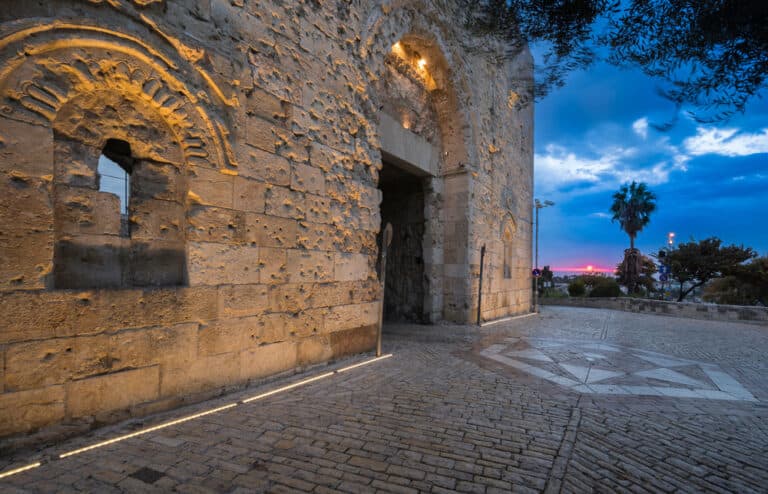

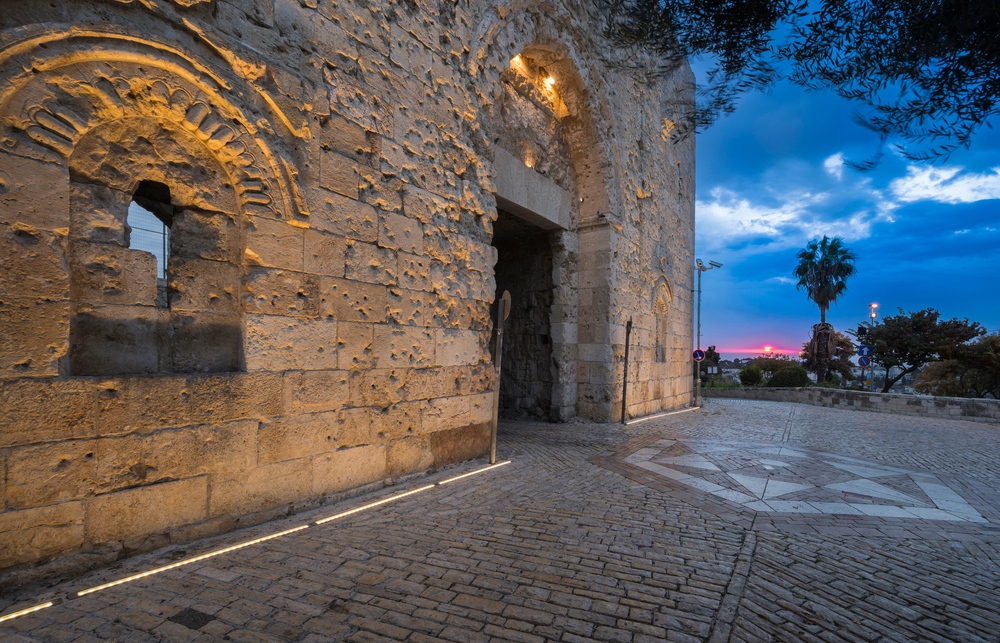
Zion Gate at dusk, Bullet Holes from 1948 War of Independence, Old City, Jerusalem | Photo: Shutterstock
Takeaways:
- The sealed Golden Gate is a promise still waiting to be fulfilled.
- Dung Gate teaches us humility, that holiness starts with clearing away what doesn’t belong.
- Zion Gate’s bullet holes from the 1948 War of Independence are part of Jerusalem’s living story.
- The New Gate turns every entrance into Jerusalem into an act of gratitude.
- All eight gates point to one city that God loves and hasn’t finished restoring.
Jerusalem’s Old City has eight gates, (the first four of which we toured here, in Part 1 of this article) and these four carry some of the deepest symbolism of all. Jewish tradition reads every one of these gates through the Psalms, and what emerges is a city whose story is still very much alive.
The Golden Gate: A Sealed Promise
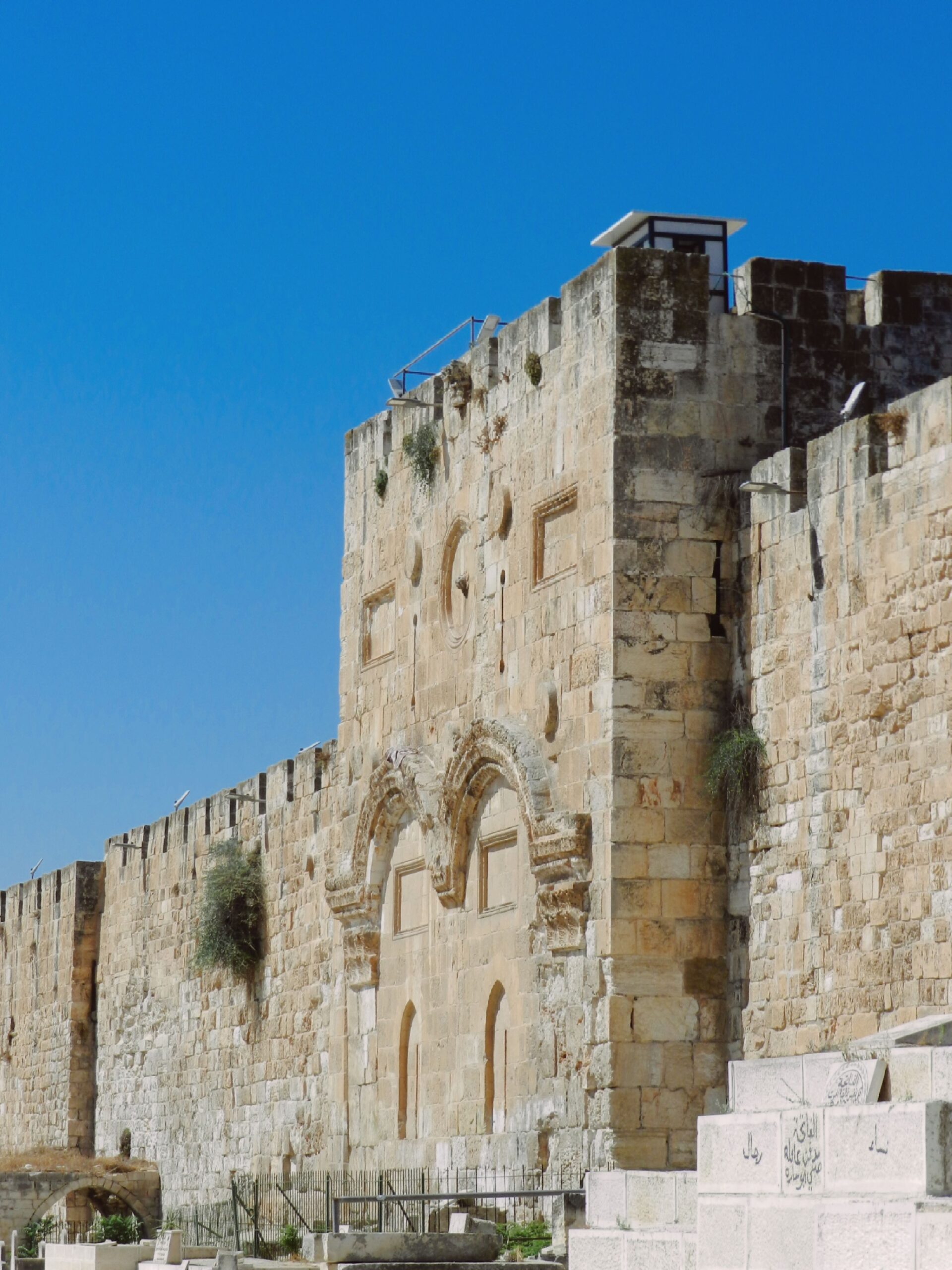
No gate draws more theological attention than this one. The Golden Gate, known in Jewish sources as the Gate of Mercy, has been sealed since the 16th century. Its stones face east, toward the Mount of Olives, and it hasn’t opened in hundreds of years.
Jewish tradition explain that when King Solomon built the First Temple and tried to bring the Ark of the Covenant into the Holy Temple, the gates clamped shut. Solomon recited these verses from Psalm 24, commanding the gates to open so the Divine Presence could enter.
Psalm 24:7–10: “Lift up your heads, O gates! And be lifted up, O ancient doors, that the King of Glory may enter! Who is this King of Glory? God, strong and mighty, God, mighty in battle!”
In Jewish tradition, the sealed gate is often seen as a symbol of messianic hope, a promise that has yet to be fulfilled.
The Golden Gate isn’t considered broken or forgotten; rather, it has always represented something quietly waiting for the right time to be opened.
Dung Gate: Holiness Begins in Humility
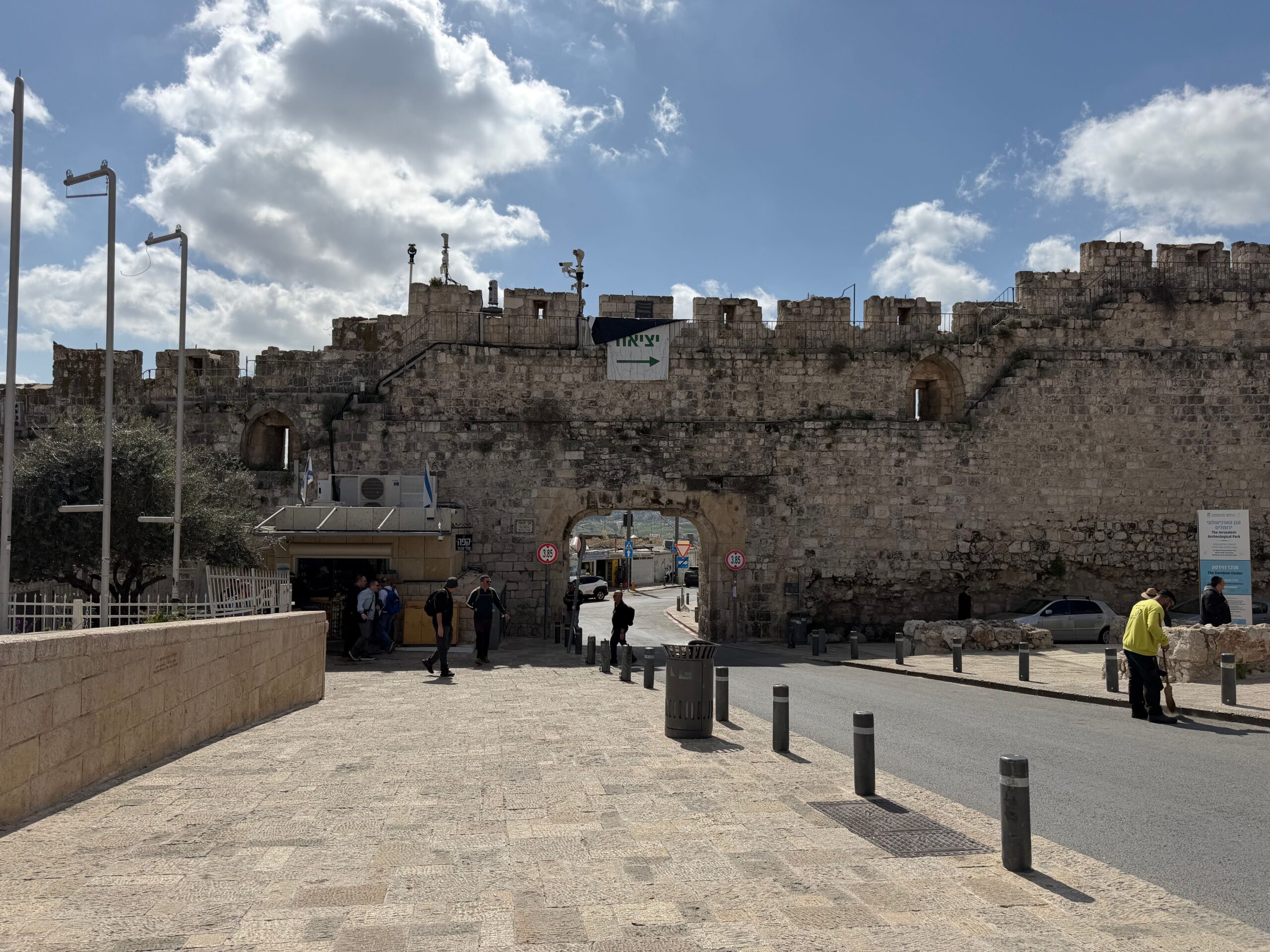
Dung Gate sits at the southern end of the Old City wall, the lowest point both physically and in terms of prestige.
In Jewish tradition, its very name carries a lesson: that holy life includes the unglamorous work of clearing away what doesn’t belong.
Psalm 51’s cry, “Create in me a clean heart, O God,” reminds us that purification matters. Jewish tradition teaches that this gate, used historically to remove refuse from the city, points toward the truth that sanctity requires honest cleansing. You can’t build something holy without first clearing the ground.
The Dung gate has always symbolized purification and spiritual reset.
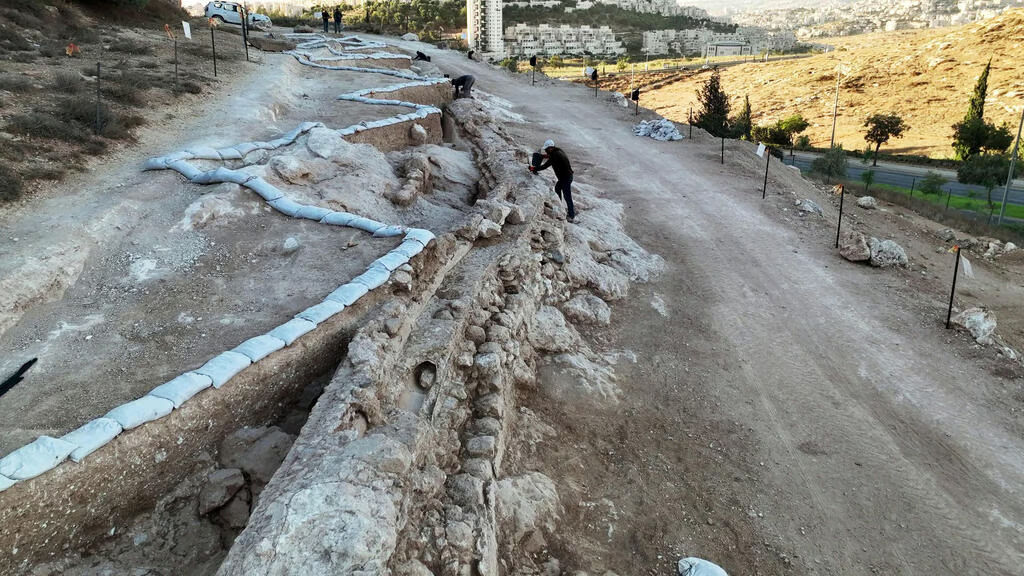
📖 For a deeper look at Jerusalem archaeological finds, read here about a remarkable artifact found in the Mount of Olives.
Zion Gate: The Gate God Loves
Zion Gate sits on the southern wall of the Old City, between the Armenian Quarter and Mount Zion. It still carries bullet holes from the 1948 war, and Jewish tradition reads those scars as part of Jerusalem’s ongoing story.
Psalm 87 says, “God loves the gates of Zion more than all the dwellings of Jacob.” That’s a striking claim. God’s attention rests on this gate, this exact place, where His people have returned generation after generation.
Zion Gate points toward Mount Zion and the Jewish Quarter, and in Jewish tradition it stands for one thing above all: coming home.
The New Gate: Where Gratitude Meets Holy Ground
The New Gate sits on the northwestern corner of the Old City wall, opening directly into the Christian Quarter.
In Jewish tradition, the New Gate is less about ancient symbolism and more about the ongoing life of Jerusalem, how the city continues to open itself to people in every generation.
A natural Psalms connection is Psalm 118:19–20: “Open for me the gates of righteousness; I will enter them and give thanks to God.”
The psalm captures the feeling that every entrance into Jerusalem, whether ancient or newly made, is ultimately an invitation to gratitude and closeness to something greater than ourselves.
Every Gate Tells the Same Story
These four gates don’t have much in common on the surface. One is sealed. One is scarred. One is humble. One is new. But Jewish tradition places them all inside the same story, a city loved by God, protected by God, and still waiting on promises God hasn’t finished keeping. Psalm 122 asks for the peace of Jerusalem. That prayer is still being prayed, at every gate, by people who believe the answer is coming.
Want to keep reading? Go back and read about the first four Gates in Part 1 of this article. Explore more on faith, values, and the Land of Israel at Sinai Project.
Discussion0
No comments yet — be the first to share your thoughts.