
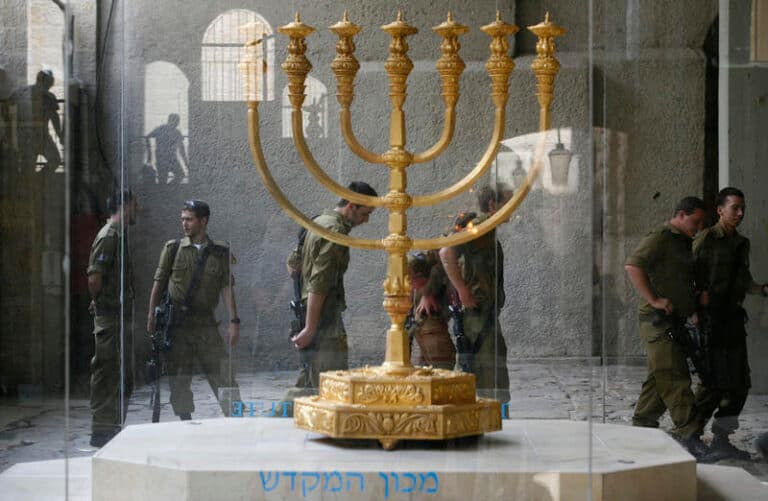

IDF soldiers pass a Menorah in the Jewish Quarter of the Old City of Jerusalem | Photo: Nati Shohat/Flash90.
Takeaways
- The Jewish presence in the Land of Israel stretches back over 3,000 years, long before modern politics entered the picture.
- Two ancient kingdoms, Israel and Judah, once ruled the same land that carries the name today.
- Jerusalem was the beating heart of Jewish worship even after both Temples fell.
- Exile never erased Jewish memory of the land, it deepened it.
- The word “Israel” itself comes from a Bible story most people have never heard the full version of.
I still remember standing in the Western Wall Tunnel Tour in Jerusalem, watching a tour guide point to stones toppled by Roman soldiers nearly 2,000 years ago. A Jewish woman next to me whispered, “And we’re still here.” Well, that’s the whole story in four words. Every empire that tried to erase this connection eventually crumbled. The connection didn’t.

Where the Name “Israel” Comes From
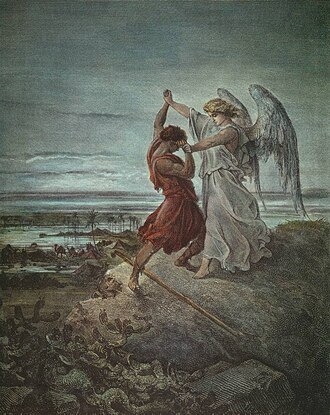
The name goes back to Genesis, where Jacob wrestles through the night with a mysterious figure and comes away changed. “Your name shall no longer be called Jacob, but Israel” (Genesis 32:29), he’s told, because he “struggled with God and with men, and prevailed.”
His twelve sons kept their own names, Reuben, Judah, Benjamin, and the rest, but together their descendants became known as the Children of Israel. Each son’s line grew into a tribe.
By the time of King David, around 1000 BCE, those tribes had a united kingdom with Jerusalem as its capital. His son Solomon built the First Temple there. For a few generations, it was one nation, one king, one house of worship.
📖 Read this article about the ancient burial site in Hebron where Abraham himself is said to rest.
A Kingdom Splits in Two
After Solomon died, things fell apart fast. The ten northern tribes broke off and formed their own kingdom, still called Israel. The southern tribes stuck with David’s line and became the Kingdom of Judah, home to Jerusalem itself.
This split weakened everyone. The Assyrian Empire crushed the northern kingdom in 722 BCE and scattered its population, the origin of what people later called the ten lost tribes. Judah held on for another 136 years, but its turn came too.
Babylon Burns the Temple
In 586 BCE, King Nebuchadnezzar’s Babylonian army breached Jerusalem’s walls and set Solomon’s Temple on fire. The book of Psalms captures the grief of that moment with brutal honesty: “By the rivers of Babylon, there we sat and wept, when we remembered Zion” (Psalm 137:1).
Thousands of Judeans were marched into exile. Here’s an interesting detail most historical accounts skip: Archaeological tablets found in Iraq show these exiles weren’t slaves. They ran businesses, traded goods, and kept their identity intact while dreaming of home. Seventy years later, Persia’s King Cyrus let them return, and the Second Temple went up in 515 BCE.
Rome Finishes What Babylon Started
The Second Temple stood for nearly 600 years, rebuilt on a massive scale under Herod. Then Rome happened. In 70 CE, after a Jewish revolt, General Titus destroyed the Temple and much of Jerusalem. A second uprising decades later, led by Bar Kokhba, ended in similar devastation by 135 CE.
Rome renamed the province Syria Palaestina, hoping to erase the Jewish connection from the map itself. It didn’t work. Jewish communities kept living in the land through every century that followed, in Jerusalem, Tiberias, Safed, and Hebron, never fully absent even when scattered.
That tour guide by the Southern Wall was right. The stones fell, the empires that toppled them are long gone, and the people who prayed there are still praying there today. It’s really a wonder! Part two of this article picks up where the exile deepens, and traces how that same longing for Zion carried a scattered people all the way back home.
Want to keep reading? Read here about why the Temple Mount is still considered one of the most holy places in the world. Explore more on faith, values, and the Land of Israel at Sinai Project.
Discussion0
No comments yet — be the first to share your thoughts.