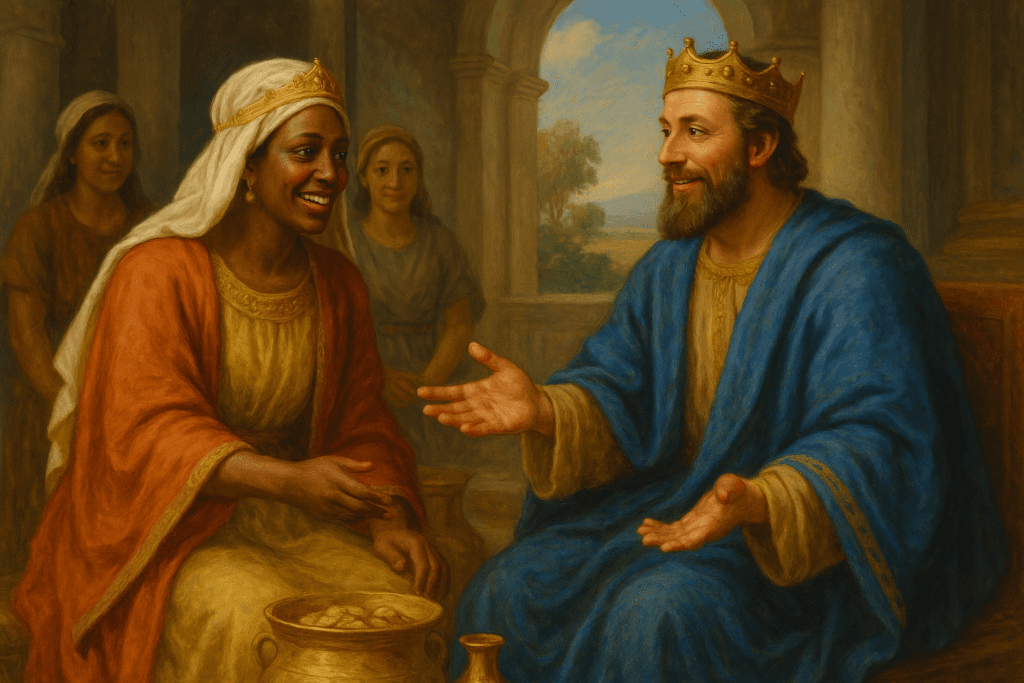

Queen of Sheba and King Solomon Illustration. | ChatGPT
The Bible tells us: “The Queen of Sheba heard of Solomon’s fame, through the name of the LORD, and she came to test him with hard questions. She arrived in Jerusalem … When she came to Solomon, she asked him all that she had in mind. Solomon had answers for all her questions; there was nothing that the king did not know, [nothing] to which he could not give her an answer. When the queen of Sheba observed all of Solomon’s wisdom, and the palace he had built…she was left breathless. She said to the king, ‘The report I heard in my own land about you and your wisdom was true. But I did not believe the reports until I came and saw with my own eyes that not even the half had been told me; your wisdom and wealth surpass the reports that I heard. How fortunate are your men and how fortunate are these your courtiers, who are always in attendance on you and can hear your wisdom! Blessed be the LORD your God, who delighted in you and set you on the throne of Israel. It is because of the LORD’s everlasting love for Israel that He made you king to administer justice and righteousness.’ She presented the king with one hundred and twenty talents of gold, … Then she and her attendants left and returned to her own land.” (I Kings 10:1-10)
The Queen of Sheba hears from afar, indeed from the farthest corners of Africa, she hears the call and comes. After testing whether Solomon was legitimate and had the right intentions, she blesses him, and blesses God, gives him some gifts and returns to her kingdom. I am convinced that she, like Malki-tzedeck, Yitro, Rahab and Hiram, went back to her country and spoke of the blessings that reside with the People of Israel and the necessity to support and spread the name of the God of Israel throughout the world.
Why doesn’t the Bible end right here? Why don’t we see the messianic era ushered in at this juncture?
The Bible tells us: “King Solomon loved many foreign women in addition to Pharaoh’s daughter—Moabite, Ammonite, Edomite, Phoenician, and Hittite women…” (I Kings 11:1)
Unfortunately, Solomon could not sustain this level of service to God, he could not balance the role of agent of God with political leader and his confidence that he would not be swayed by these outside influences was erroneous.
Solomon seemingly had all the pieces to fulfill God’s plan, except one. He had three out of the four requisites for fulfilling this lofty mission.
1. Nation
2. Land
3. Calling out in God’s name
4. Momentum
The nation of Israel under Solomon was united, served God, settled the land in peace and prosperity and through the building of the Temple, called out in God’s name to the whole world. But this process must have ‘staying power’, must exceed one person, one generation. For the plan to be fulfilled, there must be consistency in that call over a period of time such that the nations of the world recognize God and join together with Israel in acknowledging and blessing God once and for all.

Discussion0
No comments yet — be the first to share your thoughts.