Baghdad Enforces U.S. Sanctions On ISIS And Hezbollah
Iraq ordered state financial institutions to enforce U.S. sanctions targeting ISIS financing networks and entities linked to Lebanon’s Hezbollah

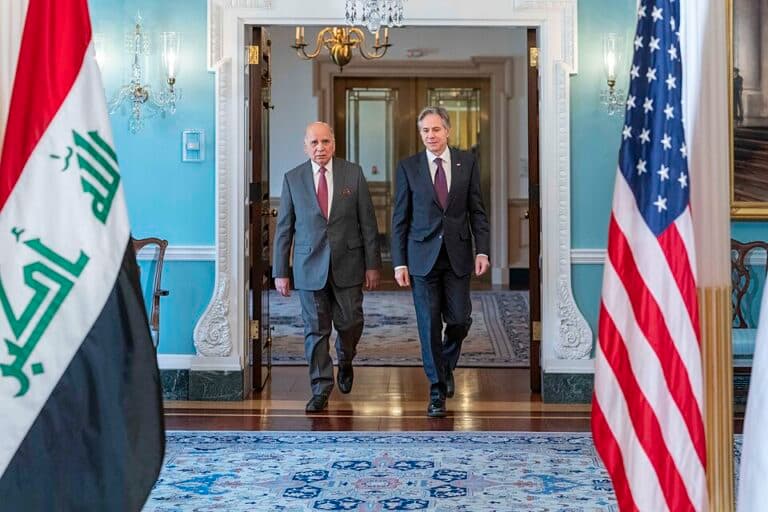
Iraq U.S. sanctions enforcement expanded after Baghdad directed state financial institutions to implement newly imposed American measures targeting ISIS financing networks and entities linked to Lebanon’s Hezbollah.
Iraq’s Finance Ministry issued the instruction on Wednesday through the Iraqi Fund for External Development. The directive followed requests from the Foreign Ministry and the Finance Minister’s Office after the latest sanctions from the U.S. Treasury Department’s Office of Foreign Assets Control.
According to the directive, OFAC sanctioned three individuals and six entities operating across Europe, West Asia, and West Africa. The United States accused them of facilitating financial transactions on behalf of ISIS.
The sanctions also include entities linked to Hezbollah under amended U.S. Executive Order 13224, which targets terrorist financing and logistical support networks.
The Tanakh says, “You shall purge the evil from your midst.” That principle fits the financial battlefield. Terror armies cannot survive on slogans alone. They need money, couriers, banks, fronts, and silence.
Iraq U.S. Sanctions Enforcement
Baghdad’s decision matters because Iraq sits at the center of several overlapping pressure systems.
The United States wants Iraq to prevent its financial institutions from becoming channels for terror financing. Meanwhile, Iran and its aligned militias have long treated Iraq as a strategic rear base.
Therefore, enforcement by Iraqi state institutions carries weight beyond paperwork.
For Washington, this is about protecting the sanctions system. If terrorist networks can move money through weak or compromised financial channels, American designations lose power.
For Iraq, the move signals that Baghdad is trying to show compliance with U.S. financial pressure. It also sends a message to banks and state-linked institutions that terror finance can carry consequences.
Why Israel Is Watching

For Israel, the Hezbollah element is direct.
Hezbollah is not only a Lebanese militia. It is Iran’s most powerful proxy army on Israel’s northern border. Any financial pressure on Hezbollah-linked entities can weaken the wider Iranian system that threatens Israeli civilians.
This issue also connects to “Israeli Foreign Minister: Hamas Wants A “Hezbollah Model” In Gaza.” Foreign Minister Gideon Sa’ar warned that Hamas’s technocratic government proposal aims to preserve its weapons and copy Hezbollah’s model in Gaza.
That warning matters here.
The Hezbollah model depends on armed power, political cover, social institutions, and external financing. If Hamas seeks the same structure in Gaza, then financial enforcement becomes part of the war over the day after.
The United States and Israel therefore share a practical interest. Terror groups must not control territory, keep weapons, and hide behind civilian structures while money keeps flowing.
Covenant Against Terror Finance
The United States and Israel share a covenantal understanding before God that gives power a moral purpose.
Both nations believe freedom requires responsibility. Both understand that law must defend the innocent. Both know that evil often hides behind systems that look ordinary from the outside.
In this story, the covenantal connection appears through financial clarity.
America uses its legal and economic power to expose terror networks. Israel faces the missiles, tunnels, and armed groups those networks help fund.
The shared calling is therefore concrete. Stop the money before it becomes rockets. Block the networks before they become armies. Enforce the law before terror turns institutions into shields.
Baghdad’s decision to implement U.S. sanctions marks one step in that wider struggle. For America, it strengthens sanctions credibility. For Israel, it pressures Hezbollah and reinforces the lesson that Hamas cannot receive a Hezbollah-style future in Gaza.
Ultimately, terror finance is not a technical issue. It is a battlefield. The countries that enforce sanctions help decide whether groups like ISIS, Hezbollah, and Hamas lose oxygen or gain time to rebuild.
For more stories on Israel, faith, and the values behind the headlines, follow Sinai on Facebook and Instagram.
Discussion0
No comments yet — be the first to share your thoughts.