Arab States Condemn Colombia’s Golan Recognition Move
Saudi Arabia, Egypt, Qatar, Jordan, Iraq, Lebanon, Kuwait, Yemen, and Libya condemned Colombia’s recognition of Israeli sovereignty over the Golan Heights

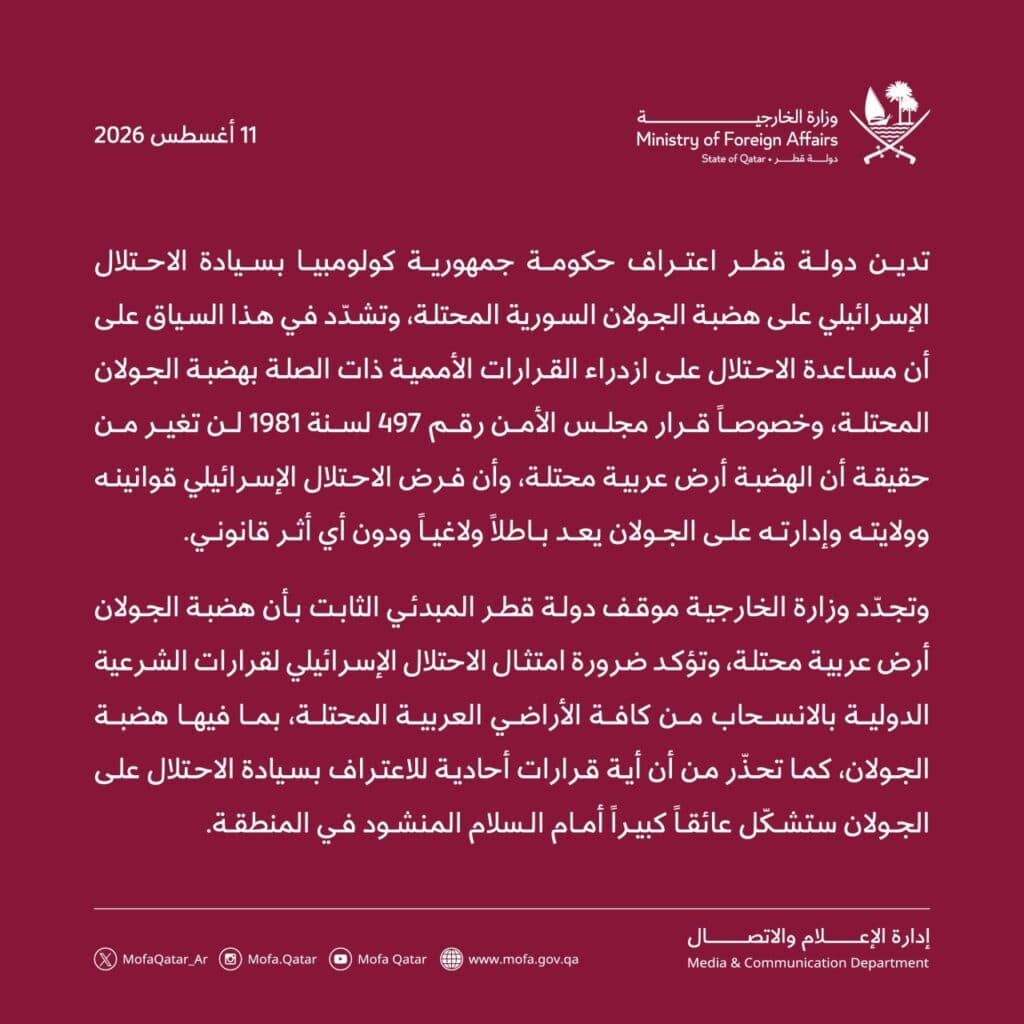
Golan recognition backlash grew across the Arab world after Saudi Arabia, Egypt, Qatar, Jordan, Iraq, Lebanon, Kuwait, Yemen, and Libya issued statements condemning Colombia’s decision to recognize Israeli sovereignty over the Golan Heights.
The wave of condemnations came after Colombia took a dramatic pro-Israel step, recognizing the Golan Heights as sovereign Israeli territory. Colombia framed the decision around regional instability, October 7, and Israel’s right to defend itself against external threats.
Qatar’s Ministry of Foreign Affairs said it condemned Colombia’s recognition and rejected what it called Israeli sovereignty over the Golan. The Qatari statement also warned that unilateral recognition would create a major obstacle to peace in the region.
The Tanakh says, “The prudent sees danger and hides himself, but the simple go on and suffer for it.” That verse fits Israel’s position on the Golan Heights. The issue is not abstract diplomacy. It is the difference between defensible borders and exposing Israeli civilians to hostile forces from the high ground above the north.
Golan Recognition Backlash
The Arab statements show how sharply Colombia’s decision disrupted the usual diplomatic consensus. For years, much of the international system has treated the Golan Heights mainly as a legal dispute. Colombia’s statement broke from that framing and focused instead on Israel’s security reality.
That shift matters. Israel has faced decades of threats along its borders, and the dangers have intensified since October 7. Colombia’s recognition argued that continued Israeli sovereignty over the Golan is essential to Israel’s national defense and to the protection of its citizens.
The backlash from Arab governments shows that the decision did not pass unnoticed. Saudi Arabia, Egypt, Qatar, Jordan, Iraq, Lebanon, Kuwait, Yemen, and Libya all moved to reject it publicly. Yet the strength of the reaction also highlights the significance of Colombia’s move: a Latin American government directly affirmed Israel’s need to hold strategic territory in a hostile region.
Colombia’s Pro-Israel Line Holds

The current controversy builds on “Colombia Recognizes Israeli Sovereignty Over Golan Heights.” Colombia recognized Israeli sovereignty over the Golan Heights, citing regional instability, October 7, and Israel’s right to defend itself.
That earlier decision now faces its first major diplomatic test. Arab governments are trying to pressure Colombia back into the old consensus, where Israel’s security needs are acknowledged in theory but challenged in practice. Colombia’s statement did the opposite. It treated Israel’s security concerns as concrete, urgent, and legitimate.
For Israel, the message is clear. Recognition from Colombia strengthens the argument that the Jewish state cannot be asked to gamble with its survival to satisfy diplomatic formulas. The Golan Heights protects northern Israel, and any serious discussion of peace must start with that reality.
The United States will also watch the dispute closely. Washington recognized Israeli sovereignty over the Golan during President Donald Trump’s first term, setting a precedent that Colombia has now echoed. The Arab condemnations show that the issue remains contested, but they also reveal how powerful pro-Israel clarity can be when another country follows that American lead.
Covenant Of Secure Borders And Moral Clarity
The United States and Israel each carry distinct covenantal responsibilities before God in matters of sovereignty and defense. America’s covenantal tradition speaks through liberty, strength, and the defense of allies against coercion. Israel’s covenant is ancient and unique, rooted in the God of Israel, Torah, Jewish peoplehood, sovereignty, and the return to the land.
The Golan Heights brings those responsibilities into practical form. America’s recognition of Israeli sovereignty there reflected a commitment to see the region as it is, not as diplomats wish it to be. Colombia’s decision now adds another voice to that same reality-based approach.
Israel’s covenantal responsibility is to protect Jewish life in the land, not to surrender vital ground because hostile governments object. Peace built on fantasy cannot endure. Peace built on secure borders, deterrence, and truth has a chance.
The Arab condemnations will likely continue. But Colombia’s decision has already changed the conversation. It forced the region to confront a basic question: should Israel’s survival needs matter in diplomacy, or should the Jewish state be expected to ignore the threats gathered along its borders?
For more stories on Israel, faith, and the values behind the headlines, follow Sinai on Facebook and Instagram.
Discussion0
No comments yet — be the first to share your thoughts.