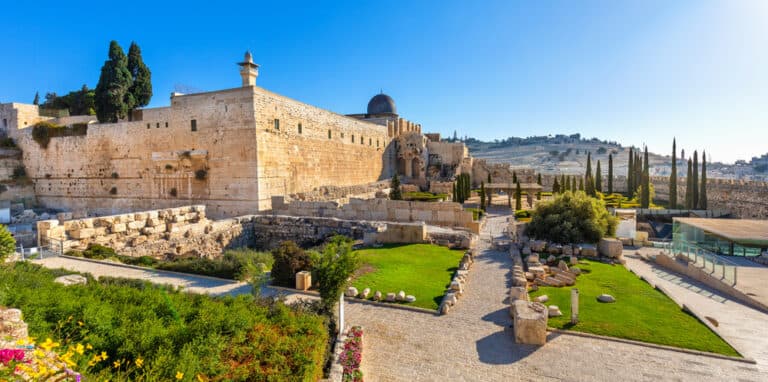

Robinson’s Arch in the Jerusalem Archaeological Park/Davidson Center, Jerusalem. | ArtMediaFactory / Shutterstock.com
The Book of Deuteronomy Chapter 16 provides detailed instructions for each of these festivals, culminating in verse 16: “Three times a year—on the Feast of Unleavened Bread, on the Feast of Weeks, and on the Feast of Booths—all your males shall appear before your God יהוה in the place that [God] will choose. They shall not appear before יהוה empty-handed.” (Deut. 16:16)
After the destruction of the First Temple by the Babylonians and the subsequent exile of the Jewish people, only some returned to rebuild the Second Temple. For the pilgrimage festivals, Jews journeyed from regions like the Galilee, the Golan, and the Negev, joining those already living in Jerusalem. Some also traveled from distant lands—Rome, Egypt, Greece, and beyond. The meeting point for these pilgrims was the spring at the base of the mountain, now known as the Gihon Spring or the Shiloah (Siloam), located in the City of David.
Ascending to the Beit HaMikdash (The Temple) Singing Psalms
From there, the procession of pilgrims would make its way up the mountain, singing Tehillim, (Psalms) as they ascended, until reaching the area just below the Temple compound, at the top of Mount Moriah. Along the way, there were shops for purchasing sacrificial animals, olive oil, and wine. Ritual baths for purification were also available. Once everything was in place, the people, in shifts, would go to the Temple for the service.
This tradition is described in the Bible, the Talmud, and by the Jewish-Roman historian Josephus. It is only in recent years, however, that archaeology has provided tangible evidence to corroborate these ancient descriptions.
The Temple Mount, is for the most part off-limits to archaeologists due to its inherent holiness and political issues. However, after the Six-Day War in 1967, when Israel gained control over Jerusalem, archaeological work began in earnest in the area surrounding the Temple Mount, particularly in the area known as ‘Robinson’s Arch.’
The Trumpeting Place
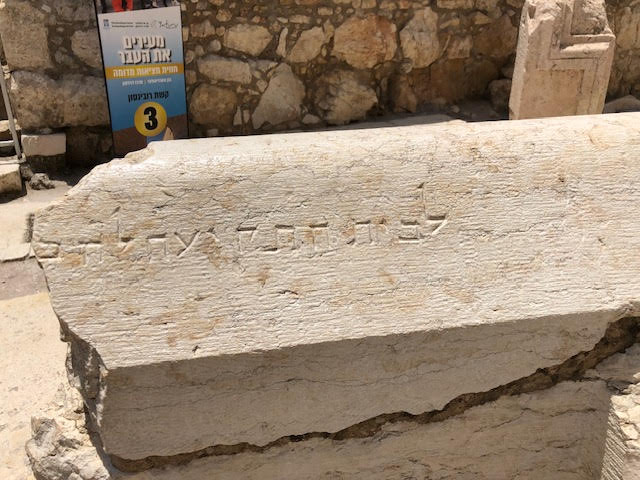
Near Robinson’s Arch, in what is today called the Jerusalem Arcaheological Park or the Davidson Center, archaeologists uncovered numerous artifacts that support the descriptions of the pilgrimage holidays found in the Bible, Talmud, and writings of Josephus. Among the findings were up to 100 ritual baths, and a smooth, flat stone with a number and letter on it. Could this have been a seating ticket, or perhaps a coat check for the ritual bath?
One inscription from the southwestern corner revealed that a priest would blow a trumpet on the eve of a holiday or Shabbat to announce the beginning of the sacred day. Another inscription described the dividing wall that separated areas for celebrants from those designated for non-Jews, who were allowed only to enter certain parts of the Temple complex.
The City of David also offers valuable insights into the pilgrimage process. Pilgrims ascended the mountain, carrying their contributions and offerings, along two roads that forked upward from the spring to the Holy Temple. Archaeologists only discovered these roads after a water pipe burst, leading to an unexpected excavation.
The western side revealed water installations that lined the path as it ascended, while the eastern side—known today as the Pilgrim’s Route—unveiled many fascinating artifacts. Among them was a podium, possibly the ‘Even To’en‘ mentioned in the Gemara, where those who had lost items could proclaim their lost belongings, making it easier for them to be returned. Coins, some dating back to the time of Agrippa (grandson of Herod), help chronologically place the construction of the road. A silver half-shekel coin was found, which was the biblically prescribed temple tax, (in Exodus 30:15) also used for census purposes. By counting the number of these coins, one could approximate the number of Jewish men aged 20-50, and from that, estimate the total population.
The Word of God is Not Just a Historical Document
Seeing these biblical events brought to life through archaeological discoveries is truly exhilarating! It reminds us that the Word of God is not just a historical document, but a living testimony that continues to be confirmed.
Esti Herskowitz is a licensed guide in Israel. She’s addicted to biblical archaeology, the natural beauty of the Land of Israel, and powerful stories from Israel’s history. Contact her for tours at Esti.h.tours@gmail.com
Discussion0
No comments yet — be the first to share your thoughts.