


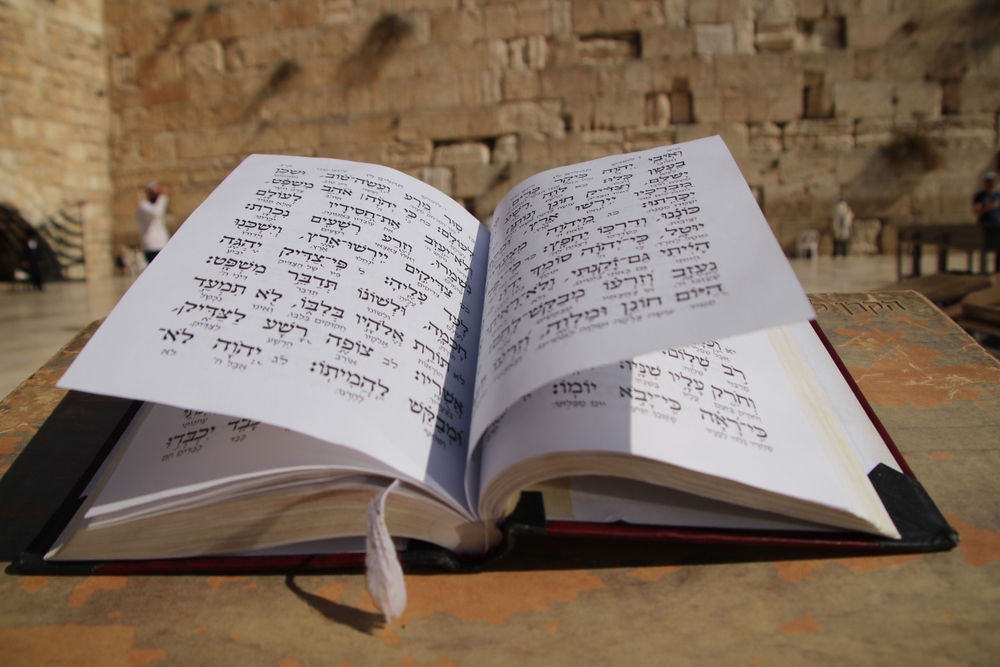
Jews from all around the world gather for prayer service at the Western Wall, Jerusalem, 2023 | Photo: Shutterstock
Takeaways
- The number 40 shows up again and again in Scripture, always carrying real meaning.
- Jewish tradition ties 40 to transformation, purification, and rebirth.
- Moses spent three separate 40-day periods on Mount Sinai.
- There’s a real prayer custom involving 40 straight days at the Western Wall.
- A fetus takes 40 days to fully form, and mystics say that’s not a coincidence.
A few years back, my friend grabbed my arm mid-conversation and took off running through the Old City, straight down the stone steps toward the Western Wall. I chased after her, confused, until she explained between breaths. In Jewish tradition a day runs from sunset to sunset, and she was on day 22 of a 40 day prayer commitment. She needed to reach the Wall before the sun dropped to keep her count intact.
We made it with minutes to spare. I stood there catching my breath while she prayed, and I kept thinking about what I’d just seen for weeks afterward.
That’s when I started noticing 40 everywhere, in story after story, once I knew what to look for.
The Womb, the Wall, and a Very Old Pattern
In Jewish tradition, 40 is the number of becoming. It shows up at the start of life, at the giving of the Torah, and in prayer customs that are still practiced today. The rabbis read this as a built-in rhythm of creation itself, woven into the world on purpose.
A fetus takes roughly 40 days to fully form in the womb. Mystical sources connect this to the Hebrew letter mem, which has the numerical value of 40. The word rechem, meaning womb, ends with a closed mem, said to represent the nine months the womb stays closed before birth. Language and biology line up on purpose, according to this reading.
📖 For a deeper look at the mystery of the Temple’s Ark of the Covenant, read here.
Moses Didn’t Just Go Up the Mountain Once
Here’s a trivia fact most people miss: Moses climbed Mount Sinai for 40 days three separate times, not once. First to receive the tablets, then to plead for forgiveness after the Golden Calf, then again to bring down the second set. That’s 120 days total spent on a mountain with no food.
The Torah puts it plainly:
“And Moses was in the mountain forty days and forty nights.” (Exodus 24:18)
Jewish teaching holds that a day spent learning on the mountain equaled a year of ordinary human understanding. Forty days became forty years’ worth of wisdom.

The Prayer Habit Nobody Talks About
The custom I saw at the Western Wall has a name: Arba’im Yom, or the 40 days. People pick one specific request, something they’re praying hard for, and show up to the same spot every day for 40 consecutive days. Miss a day, and tradition says you start the count over from day one.
It traces back to Moses pleading for the nation after the Golden Calf. He didn’t get an answer on day one. He kept showing up.
Fun Facts You Can Actually Use at Dinner
- The flood in Noah’s story lasted 40 days and 40 nights, and Jewish sources describe it as the world getting a full reset.
- A kosher mikvah must hold exactly 40 se’ah of water, roughly 200 gallons, before it’s considered valid for immersion.
- Israel’s forty years wandering the desert lines up with a full generational turnover, a detail scholars point to often.
- The number 40 appears well over 150 times across the Hebrew Bible.
Why This Stuck With Me
I never found out how my friend’s 40 days turned out, but I like to think she made it to day 40. Every time I visit the Western Wall now, especially close to sunset, I look for someone racing down those stone steps, and I usually spot one. There’s something about committing to 40 days that turns an ordinary request into an act of real devotion, and once you know the pattern, you start seeing it in every corner of the tradition
Want to keep reading? Read Part 1 of the article on Jerusalem’s Holy Temple to learn about the miraculous nature of the First Temple. Explore more on faith, values, and the Land of Israel at Sinai Project.
Discussion0
No comments yet — be the first to share your thoughts.