What Is a Shofar, and Why Do Jewish People Blow It Every Day Before the Jewish New Year?

Magazine
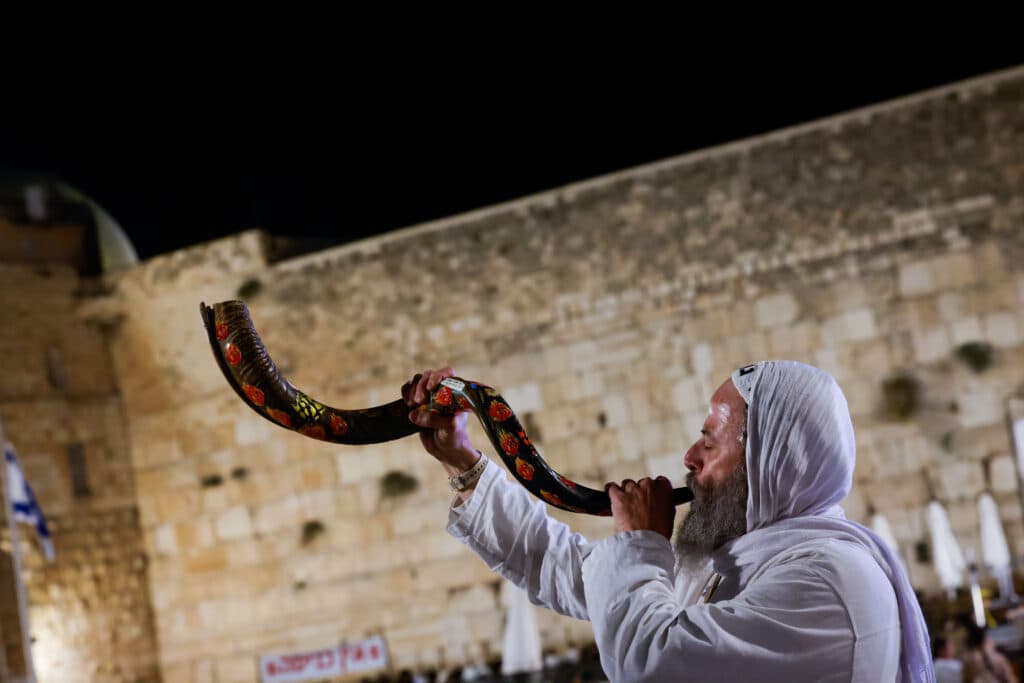
A Jewish man blows a shofar horn as Jews arrive for a forgivness prayer (Slichot), at the Western Wall. | Photo: Chaim Goldberg/Flash90
Takeaways
- A shofar is a ram’s horn trumpet, blown with breath alone.
- Elul is the month right before Rosh Hashanah, built for reflection.
- The daily shofar blast traces back to Moses on Mount Sinai.
- Amos called the shofar a wake-up call, and it still is.
- Selichot prayers pair with the shofar to build momentum toward the New Year.
If you’ve ever wandered near a synagogue in late summer and heard a strange, raw horn blast coming from inside, that really was intentional. That’s a shofar, and for one full month before the Jewish New Year, it gets blown almost every single morning. There’s a whole story behind that sound, and once you know it, you’ll never hear it the same way again.
First, What Even Is a Shofar?
A shofar is a ram’s horn, hollowed out and shaped into a kind of natural trumpet. It relies purely on breath and curved bone, nothing mechanical involved. The sound comes from breath alone, pushed through that horn until it screams out something between a cry and a wake-up call. On Rosh Hashanah itself, hearing the shofar is a command straight from the Torah. The daily blowing that comes before it is custom, and it’s older than most people realize.

Meet Elul, a Month Worth Knowing About
The month is called Elul, and it falls right before Rosh Hashanah, usually landing somewhere in August or September. Jewish tradition treats it as the last stretch of the year, a kind of runway into the High Holidays. Some rabbis describe it as the time when “the gates of love are open,” meaning it’s easier than usual to reconnect with God if you’re actually trying.
There’s a beautiful bit of wordplay here too. Elul is read as an acronym for a line from Song of Songs: “Ani Ledodi Vedodi Li.” I am to my beloved and my beloved is to me. The whole month is basically framed as a relationship check-in with God.
📖Read here about why some Jews wake up before dawn to say the ancient prayers of Slichot every day of Elul.
So Why the Daily Shofar Blast?
A few reasons stack on top of each other. The first goes back to Moses, who climbed Mount Sinai on the first of Elul after the Golden Calf disaster to beg for forgiveness. He stayed up there 40 days and came back down with the second set of tablets on Yom Kippur. A shofar sounded when he went up, so the daily blowing during Elul echoes that ascent.
There’s also a spiritual alarm clock element. The prophet Amos put it bluntly: “Shall a trumpet be blown in the city, and the people not be afraid?” (Amos 3:6). That’s the whole point. The shofar carries real weight on purpose, meant to jolt people out of autopilot before Judgment Day arrives.
And then there’s my favorite piece of trivia: Jewish traditional sources describe the month-long blowing as a way to confuse “the prosecuting angel.” Basically, by repenting a full month early, the case against you is already settled by the time Rosh Hashanah rolls around. The angel doesn’t even know which day to show up.

Quick Questions People Actually Ask
Does everyone blow it the same number of times? Pretty much, yes. The custom is once a day after morning prayers, skipping the day right before Rosh Hashanah.
What’s Selichot? These are penitential prayers. Sephardic communities say them every day of Elul, while others start the week before the holiday. Either way, it pairs with the shofar to keep repentance front of mind the whole month.
Is any of this about guilt? It’s framed mainly as hope. There’s still time to turn things around before the year closes.
Why This Sound Still Cuts Through
We live surrounded by noise, notifications, and constant distraction. A wordless horn blast, blown with nothing but human breath, carries a weight that words often struggle to match. It says wake up, there’s still time, turn back, draw near. Rooted in the bible that spans both Jewish and Western religious tradition, that message travels further than people expect.
Want to keep reading? Click here to discover why the Hebrew month of Elul is connected to the idea of “the King is in the field.’ Explore more on faith, values, and the Land of Israel at Sinai Project.
Discussion0
No comments yet — be the first to share your thoughts.