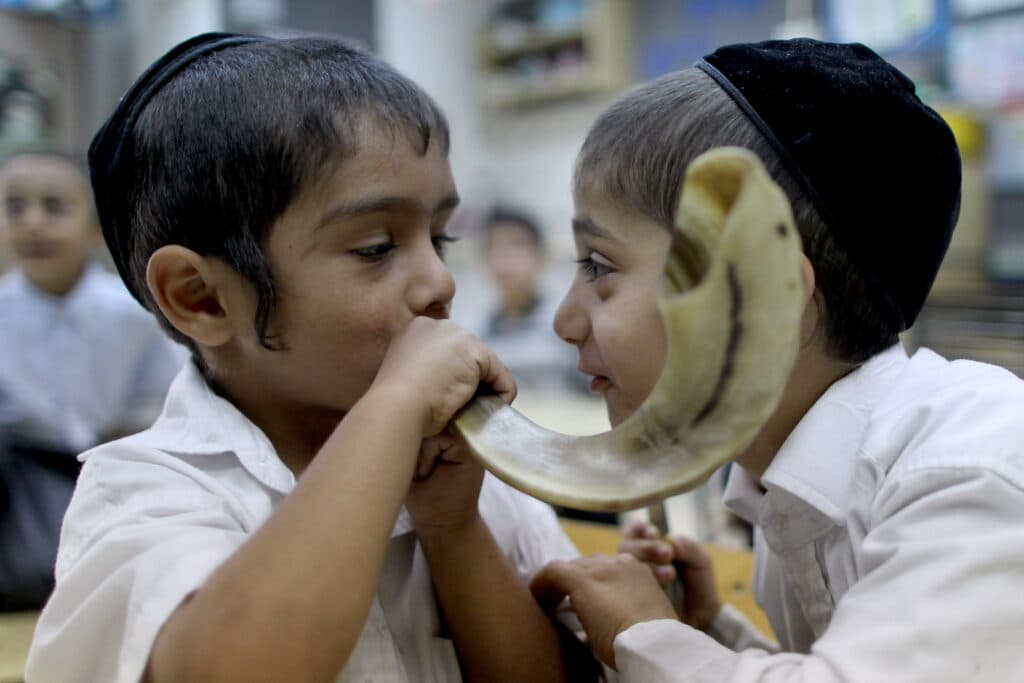
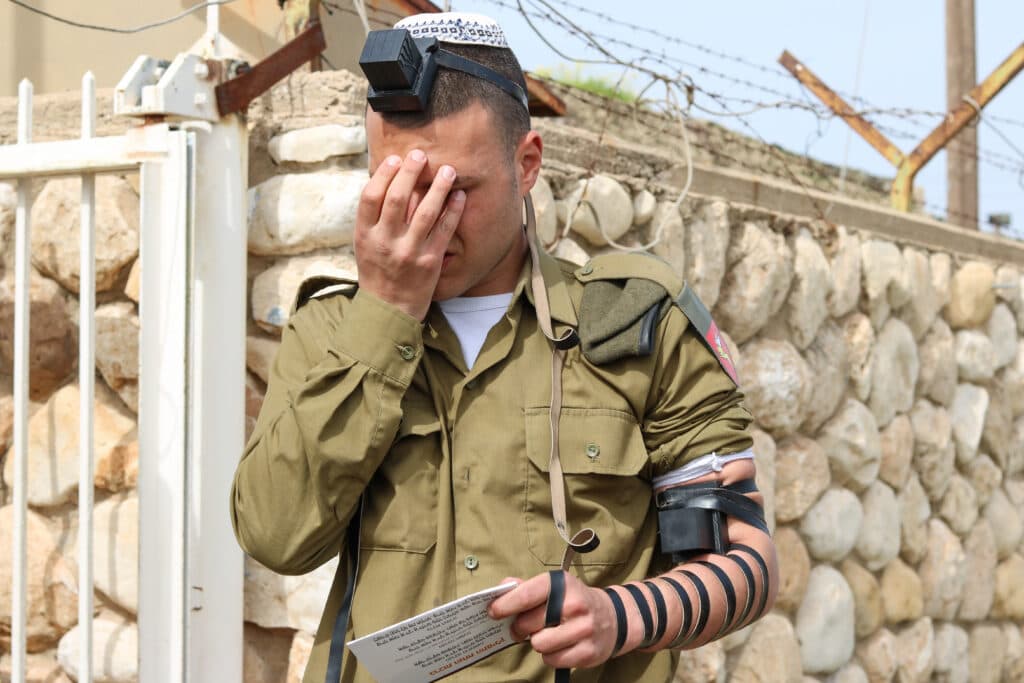

An Israeli soldier with tefillin reciting the Shema prayer | Photo: Liba Farkash/Flash90
Takeaways
- The Shema is Judaism’s central declaration of faith, recited every morning and night.
- Covering the eyes is an ancient custom, traced back to the Talmud.
- The prayer says that God’s oneness is behind everything, even when life feels scattered.
- Its final verses are also inscribed in the mezuzah on Jewish doorposts.
- It’s traditionally the first prayer taught to a child and the last words said before death.
A friend of mine once sat next to an elderly man on a flight from New York to Tel Aviv. Somewhere over the Atlantic, the cabin lights dimmed for the night, and the man pulled out a small prayer book, put his hand over his eyes, and quietly said a few words to himself. My friend asked him about it afterward. The man explained that he’s said the same six words every night before sleep since he was a boy in Brooklyn, sixty years ago. That was the Shema.
The Shema is Judaism’s central declaration of faith, a single verse from Deuteronomy that Jews recite twice a day, every day, without exception. It says one thing: God is One. I’m writing about it because that verse, and the odd little gesture of covering the eyes that goes with it, carries a lot more weight than its size suggests.

What Is the Shema, Exactly?
The Shema isn’t really a prayer in the way we usually think of prayer, asking for something or offering praise. It’s more like a declaration, and it opens with Deuteronomy 6:4: “Hear, O Israel: the Lord is our God, the Lord is One.” The Hebrew word shema means more than “hear.” It means listen and act on it, the same sense behind the Israelites’ famous line at Sinai, “we will do and we will hear.”
Q: How often is it recited, and by whom? A: Twice daily, morning and night, by observant Jews everywhere, following the instruction to speak these words “when you lie down and when you rise up.”
Trivia worth knowing: the Shema is traditionally the last thing a Jew hopes to say before death, and one of the first phrases taught to a Jewish child. Not many sentences get asked to carry that much on both ends of a life.
Why Cover the Eyes?
Q: Why do Jews cover their eyes while saying it? A: The custom goes back to the Talmud, which describes Rabbi Judah the Prince doing exactly this at this exact line. Jewish law still calls for the right hand over the eyes while the first six words are spoken.
Sight is useful, but it’s also bossy. It grabs your attention and convinces you that whatever’s right in front of you is the whole story. Covering your eyes for a moment breaks that spell.
Notice how often we close our eyes for the moments that matter most anyway. We close our eyes when we pray, when we cry, when we love, when we dream. The most sacred things were never meant to be seen with the eyes. They’re meant to be received with the soul. The Shema just takes that instinct and turns it into a daily habit.

One God, One Story
Life looks like a pile of unrelated things: a sick relative, a kid’s homework, a headline from a war zone, the smell of coffee. The Shema pushes back on that. It says the scattered feeling is just surface noise, and underneath it, one God is holding the whole story together, even the parts that seem disconnected.
From Belief to Love
The next verse won’t let the idea stay abstract. It commands: “And you shall love the Lord your God with all your heart, with all your soul, and with all your means” (Deuteronomy 6:5).
Q: Why does belief turn into love so fast? A: Because a belief that never changes how you act isn’t worth much. The passage goes on to say these words should be taught to your children, talked about at home and on the road, and fixed to your doorposts, which is where the mezuzah comes from. An idea about God’s oneness is built to end up shaping how you treat the person standing in front of you.
A Line Worth Noticing
You don’t need a particular pew or a particular family tree to feel the pull of what the Shema is saying. The idea underneath it, that the chaos of daily life hides one coherent source, is available to anyone who takes a minute to sit with it.
There’s a particular moment, when God becomes your source rather than just an idea you hold at arm’s length, that changes how gratitude works in you. You stop chasing what the world calls success and start noticing His hand in every breath, every heartbeat, every unseen turn that got you here.
That’s what a room full of Jews is doing, hand over eyes, twice a day, every day: the discipline of remembering, in a world full of noise, that the hand behind it all was always close.
Discussion0
No comments yet — be the first to share your thoughts.