Inspiration for the Week: Insights from Parshat Yitro, the Book of Exodus
This week’s Torah portion, ‘Parshat Yitro’, covering Exodus 18-20, will be read in synagogues worldwide.

It All Started at Sinai!
Sure, we can begin the narrative of the Bible with creation, or with Abraham and Sarah. Perhaps we can speak of the birth of the nation of Israel in Egypt with the Exodus. But the essential, defining characteristics of that nation relate not to physical liberation but to a spiritual one. At its core, the Torah (the Bible) is a book of law, of commandments (Mitzvot), of shaping one’s worldview, and of preparing God’s creatures to become partners in creation and in building a better society.
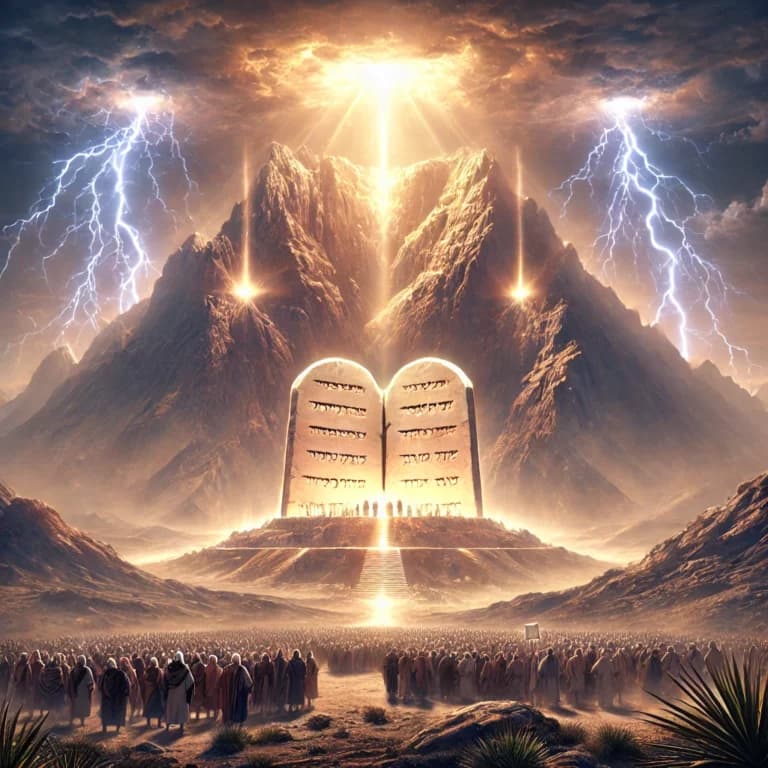
If that is the case, then it all begins at Sinai. The small mountain—called Horeb by some, “the mountain of God” by others, and Sinai by all—was the gathering place where the Israelites took their first steps toward becoming a mission-driven people. Moses, when confronting the burning bush (called sneh in Hebrew, a word intriguingly similar to Sinai), was unknowingly standing at this very site. As a simple shepherd searching for his sheep, he was drawn to an extraordinary sight: a bush on fire but not consumed. Moses approached it, saying, “Let me get closer to this amazing sight—why does the bush not burn?”
God stopped him in his tracks and called his name twice: “Moses, Moses.” His response? Hineni—“I am here.” Unaware of what lay ahead or who was speaking to him, Moses nevertheless proclaimed his readiness to engage with this miraculous vision and its invisible voice. The voice warned him that approaching the mountain of God required purity of mind, body, and soul.First, Moses was told to remove his shoes because he was standing on holy ground. In Hebrew tradition, words often carry layered meanings. Hasidic teachings suggest that Moses was not merely asked to remove his shoes but also to shed his habitual thoughts and actions—those mental habits that lock us into routines and fixed perspectives. God essentially told Moses: If you want to come close on this mountain, you must free yourself from those shackles of habit and allow yourself to experience life anew.
“I am the Lord of your father and forefathers—Abraham, Isaac, and Jacob.”
Once Moses was prepared mentally and physically, God continued: “I am the Lord of your father and forefathers—Abraham, Isaac, and Jacob. I have seen the affliction of My people; I have heard their cry. I will go down to save them from Egypt and bring them to a land flowing with milk and honey.” Moses was chosen as God’s messenger—not only for Pharaoh but for Israel as well.
Moses struggled to comprehend what he had heard. He couldn’t process what God expected from him or what his ultimate mission would be. Was it simply about freeing a nation of slaves? Was it about battling evil? Was this his life’s purpose? He questioned God’s decision in choosing him: he wasn’t an orator or a statesman; he lacked diplomatic skills and felt ill-equipped for such a task.
God responded by reframing Moses’ understanding: “You misunderstand your ultimate mission. You think it is about physical salvation? No—that could be carried out by anyone. Your mission is different; you will be called ‘Moses our teacher’ (Moshe Rabbeinu).” God explained further: “When you bring the people out of Egypt, you will serve Me on this mountain.” Freedom alone would not suffice; their first steps as a free people had to lead them through Mount Sinai.
At Sinai they will learn of holiness.
At Sinai they will learn of truth.
At Sinai they will experience the metaphysical.
At Sinai they will be prompted to choose God, His Law, their history.
At Sinai they will be given a mission.
These ideas—and many more—capture what Sinai represents not only for Israel but also for humanity at large: for anyone willing to accept God and the divine lessons of the Torah. The moment at Mount Sinai carries a universal message. The Bible records that nations far and wide heard about this miraculous event. One rabbinic teaching even states that the Torah was revealed at Sinai in 70 languages—symbolizing its relevance to all nations.
Sinai Had Another Remarkable Effect: It Brought Unity.
A rabbinic homily (midrash) teaches: “Rav Elazar Hamodai stated that when the Torah was given to Israel, the sounds of God traversed from one end of the world to the other, and all the nations trembled in fear… At that time all the nations came to Balaam son of Beor and said: ‘What is this frightening sound? Has another flood come upon the world?’ Balaam replied: ‘God already promised never again to bring a flood.’ They asked: ‘Then what is this sound we hear?’ He answered: ‘A precious gift that God has hidden for 974 generations before creation is now being given to His children,’ as it says: ‘God gives strength to His people; God blesses His people with peace.’”
This dramatic midrash raises questions: Why did hearing thunder and lightning make these nations immediately think of a flood? And why did they go straight to Balaam?
Rabbi Joseph Baumol offered an answer decades ago that still resonates today. When Israel surrounded Mount Sinai to receive God’s Word, they displayed something extraordinary: unity. Hundreds of thousands stood together at Sinai—men, women, and children—all waiting in harmony for Moses to proclaim God’s words: “I am the Lord your God…” For one blissful moment, Israel stood united—without complaints or cynicism—eyes turned toward heaven.
Witnessing this unprecedented display of unity, other nations assumed it must have been triggered by an external crisis—a catastrophe like another flood threatening destruction. They could not fathom another force strong enough to unite so many people.
“God gives strength to His people; God blesses His people with peace.”
Balaam corrected them: For Israel, unity comes not from fear or external crises but from something far more powerful—a shared spiritual mission rooted in joy, meaning, and divine purpose. As Balaam said: “God gives strength to His people; God blesses His people with peace.”
The nations could not grasp this greater ideal—that Torah itself has the power to flood minds with light, fostering peace and serenity while uniting humanity in harmony. Sinai remains a call for all who seek its eternal wisdom—a source of light capable of transforming individuals and societies alike.
Sinai symbolically, and the wisdom of the Torah, tangibly, still maintains that transformative power for Israel and all the nations who choose to stand under God and accept His Word. Today, more than ever, Sinai is our holiness and truth, our foundation of tradition and our lodestar in a world sometimes darkened; it is our anchor and our guide, our conscience and our mission. And ultimately, it is what unifies us all under one God to serve and to uplift.
Rabbi Avi Baumol grew up in New York and has a B.A. in Economics and an M.A. in Medieval Jewish History from Yeshiva University. He has been an educator, author, tour guide and lecturer for over three decades and currently lives in Judea with his wife and children.
Discussion0
No comments yet — be the first to share your thoughts.