UAE Iran Trade Halt Follows Missile Fire
The UAE halted trade and financial transactions with Iran after accusing Tehran of launching missiles toward its territory, raising pressure on Iran’s economy


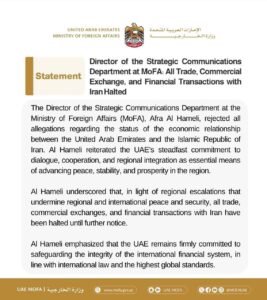
The UAE Iran trade halt marks a major escalation after the United Arab Emirates announced the suspension of all trade, commercial exchanges, and financial transactions with Iran.
The decision came after the UAE said Iran launched two missiles toward its territory. According to the UAE statement, the missiles fell into the sea. Hours later, Abu Dhabi announced that all trade and financial activity with Iran would stop until further notice.
The move delivers a serious economic blow to Tehran. For years, the UAE has served as one of Iran’s most important economic outlets. Iranian nationals have used commercial activity, financial channels, and crypto networks in the UAE to work around sanctions and access hard currency.
Proverbs warns, “A false balance is abomination to the Lord.” In this story, the issue is not only trade. It is the moral disorder of a regime that uses neighbors as financial lifelines while firing missiles, denying responsibility, and destabilizing the region around them.
UAE Iran Trade Halt
The United Arab Emirates had largely avoided becoming a central target during Iran’s recent wave of attacks. That may be because the UAE remained economically valuable to Tehran.
Now, that calculation appears to have changed. If Iran did launch missiles toward the UAE, then Tehran struck one of the same countries whose financial and commercial systems helped keep parts of its economy alive under sanctions.
The Iranian Foreign Ministry denied the UAE’s accusation and said Iran did not launch missiles toward the Emirates. But the pattern is familiar: Iran fires, then denies.
The tension is now moving beyond diplomatic statements. A halt to trade and financial transactions cuts into the networks Iran uses to survive pressure from the United States, regional rivals, and sanctions enforcement.
Tanker Tracking Raises Alarm
The maritime picture is also worsening. Vessel-tracking reports from recent hours said the oil tanker AMARA, operated by the United Arab Emirates, changed its planned route and was being directed toward the Iranian port of Bandar Abbas.
According to those reports, Iran’s Revolutionary Guards apparently seized the tanker. Maritime outlets have also reported Iranian claims that Tehran detained a UAE-linked tanker near the Strait of Hormuz.
That development fits a broader Iranian playbook. Tehran threatens shipping, applies economic pressure, and then uses legal or military language to justify seizures. The Strait of Hormuz becomes the stage where Iran tries to turn geography into blackmail.
The same Iranian axis appeared in “Ghalibaf Baghdad Visit Begins Beside Soleimani Statues.” That article reported that Mohammad Bagher Ghalibaf began his Baghdad visit beside statues of Qasem Soleimani and Abu Mahdi al-Muhandis near the airport. Tehran’s message was clear there, too: diplomacy and intimidation move together.
For Israel, the UAE-Iran rupture matters because the Abraham Accords created a new regional reality. A UAE under Iranian missile pressure is not only a Gulf story. It is part of the same struggle over whether Iran can threaten moderate Arab states, Israel, and global trade routes without paying a price.
Covenant Of Trade, Trust And Defense
The United States and Israel carry separate covenantal missions before God, but both depend on a regional order where free nations can trade without coercion. America’s responsibility is to defend open markets, deter hostile regimes, and protect partners from missile pressure. Israel’s responsibility is to stand against the Iranian system that arms terror groups, threatens civilians, and attacks regional stability.
The UAE decision shows how quickly economics can become security. A trade channel can become leverage. A port can become a pressure point. A tanker route can become a battlefield.
That is why Abu Dhabi’s move matters. By cutting trade and financial transactions with Iran, the UAE is not only responding to missiles. It is helping tighten the economic chokehold around a regime that has used commerce, sanctions evasion, and maritime threats as tools of survival.
Iran wanted regional fear. Instead, it may have pushed one of its most valuable economic corridors to close.
The next question is whether Washington, Jerusalem, Abu Dhabi, and other partners can turn this moment into sustained pressure. If Iran loses access to financial lifelines while its maritime coercion faces a united response, Tehran’s room to maneuver will shrink.
For more stories on Israel, faith, and the values behind the headlines, follow Sinai on Facebook and Instagram.
Discussion0
No comments yet — be the first to share your thoughts.