Shaibani Israel Talks Can Resume With “Real Political Will”
Syrian Foreign Minister Asaad al-Shaibani said talks with Israel could resume with “real political will,” while rejecting Israel’s claims over Turkish forces in Syria

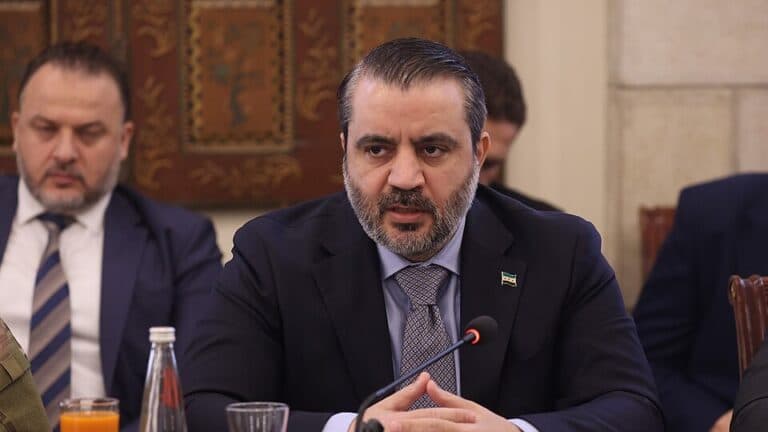
Shaibani Israel talks could resume if there is “real political will,” Syrian Foreign Minister Asaad al-Shaibani said Thursday, as tensions between Israel, Syria, and Turkey continue to rise.
Shaibani said Syria had previously worked toward a security agreement with Israel. However, he accused Israel of retreating from commitments made during those talks.
“We tried to reach a security agreement with Israel, but it retreated from its commitments,” Shaibani said.
He added that Damascus remains interested in an agreement that could reduce tensions. “We are still interested in reaching an agreement with Israel to reduce escalation,” he said, adding that talks could resume if Israel showed “real political will.”
Ecclesiastes says there is “a time to keep silence, and a time to speak.” Syria’s foreign minister is now speaking publicly about talks, but his words come after airstrikes, warnings, and a growing dispute over Turkey’s military role. Diplomacy is still possible, yet every statement now carries the weight of military facts on the ground.
Shaibani Israel Talks
For American readers, Asaad al-Shaibani is Syria’s foreign minister under the new Damascus leadership that emerged after the fall of Bashar Assad. His job is to represent Syria abroad, manage diplomatic relations, and explain Damascus’s position to regional powers, Washington, Europe, and the Arab world.
Shaibani has become one of the main Syrian voices in the dispute with Israel. He has argued that Syria wants to reduce escalation, but he also says Damascus does not trust Israel’s intentions.
According to Shaibani, Syria told the United States that it does not trust Israel. That matters because Washington has been involved in efforts to reduce tension between Israel and Syria.
The issue is not full peace yet. It is mainly about security arrangements, military activity, and whether Syria can rebuild state institutions without creating new threats near Israel’s frontier.
Turkey And The Abu Al-Duhur Dispute
Shaibani also rejected claims that Israeli military operations were connected to Turkish forces in Syria. He argued that such claims do not reflect the situation on the ground.
His remarks came after Israel struck the Abu al-Duhur airbase in northern Syria. Israel said Syria was close to violating a security status quo by allowing Turkish forces to deploy at an airbase near Aleppo. Turkey denied that a military delegation was present before or during the strike.
That dispute was central in “Turkish Defense Ministry Denies Abu Al-Duhur Delegation.” The article reported that Turkey denied any military delegation was present at Abu al-Duhur and said it would continue supporting Syria’s military rebuilding.
Shaibani’s new comments fit the same argument from Damascus and Ankara. Syria says it has the right to rebuild its military institutions and strengthen its capabilities. Israel says it will not tolerate military changes that threaten its security.
That is the core tension. Syria frames military rebuilding as sovereignty after years of collapse and war. Israel sees certain Syrian and Turkish moves as potential threats that could harden into future danger.
A Narrow Path Between Talks And Force
The United States has a direct interest in this dispute. Turkey is a NATO member, Israel is America’s closest regional ally, and Syria’s new government remains fragile. A confrontation between Israel and Turkish-backed Syrian military rebuilding could become a serious regional problem.
For Israel, the situation is simpler and more urgent. The Jewish state cannot wait for hostile infrastructure to become permanent before responding. Its campaign between the wars has long aimed to disrupt threats before they mature into direct danger.
Shaibani’s position should therefore be read carefully. He is not announcing normalization with Israel. He is saying Syria remains open to talks that reduce escalation, while rejecting Israel’s justification for recent strikes.
Covenant Of Diplomacy And Defense
The United States and Israel carry separate covenantal missions before God, and this story tests both. America’s mission requires using diplomacy to prevent regional fire from spreading between allies, rivals, and unstable states. Israel’s mission requires guarding the Jewish people when threats begin forming beyond the border.
Those missions can support each other, but they are not identical. Washington may search for formulas that keep Syria, Turkey, and Israel from clashing. Jerusalem must judge whether those formulas actually protect Israeli civilians and preserve freedom of action.
Shaibani’s remarks show that the door to talks has not fully closed. However, the battlefield around Abu al-Duhur shows why the door is difficult to keep open.
Syria wants recognition of its sovereignty and military rebuilding. Turkey wants influence and partnership with Damascus. Israel wants a security status quo that prevents hostile forces from gaining new positions near its frontier.
If there is “real political will,” talks may resume. But in Syria, political will will not be measured by words alone. It will be measured by who builds bases, who controls airfields, who keeps commitments, and whether Israel’s security concerns receive real answers.
For more stories on Israel, faith, and the values behind the headlines, follow Sinai on Facebook and Instagram.
Discussion0
No comments yet — be the first to share your thoughts.