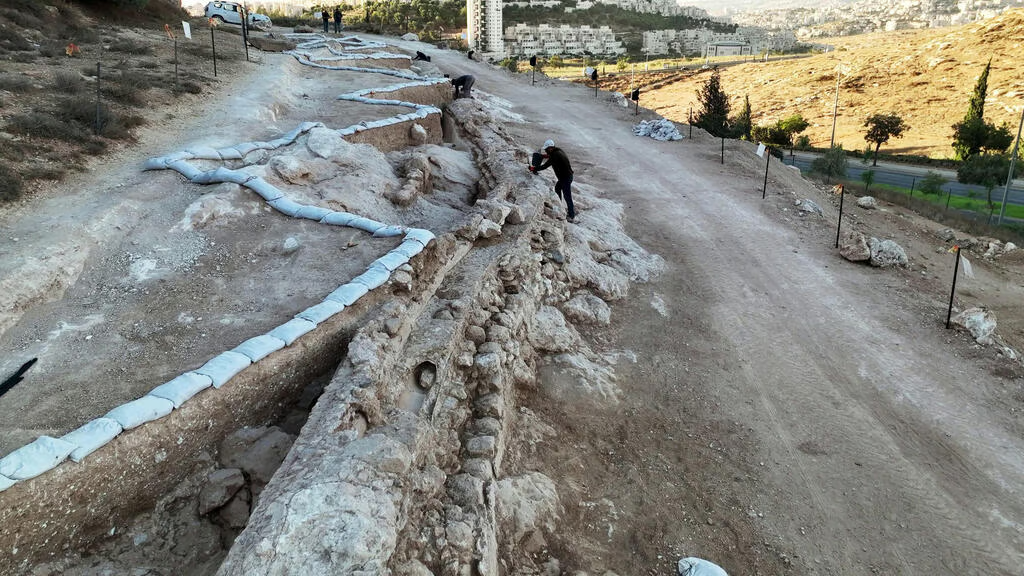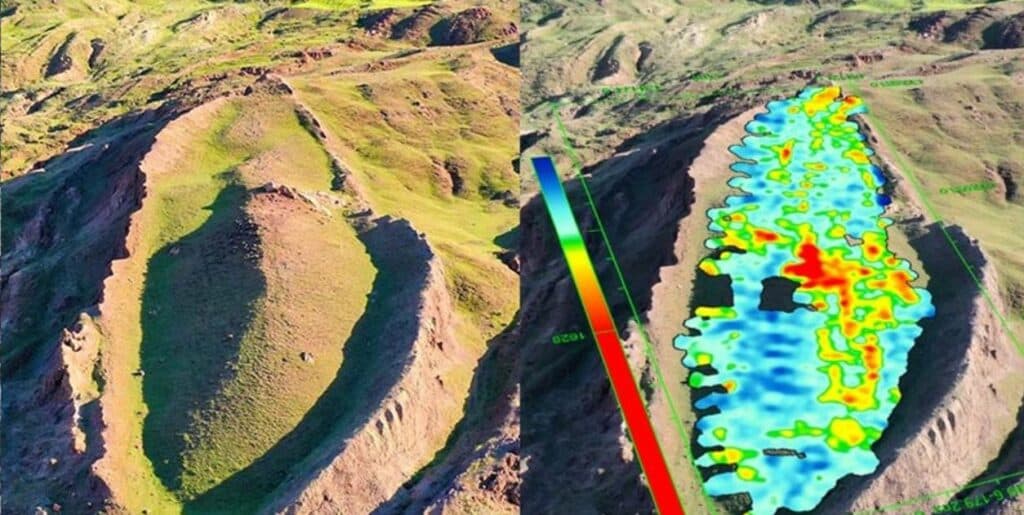

Potential archaeological site of Noah’s Ark in Eastern Turkey | Photo: Noahs Ark Scans’ X Account | Used Under Fair Use For News Reporting
Takeaways
- A major dig at Mount Ararat just pulled soil samples with 40 percent more carbon than the ground around it.
- Researchers found cavities, mud, and water inside a formation that isn’t supposed to have any of that.
- Nearby slopes hold 26 large stones with drilled holes, which some researchers read as ancient drogue anchors.
- The site sits exactly where the Hebrew Bible says the ark landed.
- Lab results won’t be final until 2027, and the debate over what they’ll show is already heating up.
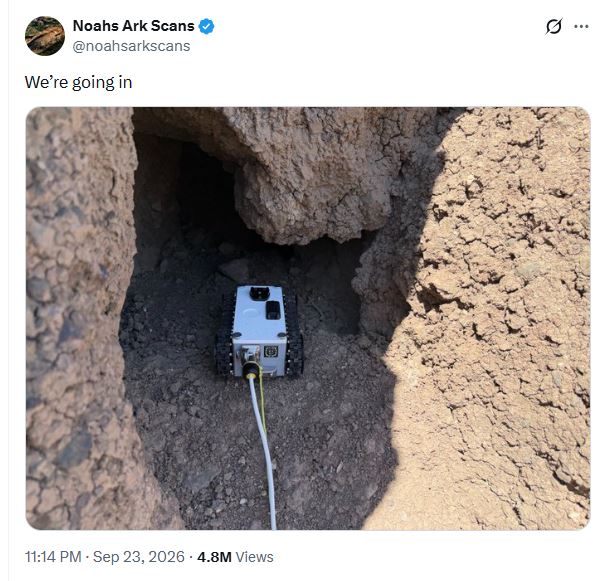
- The team is sending an underground robot named Gopher into the formation’s mapped cavities.
Something is happening at Mount Ararat right now, and it’s the kind of story that doesn’t come around often. In late September 2026, an international research team started core drilling at the Durupınar Formation, a massive boat shaped mound in eastern Turkey. They’re calling it the largest permitted scientific program ever run at the site.
What the Team Actually Dug Up
The numbers here are specific enough to take seriously. Crews pulled roughly 1,000 soil samples from 150 locations, drilling as deep as 18 meters. Ground penetrating radar picked up right angle intersections inside the mound, the kind of geometry you don’t usually find in plain limestone.
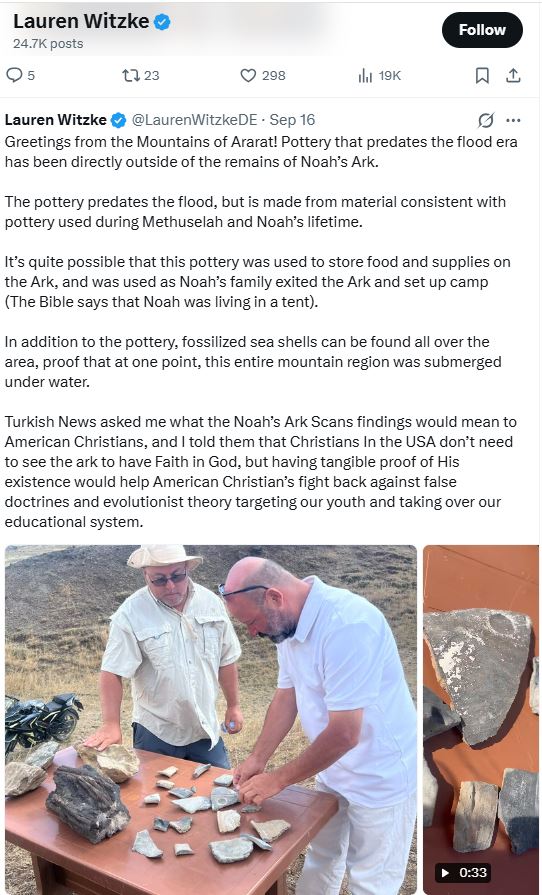
Soil from inside the formation showed about 40 percent more carbon than the surrounding earth. Researchers have floated decayed wood as one possible explanation. Pottery fragments turned up nearby too, though dating them will take time in the lab.
The team behind this season’s work includes Andrew Jones of Noah’s Ark Scans, radar specialist Dr. Khosrow Bakhtar of Bakhtar Research and Engineering, and archaeologist Cenker Atila of Sivas Cumhuriyet University. Jones announced the team is sending down Gopher, an underground robot built to reach spaces no person can enter, to map what’s inside the cavities they’ve already located.
Why the Location Isn’t a Coincidence
The Hebrew Bible is direct about where the ark ended up. Genesis 8:4 states, “the ark came to rest… upon the mountains of Ararat.” Investigators have been drawn to this exact region since 1959, when the formation’s outline was first spotted from the air.
That’s not a small detail. A team of scientists is now standing on the precise ground a text written thousands of years ago pointed to, running instruments that can detect wood, organic material, and human activity.
The Case for the Site, and the Pushback It’s Getting
People who take this formation seriously usually point to three things. The mound’s length lines up closely with the dimensions ancient sources give for the ark. Investigators have also catalogued 26 large stones with drilled holes on the surrounding slopes, stones some researchers believe were used as drogue anchors to steady a massive wooden vessel at sea. And the location itself sits in the exact stretch of mountains the Hebrew Bible names.
That combination is part of why the site keeps drawing funded research decades after it was first spotted. Skepticism has followed just as fast, and it isn’t new. A 1996 study by geologist Lorence Collins and explorer David Fasold labeled the site a natural rock formation and dismissed the ark theory outright.
Jones has been direct about where he stands against that history. “We believe the Durupınar Formation is the remains of Noah’s Ark,” he said, adding that this belief is exactly why the team wants rigorous testing rather than a quiet dismissal.
It’s worth naming the stakes plainly. A confirmed find at Durupınar would force a real rewrite of textbook timelines on the flood narrative, and it would land hardest on the historians and archaeologists who’ve spent careers treating that narrative as legend. That’s a steep professional cost, and it shapes how cautiously some corners of the field are willing to engage with the data before 2027’s results are even in.
None of that proves the formation is the ark. But it does explain why this dig has become as much a story about who gets to define history as it is about soil samples and radar scans.
Where the Science Actually Stands
The researchers themselves are careful. Nothing is confirmed, and the samples are still sitting in labs in Ankara. What they will say is that current data raises the probability the formation isn’t purely natural rock.
For anyone who reads the flood narrative as history rather than legend, that’s a meaningful update. A funded, multi university project is extracting physical material from the exact spot the Hebrew Bible names, using tools built to answer exactly this kind of question.
This isn’t the first time modern archaeology has bumped into a biblical location and found something worth a second look. It fits a pattern where digging in the region tends to back up the text rather than undercut it.
What Happens Next
Full soil and core analysis is expected over the winter, with comprehensive published findings targeted for 2027. Wherever possible, researchers plan to run radiocarbon dating on any preserved organic material they recover.
Additional field seasons are already planned, so this isn’t a quick dig that wraps up and disappears from the news cycle. It’s a multi year effort, and the team’s early language, cautious in public, optimistic in tone, suggests they think they’re onto something real.
Patience is the right posture here. But for a story that starts with ancient words about a mountain in Ağrı province, and ends with modern drills pulling carbon rich soil from that same mountain, patience feels a lot easier than usual.
Discussion0
No comments yet — be the first to share your thoughts.