
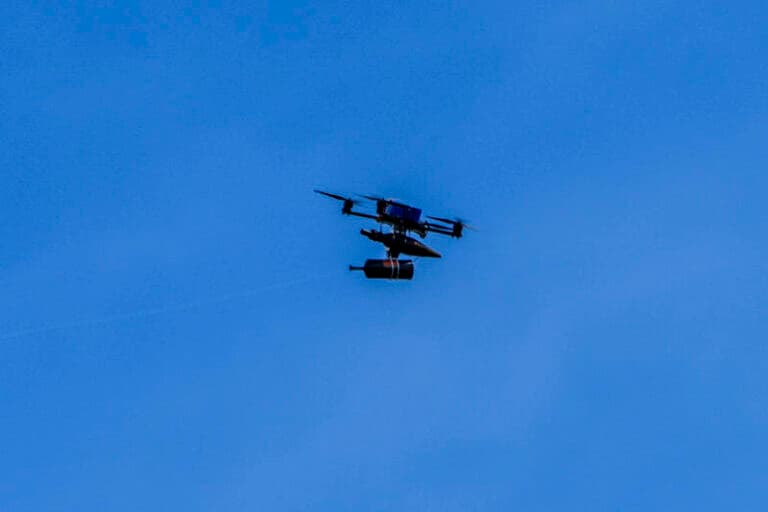

An explosive drone launched by Hezbollah is seen near the Israeli border with Lebanon during a Hezbollah attack in northern Israel, May 19, 2026 | Photo: Ayal Margolin/Flash90
Takeaways
- Cheap drones are a real danger to American cities and bases.
- Israel already fought this war and built what works.
- Iron Beam kills a drone for a few dollars a shot.
- U.S. interceptors cost millions against cheap drones.
- Israel’s lessons save American lives right now.
Drones used to be someone else’s problem. Not anymore. They are cheap to build, simple to launch, and now sitting on America’s own doorstep.
Hostile actors know this, and they are moving faster than most American laws and defense systems can keep up with.
Israel learned this the hard way, under real fire, and its response now offers the United States a working blueprint.
The Threat Is Bigger Than Most People Realize
A drone that costs a few thousand dollars can carry an explosive, gather intelligence, or overwhelm a radar system simply by showing up in a swarm.
Iran’s Shahed drones, used against Israel and against American ships and bases in the Middle East, illustrate the problem well. They are slow, but they are numerous, and they are cheap to replace.
Traditional American air defense was built to stop expensive, sophisticated threats. It was not built to handle a swarm of low-cost drones arriving again and again.
Israel Has Already Fought This War
Israel has faced drone attacks from Gaza, Lebanon, and Iran for years, sometimes daily during periods of active conflict.
That pressure forced rapid innovation. Israeli defense officials and engineers didn’t have the luxury of slow development timelines. They had sirens going off and drones crossing the border in real time.
📖Read here to learn what Israelis have done to increase their personal security after October 7th.

Iron Beam Changes the Math
Israel’s biggest breakthrough is a laser weapon called Iron Beam, developed by Rafael Advanced Defense Systems with U.S. financial backing. It was delivered to the Israeli Air Force in December 2025 after a decade of development.
Instead of firing a missile, Iron Beam holds a focused beam of light on a target until it burns through it. Officials have described the cost per shot as a few dollars, sometimes cited as low as $2 to $3.50.
Compare that to a typical Iron Dome interceptor, which costs around $50,000, or a U.S. Patriot missile, which runs into the millions. When the target is a $2,000 drone, that gap in cost cannot be sustained forever.
The system does have limits. Rain, fog, and dust can weaken a laser beam, and it can only strike one target at a time, so it works alongside missile defenses rather than replacing them. But it gives defenders a tool that never runs out of ammunition as long as it has power.
Layered Defense, Not One Silver Bullet
Israel’s other major lesson is that no single system stops every threat. Iron Dome, David’s Sling, Arrow, and now Iron Beam all work together, each covering a different range and type of threat.
The Council on Foreign Relations has pointed to this layered approach, alongside systems like the Trophy tank defense already used by the U.S. Army, as proof of Israel’s value as a defense partner.
America’s homeland defense will likely need the same layered thinking, combining detection, cyber tools, and interceptors instead of relying on one expensive system to catch everything.

Cyber Takeover Offers a Quieter Option
Not every drone needs to be shot down. Israeli company D-Fend Solutions builds a system called EnforceAir that takes control of a rogue drone through its radio signals and guides it to a safe landing, without an explosion or debris.
It has already been deployed by multiple U.S. government agencies, including military, law enforcement, and homeland security units.
Near airports, stadiums, or crowded cities, that kind of quiet, controlled response matters just as much as raw firepower.
Why This Matters for Israel Supporters
Israel’s security experience was earned through years of real attacks, not theory.
The systems built under that pressure are already helping protect American forces overseas and could soon help protect American cities.
Supporting Israel has never just been a moral stance. It also means standing behind an ally whose battlefield lessons are protecting lives on both sides of the ocean.
Want to keep reading? Read here about how Hamas exploited Israel’s blindspots to accomplish their Oct. 7 mission. Explore more on faith, values, and the Land of Israel at Sinai Project.
Discussion0
No comments yet — be the first to share your thoughts.