Heirs of Abraham’s Allies: Montana Cowboys Build Healing in the Hills of Binyamin
Christian volunteers from Montana have partnered with a therapeutic horse farm in the community of Alon to personally build a unique rehabilitation center for trauma victims and soldiers. The project is being constructed using a traditional American building method. “They love the people of Israel, sometimes more than we love ourselves,” those at the farm

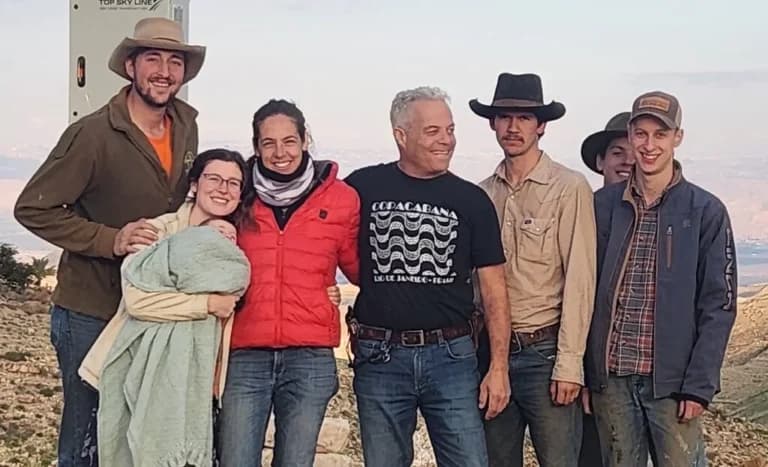
Christian volunteers from Montana have partnered with a therapeutic horse farm in the community of Alon to personally build a unique rehabilitation center for trauma victims and soldiers. The project is being constructed using a traditional American building method. “They love the people of Israel, sometimes more than we love ourselves,” those at the farm say.
The special bond with the volunteers was forged after October 7, when the cowboys came to Israel to help and met Ruthie and Chaim, owners of a therapeutic horse farm in the Binyamin region. The distinctive group from the United States moved onto the farm for three months during the difficult early days of the war, assisting the owners in building and developing the property.
Watch the ILTV story:
“They Would Go Fight in Gaza if They Could”
Recently, the volunteers offered to return to Israel. “Two and a half months ago they called and said, ‘We’re coming back. How can we help?’” Ruthie recalls. “When we told them we were establishing a healing center for soldiers, they immediately showed up. These are the purest people I’ve ever met. They would go fight in Gaza if they could.”
The connection with the cowboys, whose names are Joseph, Jesse, and Levi, is not merely practical, it has become familial. “They leave us speechless with their generosity and their love for Israel,” Ruthie says. “We make Kiddush [blessing on the wine] together on Shabbat, and they cry.”
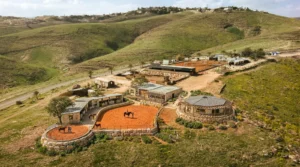
The construction process employs a distinctive technique adapted for extreme conditions, one the volunteers brought from their home in Montana. It is, in Ruthie’s words, a kind of “human machine” of intense physical labor: hand-poured concrete, stones gathered from the mountain, and the artistic exposure of the local stones once the concrete sets. At times the work continues late into the night by flashlight.
“This is how they build their homes in minus 40 degrees in Montana,” Ruthie explains. “Here, that same method will provide perfect insulation against the 45-degree summer heat. Every stone revealed in the walls of the structure is truly handcrafted.”
The new center now being established is intended to address the growing distress in the region and the shortage of available resilience farms. The facility will combine equine-assisted therapy with nature-based healing. Among the instructors are veterans of elite IDF units who themselves underwent rehabilitation at the farm and have since returned to guide the next generation.
Biblical Tradition of Friendship
The sight of Christian cowboys from Montana pouring concrete in the hills of Binyamin is not an anomaly in Jewish history. It is part of an older story woven through Scripture itself, of righteous men and women from the nations who chose to bind their destiny to that of the people of Israel.
When Abraham dwelled by the oaks of Mamre, he did not stand alone. Scripture names his allies, Eshkol, Aner and Mamre, Amorite chieftains who stood at his side when he went to rescue his nephew Lot (Genesis 14). Their loyalty was not incidental but recorded for generations, a testimony to those among the nations who recognized the call of God upon Abraham and aligned themselves with it.
Centuries later, as King David fled Jerusalem during Absalom’s rebellion, support again came again from beyond his immediate circle. Barzillai the Gileadite, an elderly and wealthy man from Rogelim, sustained the king and his men in their hour of need (Samuel II 17). David never forgot that act of kindness. On his deathbed he instructed Solomon to show enduring loyalty to Barzillai’s family (Kings I 2:7).
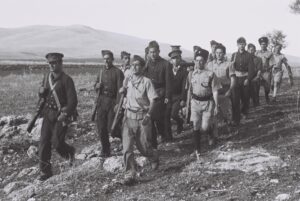
In more recent history, that same pattern appeared in the remarkable figure of Orde Wingate, the British officer affectionately known in Hebrew as “HaYedid,” the Friend. In the 1930s, Wingate threw himself wholeheartedly into the defense of the Jewish community in Mandatory Palestine, training Jewish fighters and openly declaring his conviction that the return of the Jewish people to their land was part of the biblical promise. Though an outsider by birth, he bound himself to Israel’s cause with uncommon courage and conviction.
These friendships are not only individual decisions, but involve covenantal vision. From Genesis onward, God’s promise to Abraham carried a global horizon: “All the families of the earth shall be blessed in you,” Genesis 12:3. The prophets foresaw a day when that blessing would reach its fullness, when the knowledge of the Lord would saturate the world “as water covers the seabed” (Isaiah 11:9).
The partnership of believers from Montana building a healing center in the hills of Binyamin is a small but luminous echo of that promise. It reflects a growing alignment of hearts across nations, not erasing distinctions, but joining in shared devotion to the God of Israel and His promises to mankind.
Discussion0
No comments yet — be the first to share your thoughts.