Hapoel Be’er Sheva Fan Ban Sparks Hamas Sign Row
Israel’s ambassador condemned the exclusion of Hapoel Be’er Sheva supporters in Alkmaar while alleging that people displaying “Go Hamas” signs faced no comparable restriction
Sinai Desk

The Hapoel Be’er Sheva fan ban in the Netherlands drew sharp criticism from Israel after visiting supporters were barred from Thursday’s Europa League match against AZ Alkmaar. Israel’s ambassador to the Netherlands, Zvi Aviner Vapni, accused local authorities of applying a glaring double standard. He said Israeli fans were excluded over “security risks” while people displaying Hebrew signs reading “Go Hamas” faced no similar restriction.
“Bravo to the Mayor of Alkmaar,” Vapni wrote sarcastically. He said “a handful of Israeli fans” could not attend, yet a crowd carrying the pro-Hamas signs was “allowed right in.” His account of the signs was also reported by Israeli media. Local Dutch reporting separately confirmed that pro-Palestinian demonstrations took place near the stadium, while all visiting Israeli supporters were barred.
Amos 5:15 commands, “Hate the evil, and love the good, and establish judgment in the gate.” The verse speaks directly to the responsibility of public authorities to distinguish between threat and victim. That distinction sits at the center of Israel’s anger over the events in Alkmaar.
Hapoel Be’er Sheva Fan Ban Cited Security Risks
Alkmaar authorities classified the October 15 match as a “very high risk” event because of the geopolitical climate. The municipality, police and public prosecutor decided in September that no Hapoel Be’er Sheva away fans could enter the stadium. Officials cited planned pro-Palestinian demonstrations and concerns about possible confrontations.
The decision went beyond UEFA’s own assessment of the visiting supporters. Dutch broadcaster NOS reported that UEFA had assigned Hapoel fans a “medium risk profile.” Nevertheless, Alkmaar authorities concluded that the wider environment surrounding the game created a much higher security threat.
Israel challenged that reasoning before kickoff. Foreign Minister Gideon Sa’ar raised the issue with his Dutch counterpart, while Israel’s embassy pressed Alkmaar officials to reverse the decision. Israeli diplomats argued that authorities should protect visiting fans rather than exclude them because extremists might target or confront them.
The ban remained in place. Hapoel supporters who traveled to the Netherlands could not enter the stadium, and the away section remained empty as AZ defeated Hapoel 2-1. A small group of Israeli supporters instead gathered peacefully in Alkmaar before the match.
Hamas Signs Sharpen Israeli Anger
The ambassador’s strongest criticism centered on the reported Hamas signs. The Netherlands officially describes Hamas as a terrorist organization. A 2026 Dutch foreign-policy document states explicitly that the “terrorist organisation Hamas” can have no role in a future Palestinian political settlement.
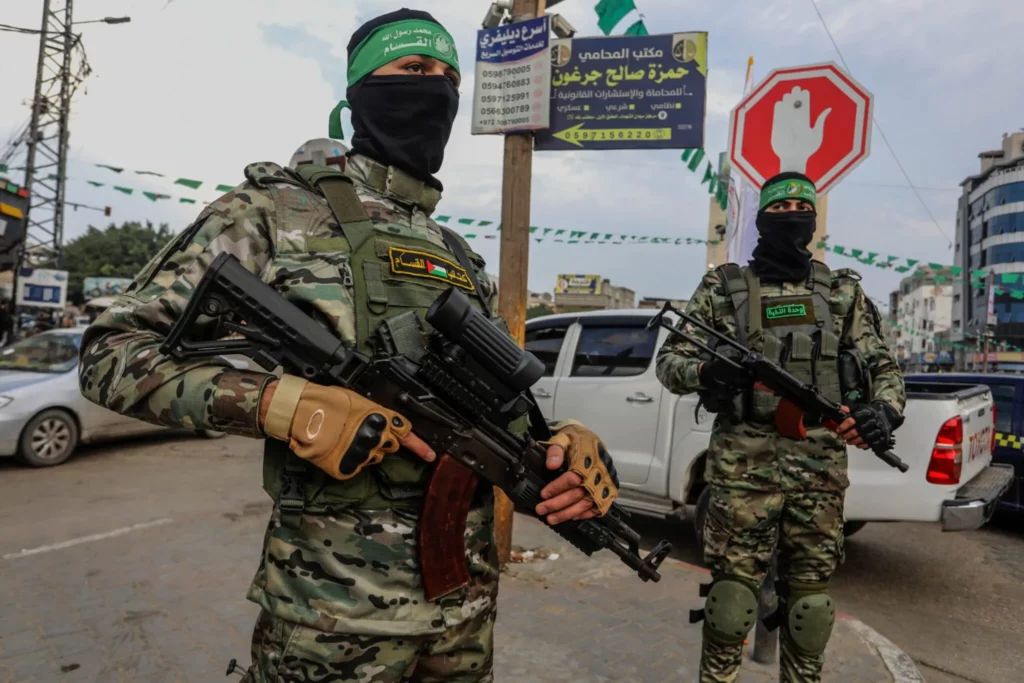
That made the scene especially provocative from Israel’s perspective. Hamas carried out the October 7, 2023 massacre, murdering civilians and taking hostages into Gaza. Vapni described that day as the deadliest for Jews since the Holocaust and said the contrast in Alkmaar showed that “something is deeply broken in the Netherlands.”
It is important to distinguish the ambassador’s allegation from what Dutch reports independently established. Local coverage confirmed pro-Palestinian protests near the stadium and the blanket ban on Israeli supporters. The specific claim that people carrying “Go Hamas” signs were allowed into the match came from Vapni’s statement and should be understood as his account of the incident.
The controversy also follows a difficult history surrounding Israeli soccer fans in the Netherlands. Alkmaar officials explicitly considered the violence surrounding the 2024 Ajax-Maccabi Tel Aviv match in Amsterdam when assessing the risk. Israeli supporters were attacked before and after that game, while some Maccabi fans were also reported to have shouted offensive slogans.
That history made security planning necessary. Israel’s criticism is that authorities responded by excluding the Israeli side entirely rather than confronting those threatening disorder.
The symbolism also recalls “October 7 Anniversary: Hamas Celebrates Attack.” In that story, Hamas openly praised the 2023 massacre as a military achievement while Hamas-linked imagery continued appearing at Western demonstrations. The Alkmaar controversy raises the same underlying question: how openly can symbols or slogans associated with a designated terrorist organization enter European public spaces while Israelis themselves face restrictions justified by security concerns?
The issue reaches beyond soccer. Dutch authorities themselves have warned about jihadist extremism and the glorification of violence. Government policy says the Netherlands acts against incitement, recruitment and links to terrorist activity. That makes any public display apparently praising Hamas politically sensitive, especially when Israeli visitors face exclusion from the same event environment.
When Security Measures Punish the Threatened
Israel’s covenantal mission before God places the defense of Jewish life alongside the demand for justice. Jewish sovereignty means Jews no longer have to accept exclusion or vulnerability as the unavoidable price of living among hostile crowds. When Israelis travel abroad, however, their safety still depends on foreign governments enforcing their own laws fairly.
America’s covenantal tradition approaches the same issue through equal protection, religious liberty and opposition to political violence. The United States has repeatedly confronted the question of how democracies protect free expression without normalizing support for terrorist organizations. That challenge now confronts European allies as anti-Israel activism increasingly intersects with Jewish security.
The Netherlands has the right and responsibility to prevent violence at sporting events. The dispute is over whom its security policy burdened. Israeli officials argue that Alkmaar protected public order by excluding the potential targets rather than confronting the people threatening disorder.
That perception is why the incident has become much larger than a football match. At a time when Jewish communities across Europe are watching antisemitism and anti-Israel hostility closely, a ban aimed exclusively at Israeli fans carries consequences beyond the stadium.
The match ended after 90 minutes. The argument over what happened around it will last much longer.
For more stories on Israel, faith, and the values behind the headlines, follow Sinai on Facebook and Instagram.
Discussion0
No comments yet — be the first to share your thoughts.