Gaza City Operation Captures Senior Hamas Official
A Gaza City operation captured a senior Hamas security official after a covert raid triggered heavy gunfire and Israeli airstrikes in the city’s west

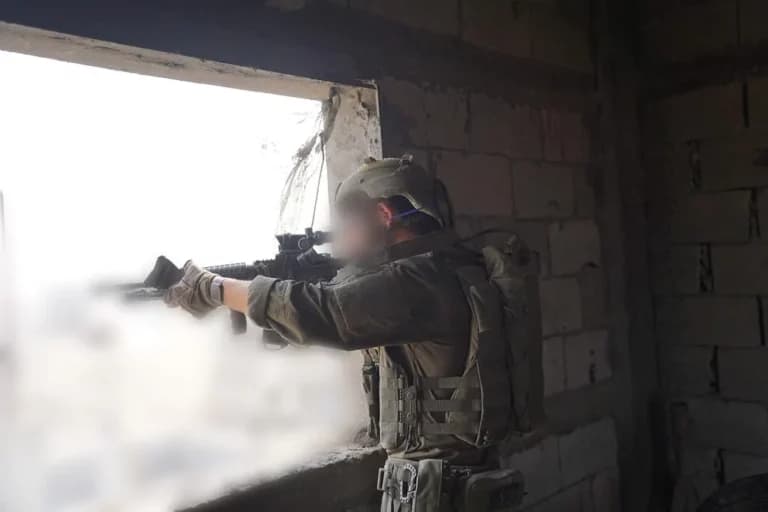
A Gaza City operation ended with the capture of a senior Hamas official Tuesday after a covert force was discovered in the western part of the city, triggering a major firefight and Israeli airstrikes. Defense Minister Israel Katz confirmed that a senior Hamas terrorist had been apprehended. An Israeli security official later told Reuters that the detainee heads Hamas’s internal security service.
The raid unfolded amid more than a dozen reported strikes around the Al-Katiba area. Palestinian reports described intense gunfire, drones operating overhead, and smoke shells near the Shati refugee camp. The IDF confirmed striking several targets “to remove threats to security forces” and said no Israeli troops were wounded.
Psalm 34:15 commands, “Seek peace and pursue it.” The wording matters in a conflict where peace cannot mean allowing armed organizations to rebuild unchecked. Israel’s stated policy is to pursue emerging threats before they develop into another attack on Israeli communities.
Gaza City Operation Turns Into a Firefight
Accounts from inside Gaza initially described an Israeli special force entering western Gaza City. Other reports suggested the force may instead have consisted of Palestinians from an Israeli-backed anti-Hamas militia. Reuters reported that the operation was exposed while underway, prompting Israeli aircraft to provide cover during the withdrawal.
Witnesses reported at least 12 strikes near Al-Katiba. Gaza medics told Reuters that three Palestinians, including two children and a woman, were killed during the bombardment. Several others were wounded. A child was killed separately in Israeli fire near Deir al-Balah in central Gaza.
Katz announced the capture while visiting Netiv HaAsara near the Gaza border.
“A short while ago, a senior Hamas terrorist was arrested,” Katz said. “This is our policy: We do not wait for threats, but rather pursue Hamas terrorists, thwart them, and destroy their terror infrastructure.”
The operation is notable because Hamas’s internal security apparatus plays a central role in maintaining the organization’s control inside Gaza. An Israeli security official told Reuters that the detainee was the head of that apparatus. Katz himself did not publicly identify the man.
Conflicting Claims Over the Captured Official
Gazan sources offered several conflicting versions as the operation unfolded. Early reports claimed the mission had failed and that its intended target had survived. Hamas-affiliated outlets even portrayed the incident as an Israeli embarrassment after the covert force was discovered.
Later reports acknowledged that someone from Hamas’s Internal Security Apparatus had been taken. According to the Gazan sources cited during the incident, the detainee was identified as Moein al-Arabid. Those reports described him as a commander in Hamas’s internal security structure. His identity has not yet been independently confirmed.
Al Jazeera also cited a Gaza security source denying that the head of the Internal Security Apparatus had been arrested. That account nevertheless acknowledged that a special force had seized one of the organization’s officers after his home was struck. The source said the officer’s wife was killed and that Israeli aircraft provided covering fire during the force’s withdrawal.
That creates a notable contradiction with the earlier claim that the operation had simply failed. It is not clear whether Al Jazeera’s separate reports relied on the same security source.
The difference between the early Palestinian narrative and Israel’s later confirmation also illustrates the information battle surrounding operations inside Gaza. In the opening minutes of a covert raid, incomplete reports can quickly become declarations of success or failure before the basic facts are established.
That wider struggle over how the Gaza war is described also connects naturally to “Hakan Fidan Calls Netanyahu ‘Genocidal Murderer.’” Turkey’s foreign minister portrayed Netanyahu as the central threat to regional security. Tuesday’s operation highlights the security reality Israel points to in response: Hamas retains an organized internal apparatus, and Israeli forces continue pursuing senior members even under the current ceasefire framework.
Security Means Acting Before the Next Attack
The United States and Israel share a covenantal tradition that connects freedom with responsibility before God. Both nations have learned that protecting a free society sometimes requires intelligence, deterrence, and action before an enemy has the opportunity to strike. Waiting for terrorism to reach civilians is not the same as pursuing peace.
That principle is particularly sharp for Israel after October 7. Israeli sovereignty carries the responsibility to ensure that Hamas cannot regain the freedom to organize another large-scale attack. American counterterrorism policy has often rested on a similar conviction: hostile networks should not be given sanctuary simply because confronting them is difficult.
The Gaza City operation reflects that doctrine in unusually visible form. A covert force entered an area under Hamas influence, came under threat, and received Israeli air support. By the end of the incident, Israel said a senior Hamas figure was in custody and no Israeli forces had been injured.
Important details remain disputed, including the precise identity of the detainee and who physically carried out the raid. What is no longer seriously disputed is that someone senior within Hamas’s security structure was captured during a major operation in western Gaza City.
For Israel, Katz made the policy explicit: do not wait for the threat to arrive at the border. Pursue it first.
For more stories on Israel, faith, and the values behind the headlines, follow Sinai on Facebook and Instagram.
Discussion0
No comments yet — be the first to share your thoughts.