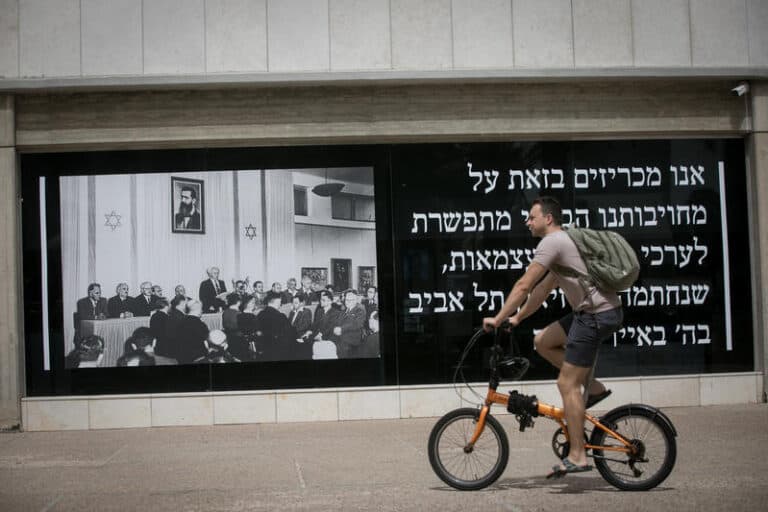

People walk by a large photograph depicting the Declaration of the State of Israel, by first premier David Ben Gurion, in Tel Aviv. September 12, 2023. | Photo: Miriam Alster/FLASH90
Takeaways
- Jewish prayer never stopped facing Jerusalem, even 2,000 years after exile began.
- “Next year in Jerusalem” isn’t a slogan, it’s been said at Passover tables for centuries.
- By the 1800s, fewer than 25,000 Jews remained in the land, yet the community never fully vanished.
- Modern Zionism turned an ancient prayer into a political movement in 1897.
- Israel declared independence on May 14, 1948, and was invaded by five Arab armies the next day.
Part 1 ended with Rome renaming the land to erase the Jewish connection. That Jewish woman on the Western Wall Tunnel Tour with me, the one who whispered “And we’re still here,” stayed on my mind for weeks after that trip. I kept thinking about what actually kept a scattered people connected to one small piece of land for over 2,000 years (after exile began).
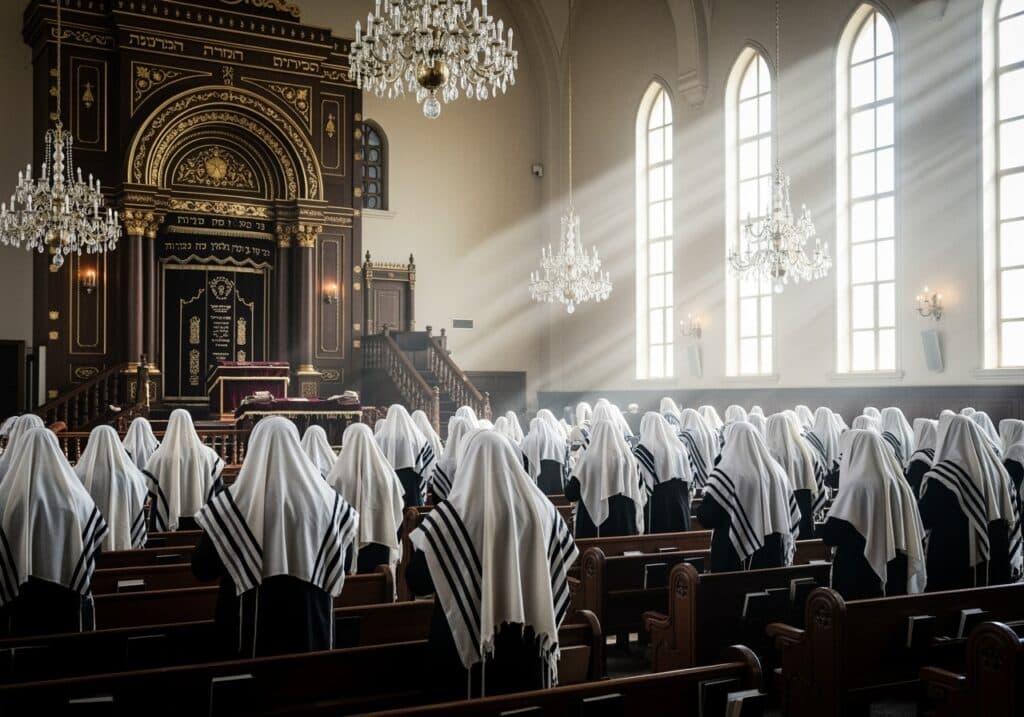
The answer turned out to be something Jews did without fail, morning, afternoon, and evening: they prayed, and every single time, they faced Jerusalem.
A Prayer That Never Let Go
Jewish prayer has always faced a calculated, specific direction toward Jezrusalem. Someone in New York faces east, someone in Yemen faces north, someone in Poland faces southeast. The destination never moves.
The Passover Seder ends with “Next year in Jerusalem.” Yom Kippur closes the same way. These aren’t poetic flourishes tacked onto a holiday. Scholars of Jewish liturgy point out that exile, Jerusalem, and return form the backbone of rabbinic prayer itself, woven into daily worship for two millennia straight.
📖 For a deeper look at the mystery of the Temple’s Ark of the Covenant, read here.
Life Scattered, Memory Intact
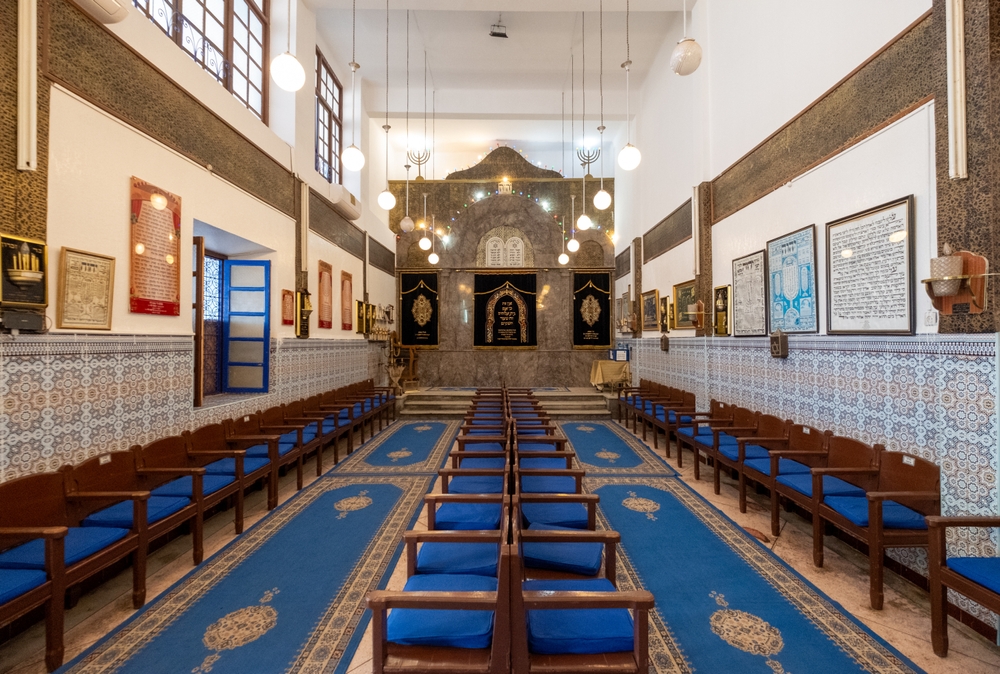
Jewish communities built full lives across Babylon, Persia, Spain, North Africa, and later Europe. Synagogues went up, schools opened, courts functioned, and religious poetry got written in half a dozen languages.
None of it looked the same twice. Spain’s Jewish community thrived for centuries before the 1492 expulsion. Communities in Eastern Europe faced pogroms and forced conversions that others never experienced. Through all of it, Hebrew prayer and the memory of the land held steady.
Small Jewish communities also kept living in the land itself the whole time, in Jerusalem, Safed, Tiberias, and Hebron. By the 1800s, Britannica puts the number at under 25,000 Jews still there, mostly clustered in Jerusalem. Small, but never zero.
From Prayer to Politics
Theodor Herzl gave that ancient longing a modern engine. In 1897, he ran the First Zionist Congress in Basel, Switzerland, calling for a legally recognized Jewish homeland in the historic land.
Not every Jew backed the plan. Some pushed for integration where they lived, others leaned socialist, some just moved to America. But rising pogroms in Eastern Europe kept proving the same point: minorities without a state of their own stay vulnerable.
Britain, the Holocaust, and a Vote at the UN
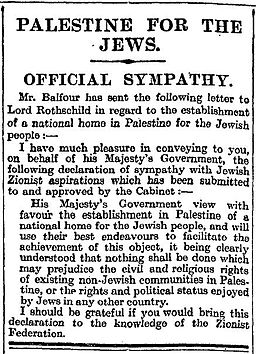
Britain’s 1917 Balfour Declaration backed a Jewish national home in Palestine, while promising to protect the rights of non-Jewish residents already there. Arab opposition grew through the following decades, and violence flared more than once.
Then the Holocaust happened, and the argument for Jewish sovereignty became impossible to ignore. In 1947, the UN voted to partition the land into Jewish and Arab states. Jewish leadership accepted it. Arab leaders rejected it.
Independence, and an Immediate War
David Ben-Gurion declared the State of Israel on May 14, 1948, in Tel Aviv. The declaration named the land as the birthplace of the Jewish people and promised equality and religious freedom to everyone living there.
The United States recognized Israel that same day. On May 15, five Arab armies invaded, and the new state fought for its life before it was even a day old. It won that fight and kept standing.
Remember the woman from Part 1, standing in the Western Wall tunnel, whispering “And we’re still here”? She wasn’t just talking about old stones. She was talking about a people who kept facing Jerusalem through exile, pogroms, and the Holocaust, and then built a country on that same ground. The prayer got answered.
Want to keep reading? For a deeper look at the First Temple Menora, read here about the menorah’s Divine ability to light up the world. Explore more on faith, values, and the Land of Israel at Sinai Project.
Discussion0
No comments yet — be the first to share your thoughts.