
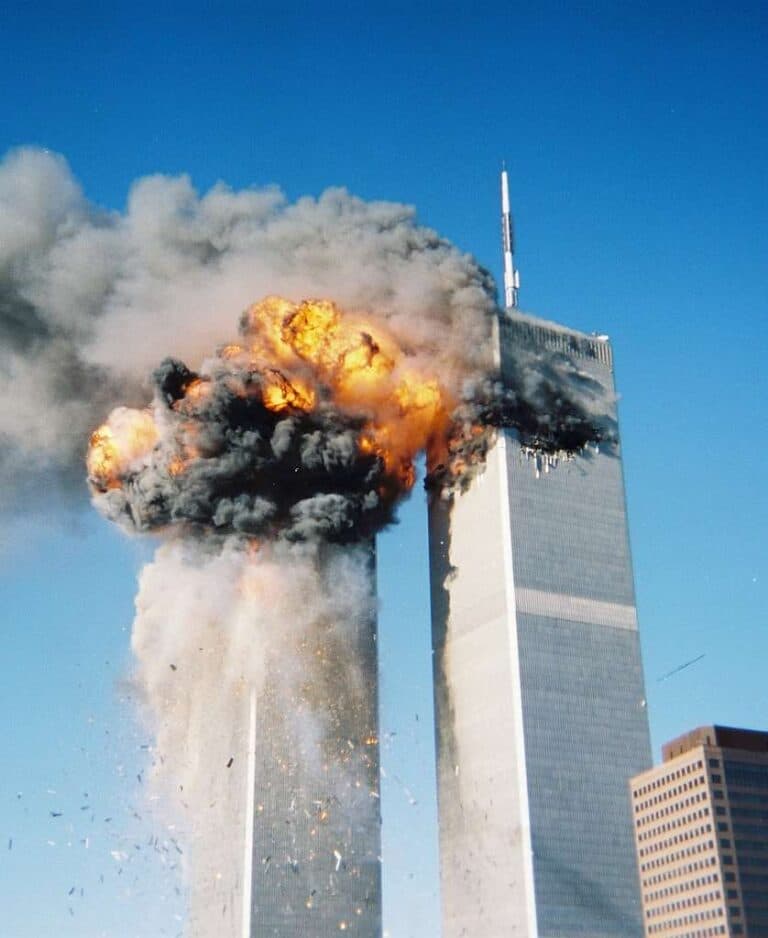

Twin Towers explosion on 9/11, lest we forget | Photo: Picryl Commons
Takeaways
- Texas approved new high school standards that name radical Islam as the ideology behind 9/11.
- Students will study the Muslim Brotherhood, al-Qaeda, and ISIS as one continuous extremist thread.
- The curriculum traces jihad’s role in the conquest of ancient lands, not just modern headlines.
- Standards phase into classrooms starting the 2030-31 school year.
- This is a template other states can copy immediately.
A Curriculum That Finally Tells the Truth
In early September 2026, the Texas State Board of Education approved something most school boards have spent two decades avoiding. The new standards require teachers to explain that the September 11 attacks were motivated by radical Islam, not some vague, unnamed grievance.
That single word choice matters more than people realize. For years, textbooks described 9/11 in passive language, as if the attacks simply happened rather than being planned, funded, and carried out by people acting on a specific worldview. Texas broke that pattern.
What Students Will Actually Learn
The updated lessons run across U.S. History, U.S. Government, World History, and World Geography. In World History classes, students will trace the rise of radical Islam through the Muslim Brotherhood, al-Qaeda, 9/11, and ISIS as connected chapters of the same story.
That’s a meaningful shift. Most curricula treat these as isolated news events. Texas is teaching them as one continuous ideology, which is closer to how the people who study terrorism for a living actually understand it.

Going Back to the Root
The Texas curriculum standards don’t stop at 2001. They also require teaching how early Islamic military campaigns targeted ancient religious communities, how slavery became normalized under jihadist expansion, and how conquest pushed into lands including Jerusalem, Syria, and Egypt. They also require teaching how early Islamic military campaigns targeted ancient religious communities, how slavery became normalized under jihadist expansion, and how conquest pushed into lands including Jerusalem, Syria, and Egypt.
This is where the curriculum earns real credibility. This connects modern terrorism to over a thousand years of history. The ideology behind 9/11 has roots stretching back over a thousand years, and ancient communities in that region have faced this pattern before.
There’s an old teaching worth remembering here, rooted in the account of King Saul sparing a cruel enemy king in 1 Samuel 15: “Whoever is kind to the cruel will end up cruel to the kind.” Misplaced mercy toward ideologies built on conquest simply delays the reckoning.

Why Naming Things Correctly Protects Free Societies
Vague language doesn’t protect anyone. When schools describe terrorism without naming its ideological source, students grow up unable to recognize the same pattern when it resurfaces. Texas is betting that clarity builds better citizens than comfort does.
The standards distinguish between individual believers and extremist doctrine, which matters. Naming radical Islam as a threat isn’t the same as condemning an entire faith community, and the curriculum is careful about that line.
The Pushback Is Already Coming
Expect resistance from groups who’d prefer a softer, more equivalent framing of world religions in the classroom, regardless of the historical record. That pressure isn’t new, and Texas isn’t the first state to feel it.
What’s different now is that a board with real influence over textbook publishing just refused to bend. Texas has historically shaped what appears in classrooms nationwide, since publishers often build national editions around Texas-approved content.
A Marker Other States Can Follow
The rollout starts with younger grades in the 2030-31 school year and moves upward from there. That’s a slow timeline, but it gives other states years to study the standards and adopt something similar.
For families who’ve watched history get sanitized in classrooms for a generation, this is a rare, concrete win. It puts historical fact ahead of comfortable ambiguity, and it hands the next generation the vocabulary to recognize a dangerous ideology instead of a euphemism for it.
Discussion0
No comments yet — be the first to share your thoughts.