Uprooted Residents of Homesh, Samaria, Plant Olive Trees Upon Return Home
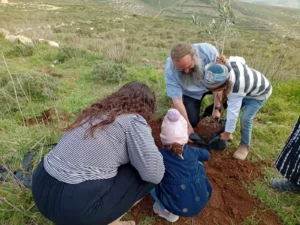
Several weeks after receiving official recognition, and alongside preparations to establish themselves once again on the land in the coming weeks, former residents of Homesh planted olive trees on the site where the renewed community is to be built. Ahead of reconstruction, Homesh families are calling on additional families to come and join them, and

Hadas Amram
Opinion contributor··4 min read
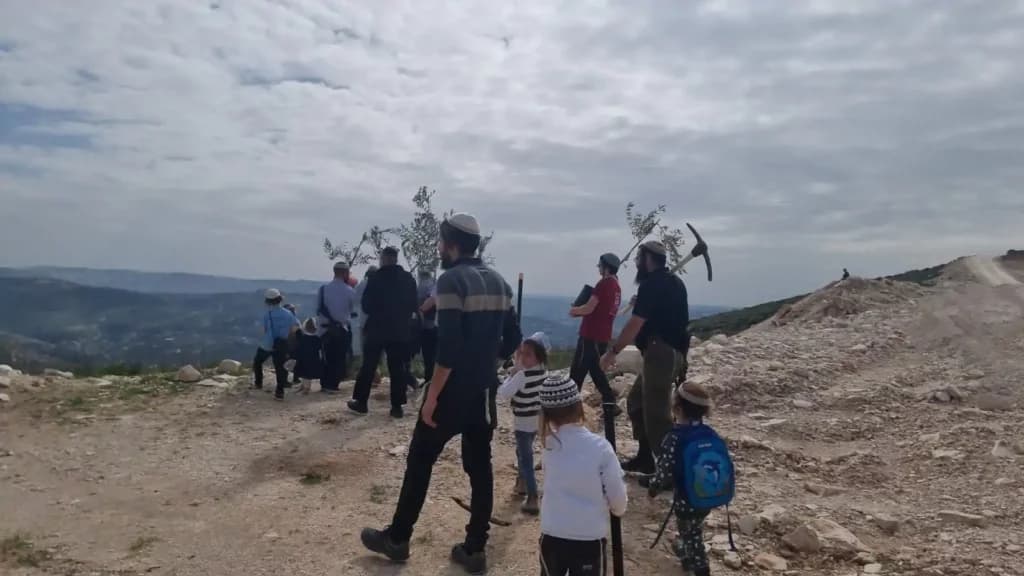
Several weeks after receiving official recognition, and alongside preparations to establish themselves once again on the land in the coming weeks, former residents of Homesh planted olive trees on the site where the renewed community is to be built. Ahead of reconstruction, Homesh families are calling on additional families to come and join them, and take part in renewing the Jewish settlement of northern Samaria.
“We will Continue to Put Down Roots”
Benny Gal, who was evacuated from Homesh during the 2005 Disengagement Plan, said:
“The struggle to return to Homesh and to erase the stain of expulsion and uprooting is part of the historic process of the Jewish people returning home.
Our vision is to establish a thriving community, a community that lives a life of Torah and pioneering spirit. With G-d’s help, we will continue to put down roots in northern Samaria.”
Yossi Dagan, head of the Samaria Regional Council, added:
“The return to Homesh is a victory of spirit and justice. Planting trees in a place that was forcibly uprooted is a clear declaration regarding the future of Jewish settlement in northern Samaria. This is a profound correction of the sin of expulsion, and proof that when the people of Israel fight for their land with perseverance and faith, they ultimately return to it and cause new life to grow.”
Sa-Nur Renewed as Well
Another abandoned community in northern Samaria saw a parallel reversal last month. In nearby Sa-Nur, also evacuated during the 2005 Disengagement Plan, the IDF is in the midst of returning in force. The Menashe Brigade, uprooted two decades ago and relocated to central Israel, is being rebuilt in northern Samaria, with a new company outpost already under construction.
The move, led by senior government and defense officials, is part of a multi-year plan estimated at roughly 800 million shekels and designed to support both renewed Israeli presence and the return of civilian families. Officials emphasized that military deployment and settlement go hand in hand, marking what they describe as a strategic and moral correction of the withdrawal – and a decisive step toward restoring security and stability across the region.
Homesh History
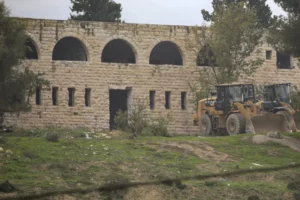
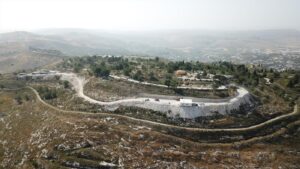
The community of Homesh was originally established in 1980 as a secular communal settlement affiliated with Israel’s National Workers’ Movement, on a strategic ridgeline in the heart of Samaria, north of the Jewish town of Shavei Shomron (Returnees to Samaria) and northwest of the city of Shechem (Nablus), overlooking Route 60. At its peak, the community was home to roughly 70 families before it was evacuated and demolished in 2005 as part of Israel’s Disengagement Plan.
The site’s name preserves an ancient legacy, derived from the Greek Pentakomia—“five villages”—a designation dating back to the Mishnaic and Talmudic periods and recorded in an ancient synagogue mosaic that outlines the biblical borders of the Land of Israel. Situated some 650 meters above sea level, Homesh commands sweeping views of northern Samaria, the Galilee, Mount Hermon, Mount Carmel, and Israel’s coastal plain.
Since the forced evacuation, Jewish presence at the site has persisted, most notably through the establishment of the renewed Homesh Yeshiva in 2009, which has maintained continuous study and residence despite repeated evacuations. In recent years, following government decisions reversing key elements of the Disengagement, the site has seen growing permanence, with restored access, permanent structures, and the gradual return of civilian life.
In the latest positive development, the Israeli Ministry of Interior restored Homesh’s community symbol, which had been frozen for nearly 20 years, thus returning the community to official and recognized status. Alongside Homesh, community symbols were also granted to other communities such as Yonadav in the Hebron Hills, and Bitron in the Jordan Valley.
Homesh residents celebrate the planting with song : “It is good to thank the Lord”
Psalms 126:5 teaches us: “Those who sow with tears will reap with song”. The residents of Homesh kept their faith to the land despite their removal, sowing their steadfastness with bitter tears. Today they reap their return with song, and elevate the cycle by immediately toiling to sow again, this time olive trees.
May they merit to reap the harvest of the olive branches both in fruit and in true peace upon the land.
Discussion0
No comments yet — be the first to share your thoughts.