Turning the Tide: Nearly 50% Drop in Palestinian Construction Rate in Judea and Samaria
Regavim Movement reports a sharp decline in illegal Palestinian construction in Area C following increased enforcement, heightened security presence, and a severe economic crisis within the Palestinian Authority, but warns: the struggle is far from over. Area C, comprising roughly 60% of Judea and Samaria, is under full Israeli administrative and security control, as per

By Menachem Marton
Opinion contributor··5 min read
Regavim Movement reports a sharp decline in illegal Palestinian construction in Area C following increased enforcement, heightened security presence, and a severe economic crisis within the Palestinian Authority, but warns: the struggle is far from over.
Area C, comprising roughly 60% of Judea and Samaria, is under full Israeli administrative and security control, as per the Oslo Accords. Today (Sunday), the Regavim Movement published its fourth monitoring report in their “War of Attrition” series, according to which the 2025 updated mapping data points to a significant shift in trend in illegal Palestinian construction within Area C. After years of rapid expansion in illegal Palestinian construction throughout the area, the rate of new Palestinian construction has dropped dramatically in comparison to peak years.
According to the report, more than 600 new structures per month were recorded in 2022, while in 2025, the monthly average stands at approximately 220 structures – a decline of nearly 50 percent.
What Led to the Slowdown?
Regavim attributes the decline to a combination of parallel processes. Chief among them is a policy shift that included intensified enforcement following the establishment of the Settlement Administration under Minister Bezalel Smotrich, alongside real-time reporting of construction violations by land departments within regional councils.
Another major factor is the ongoing “Swords of Iron” war, which has turned Judea and Samaria into an active security arena. Increased military presence and movement restrictions have hindered the advancement of large-scale construction projects. These developments have been compounded by the deepening economic crisis within the Palestinian Authority, significantly reducing the resources allocated to strategic construction initiatives.
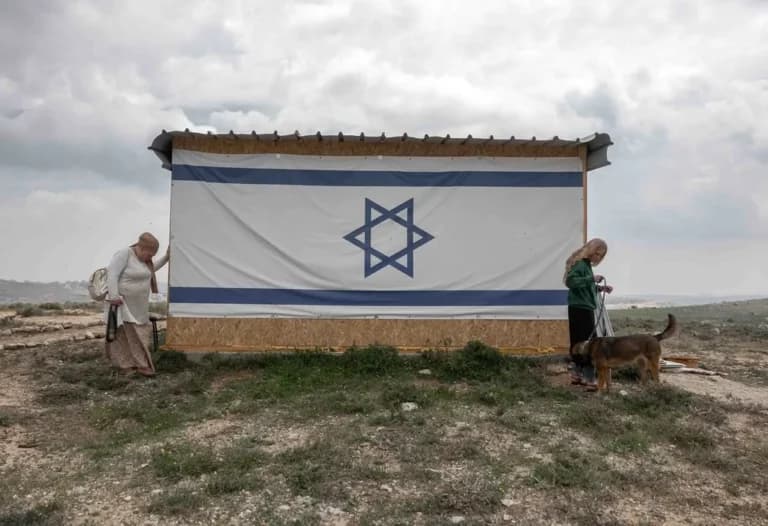
Alongside the decline in Palestinian construction, the report also notes an increase in unregulated construction within the Jewish sector. According to Regavim, the majority of this data stems from the expansion of agricultural farms – initiatives that are approved and coordinated with state authorities but not yet approved under formal statutory regulation.
These farms now account for approximately 70 percent of new construction within the Jewish sector. Regavim maintains they are reshaping reality on the ground by creating a continuous physical presence and disrupting the territorial contiguity of Palestinian land takeover.
Meir Deutsch, Director General of Regavim, says Israel is at a decisive crossroads. “When the state acts with determination, there are results,” he said. “But illegal construction has not been fully halted, and the disparities created over many years remain wide.”
Regavim is calling for an expansion of demolitions targeting strategic structures, destruction of the infrastructure that facilitates illegal land seizures, reinforcement of formal land registration processes, and the restoration of deterrence through the confiscation of heavy construction equipment. Only such measures, the movement argues, will turn the current slowdown into a complete halt.
The Ideological Context
Despite the decline in construction rates, Regavim stresses that the cumulative picture remains troubling. According to the report, land currently under Palestinian Authority control in Area C totals roughly 100,000 dunams – an area nearly twice the size of the municipal territory of Tel Aviv. The land struggle in Judea and Samaria cannot be separated from the declared intentions and ideological messaging of the Palestinian Authority leadership.

Last week, the movement released documentation of content that is systematically disseminated through official pages associated with Palestinian Authority security forces’ training facilities. These materials portray Israeli cities as future targets of “liberation.”
The videos, published regularly on Fridays and accompanied by nationalist songs, reference Israeli cities such as Tiberias, Be’er Sheva, Acre, and Haifa — the latter explicitly labeled “occupied Haifa.” According to Regavim, these are not marginal or isolated incidents, but educational and ideological messages promoted by official PA bodies.
“The same leadership that tells the world it seeks a state only within the 1967 lines is, in practice, educating toward the conquest of Haifa, Jaffa, and Be’er Sheva,” Regavim stated. “This has never been a debate about Shechem or Jenin — it is about the very existence of the State of Israel. This is not a civilian police force, but an army waiting for its moment.”
You know those aunties who spam family WhatsApp groups with glittery “Shabbat shalom” stickers?
Meet the PA’s happy weekend videos: fantasies about conquering Acre, Haifa, Tiberias, and Be’er Sheva.
The PA leadership keeps selling the world, and even parts of Israeli society,… https://t.co/mBsdIXF95q
— Regavim (@RegavimEng) January 28, 2026
The current drop in construction rates, then, can be seen as a significant achievement, but far from the final word. The broader context is essential to understanding that the battle over land in Area C is not as a purely local or planning issue, but part of a comprehensive struggle over borders, sovereignty, and national vision.
In 2009, then-Prime Minister of the Palestinian Authority Salaam Fayyad published a plan encapsulating the vision and blueprint for the de facto, unilateral creation of a Palestinian state, titled “Palestine: Ending the Occupation, Establishing the State.” The plan declared
that it would work toward establishing “an independent Arab state with full sovereignty over all of the territory of the West Bank and Gaza Strip in the 1967 borders, with Jerusalem as its capital.” The Palestinians have been assiduously pursuing this goal in Judea and Samaria through large-scale illegal construction, massive agricultural projects in strategic locations and “lawfare” activity aimed at preventing Israeli law enforcement.
Israel however, is fulfilling a blueprint that goes back far beyond 2009, foretold in the holy words of Scripture:
“The days are coming,” declares the Lord,
“when the reaper will be overtaken by the plowman
and the planter by the one treading grapes.
New wine will drip from the mountains
and flow from all the hills,
and I will bring my people Israel back from exile.
“They will rebuild the ruined cities and live in them.
They will plant vineyards and drink their wine;
they will make gardens and eat their fruit.
I will plant Israel in their own land,
never again to be uprooted
from the land I have given them”
(Amos 9: 13-15 NIV)
Discussion0
No comments yet — be the first to share your thoughts.