
Rubio Backs Lebanon Push To Disarm Hezbollah
Rubio met Lebanese President Joseph Aoun in Washington and backed Lebanon’s efforts to restore sovereignty, recover economically, and disarm Hezbollah

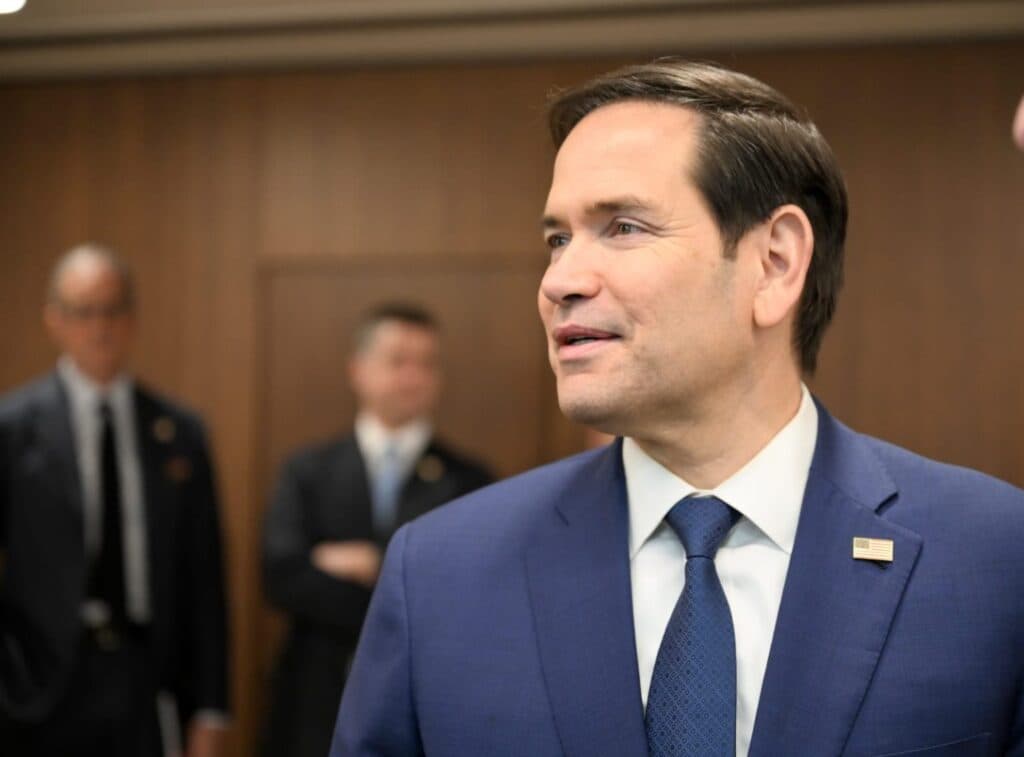
Secretary of State Marco Rubio met Lebanese President Joseph Aoun in Washington to discuss the trilateral framework agreement and reaffirm American support for Lebanon’s effort to restore sovereignty and disarm Hezbollah.
According to the U.S. State Department readout, Rubio and Aoun discussed implementation of the framework agreement. Rubio also reaffirmed U.S. support for the Lebanese government’s efforts to achieve peace, promote economic recovery, restore sovereignty, and disarm Hezbollah.
The Tanakh says, “Violence shall no more be heard in your land, devastation or destruction within your borders.” That verse fits Lebanon’s central test. A country cannot enjoy peace while an armed terror movement holds its borders hostage.
Trilateral Framework Agreement
The trilateral framework agreement places Lebanon’s sovereignty at the center of the diplomatic track.
For Washington, the meeting showed continued American pressure to move Lebanon away from militia rule and toward state authority. For Jerusalem, the issue is not theoretical. Hezbollah has used Lebanese territory for years as an Iranian-backed front against Israeli civilians. Therefore, any serious framework must address Hezbollah’s weapons, infrastructure, and ability to decide when Lebanon goes to war.
Rubio’s message matters because it links peace to disarmament. Economic recovery cannot stand on the same ground as Hezbollah’s missile arsenals. Lebanese sovereignty cannot coexist with an Iranian proxy that answers to Tehran rather than Beirut.
Lebanon, Israel, And Regional Pressure

That regional pressure also connects directly to “Kuwait Says Iran Hit Power And Desalination Plant.” Kuwait says Iran struck power and water desalination infrastructure for the second time in two days, raising new concerns for U.S., Israeli, and Gulf security.
Iran’s regional strategy does not stop at Israel’s northern border. It stretches through Hezbollah in Lebanon, militias in Iraq and Syria, the Houthis in Yemen, and direct pressure on Gulf states. As a result, disarming Hezbollah is not only a Lebanese issue. It is part of the wider struggle against Iranian expansion.
For the United States, a sovereign Lebanon would reduce Iran’s reach and strengthen regional stability. For Israel, it would reduce the threat of another northern war and create space for a more secure border.
However, the framework will only matter if it leads to enforcement. Statements about sovereignty must become action on the ground.
Sovereignty Under God And Allied Resolve
The United States and Israel share a covenantal understanding before God that joins liberty, justice, and the duty to protect life.
Both nations believe that peace requires responsibility. Both understand that free countries must defend their citizens against terror. Both also know that sovereignty means legitimate governments, not armed factions, must control borders, weapons, and national decisions.
That shared covenant appears clearly in this story.
America is backing a Lebanese state that must reclaim authority from Hezbollah. Israel is demanding a northern frontier where families can live without Iranian-backed missiles pointed at their homes. Both goals serve the same moral and strategic purpose: peace through real sovereignty, not surrender to terror.
Rubio’s meeting with Aoun therefore carries significance beyond diplomacy. It tests whether Lebanon can become a country governed by its institutions instead of by Hezbollah’s guns.
For Israel, that test will shape the future of the northern border. For America, it will show whether Washington can help turn regional pressure into a durable political outcome.
Ultimately, the path to peace runs through one basic principle: Hezbollah must not remain stronger than the Lebanese state.
For more stories on Israel, faith, and the values behind the headlines, follow Sinai on Facebook and Instagram.
Discussion0
No comments yet — be the first to share your thoughts.