New Mexico Joins Growing U.S. Initiative to Affirm the Biblical Heartland in Official Language
A bill recognizing Judea and Samaria has been introduced in New Mexico, making it the 16th U.S. state to advance the initiative. According to its sponsors, the move is intended to change the official terminology used in public documents, replacing the term “West Bank” with “Judea and Samaria.” The advocacy campaign behind this effort has

By Linoy Reter
Opinion contributor··5 min read
A bill recognizing Judea and Samaria has been introduced in New Mexico, making it the 16th U.S. state to advance the initiative. According to its sponsors, the move is intended to change the official terminology used in public documents, replacing the term “West Bank” with “Judea and Samaria.”
The advocacy campaign behind this effort has been years in the making, built through sustained engagement with American lawmakers. Activities have included hosting dozens of delegations and tours in Samaria, holding meetings with legislators in state houses and senates, organizing dedicated conferences in various states and in Washington, D.C., and partnering with additional allies, including evangelical pastors.
At the heart of these initiatives is a push to change official terminology in U.S. public documents, discontinuing use of the term “West Bank” in favor of “Judea and Samaria.” The effort is being promoted by American Friends of Judea and Samariaת in cooperation with the Foreign Relations Department of the Samaria Regional Council and led by council head Yossi Dagan.
Struggle for Sovereignty
“We are concluding a year of struggle for sovereignty and a struggle for truth in the face of falsehoods,” said Samaria Regional Council head Yossi Dagan. “Judea and Samaria is the land of the Bible and the foundation of the history and values of the Jewish people and the State of Israel. Recognition of sovereignty in this region reflects historical justice and strengthens Israel’s security, and by extension, the security of the world.”
“We are witnessing an extraordinary awakening among our friends in the United States, a strategic process that begins with changing the language in official documents and ends with unwavering recognition of our right to this land. The fact that the law has passed in Arkansas and has been introduced in 16 additional states proves that the people of Israel are not alone in the battle for historical truth.”
Arkansas has already passed similar legislation, and in additional states such as Arizona, Virginia, Utah, South Carolina, and West Virginia, the bills have been formally introduced and are currently at various stages of the legislative process.
The Call to Change All Official Documents
In a November of last year, discussions took place in the Knesset regarding similar terminology changes in Israeli law, while a parallel initiative was being advanced in the United States. The American proposal called for all official U.S. documents to exclusively use the term “Judea and Samaria”, avoiding the term “West Bank” or any alternative designations.
The American proposal mirrored the legislation discussed in Israel’s Constitution Committee, which would require that any Israeli statute referring to the area use only the term “Judea and Samaria,” and would amend existing laws whose titles currently include the term “West Bank.” Explanatory notes accompanying the Israeli bill state that replacing the term would reflect a recognition of the Jewish people’s historical right to the land and correct the historical distortion introduced by foreign powers. The change aligns with a broader trend of strengthening Israel’s connection to the region and safeguarding the Jewish people’s historic rights.
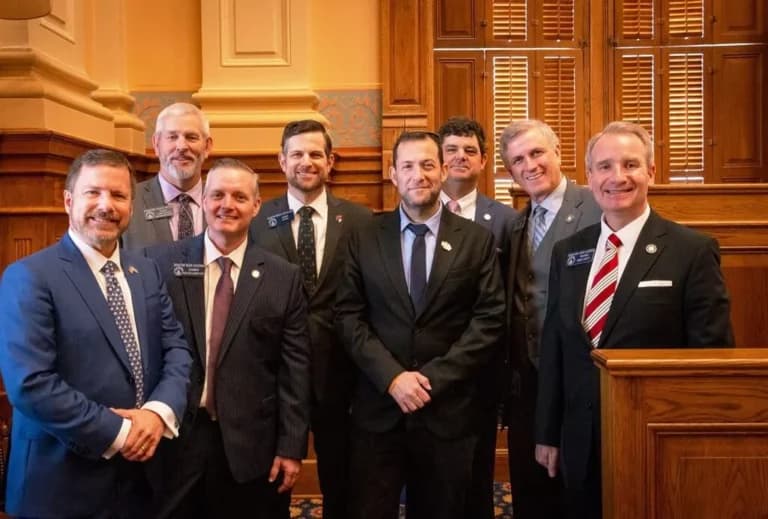
The developments coincided with a high-profile visit to Samaria by a delegation of 20 senior American state legislators, who toured the region as guests of Samaria Regional Council head Yossi Dagan and later joined Jewish worshippers for prayer at Joseph’s Tomb in Shechem (Nablus) under IDF and police security. The delegation was led by Jason Rapert, President of the National Association of Christian Lawmakers, and included lawmakers from Maine, Hawaii, Kansas, Indiana, Michigan, Texas, Arkansas, Arizona, and Tennessee.
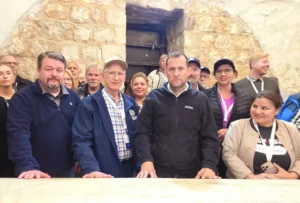
Rapert publicly referred to the joint initiative between the National Association of Christian Lawmakers and the Samaria Regional Council to formalize the exclusive use of “Judea and Samaria” in American governmental language. “There is no such thing as the ‘West Bank,’” he declared, voicing support for the application of sovereignty.
Several members of the U.S. delegation emphasized the spiritual and historical significance of the visit. Michigan State Senator Lana Theis, who chairs the America–Israel Committee within the organization, said that being in the region underscored for her the biblical foundations that, in her view, helped shape America’s own core values. Texas State Representative Mark Dorazio expressed full support for Israel and for what he described as Israel’s sovereign future, while an Arkansas lawmaker affirmed her state’s backing for Judea and Samaria as an integral part of Israel.
The idea that the so called “West Bank” (a name invented by the Jordanians around 1948) is not an inherent part of Israel is only possible for those unfamiliar with Scripture. It was here in Hebron that Abraham purchased the Cave of Machpelah as a burial place for Sarah, anchoring the Jewish people’s claim to the land in tangible payment; here in Beth-El that Jacob dreamed of a ladder reaching to heaven and declared “”Indeed, the Lord is in this place” (Genesis 28:16); here in Shiloh that the Tabernacle stood for centuries as the spiritual center of Israel; and here on Mt. Ebal that Joshua built an altar after the tribes of Israel crossed the Jordan River into the Promised Land.
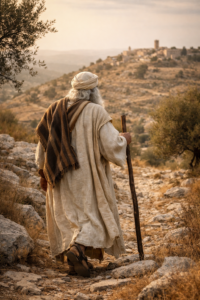
From the fields where Ruth the Moabite gleaned near Bethlehem to the hills where the prophet Samuel walked, Judea and Samaria are not peripheral territories but the very heartland of the biblical story, woven into the faith and identity of the Jewish people and, by extension, into the spiritual heritage cherished by millions of Christians around the world.
Discussion0
No comments yet — be the first to share your thoughts.