
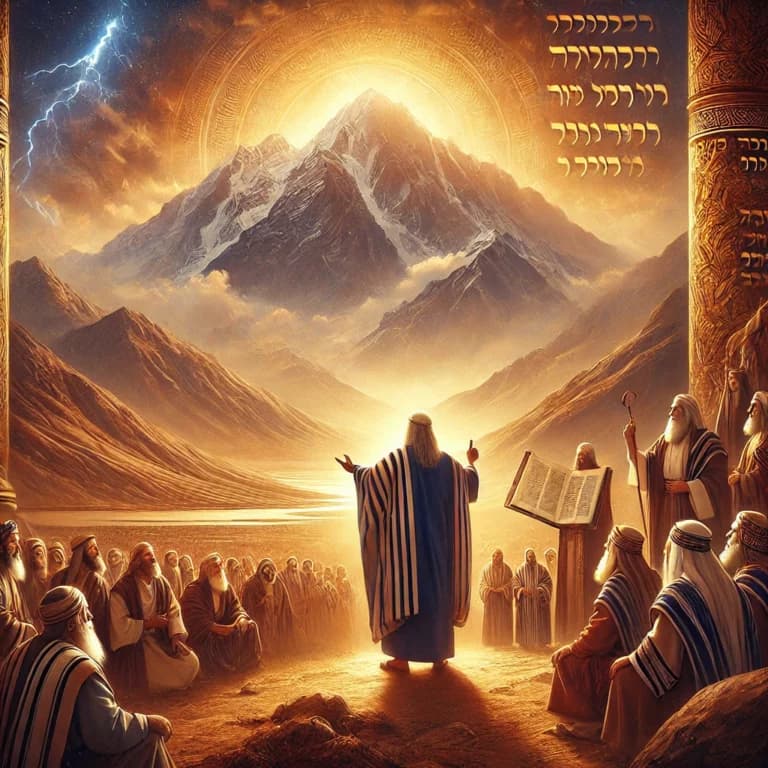

Illustration of Moses in the Desert, Parshat Mishpatim. | Image: ChatGPT
From Thunder to Detail: The Dual Nature of Revelation at Sinai
The story of the Revelation at Mount Sinai is a pivotal moment in Jewish history, marking the divine transmission of the Torah to the Israelites. This event, which begins in Exodus chapter 19, is a dramatic narrative filled with thunder, lightning, and the voice of God. However, what follows this intense encounter is equally significant, though often overlooked.
As the Israelites arrive at the foot of Mount Sinai, the stage is set for an awe-inspiring encounter with the divine. The people are instructed to prepare themselves, and on the third day, amid smoke and trembling earth, God descends upon the mountain. This dramatic scene culminates in the giving of the Ten Commandments, a set of fundamental principles that form the cornerstone of Jewish law and ethics.
Following the Ten Commandments: Detailed Laws and Ordinances
One might expect the narrative to continue with more celestial fireworks or profound spiritual experiences and it does! But first, it is interrupted with chapter 21, ‘And these are the laws that shall be set before them’. Following the Ten Commandments, we encounter three chapters filled with detailed laws and ordinances. These range from instructions on how to treat slaves and parents to regulations about fields, workers, sorcery, damages, festivals as well as sexual conduct. At first glance, this shift from the sublime to the mundane might seem jarring or even anticlimactic.
This apparent interruption in the narrative flow raises an intriguing question: Why insert these seemingly tedious details into such a captivating story? The answer lies in a fundamental debate that extends far beyond the realm of biblical interpretation – the tension between generalism and particularism.
Generalism, in essence, advocates for a broad, overarching approach to understanding and engaging with the world. It emphasizes the importance of grasping big ideas and general principles. In contrast, particularism focuses on the specific, the detailed, and the nuanced aspects of reality.
This philosophical divide manifests in various aspects of life. In education, for instance, we see the ongoing debate between a liberal arts approach (generalist) and specialized training (particularist). Leonardo da Vinci epitomizes the genius with wide-ranging intellect. As a quintessential Renaissance man, he excelled in diverse fields including art, science, engineering, and anatomy. His genius was characterized by an insatiable curiosity across multiple disciplines. His ability to connect seemingly unrelated concepts and willingness to challenge conventional positions were a result of his multi-faceted interests.
Da Vinci’s notebooks reveal a mind constantly exploring, questioning, and imagining. His wide breadth of knowledge allowed him to make groundbreaking contributions in art (e.g., “Mona Lisa”), anatomy (detailed human body sketches), and engineering (designs for flying machines). Rather than focusing on a single area, da Vinci’s genius lay in his ability to synthesize knowledge from various fields, leading to revolutionary ideas and creations that were often centuries ahead of his time.
In sports, some argue for early specialization in a single discipline, while others advocate for a more well-rounded athletic development. Roger Federer, as mentioned in the query, is a prime example of a well-rounded athlete. He played various sports in his youth, including basketball and badminton, before focusing on tennis. This diverse athletic background is credited with developing his exceptional coordination and adaptability on the tennis court. In contrast, gymnasts often specialize very early, sometimes as young as 5 or 6 years old, dedicating themselves entirely to gymnastics to master the complex skills required for elite competition. This early specialization can lead to extraordinary performances but may also increase the risk of burnout or overuse injuries.
What is the Torah’s Position?
In the context of the Sinai revelation, the Torah takes a clear stance on this debate – it embraces both perspectives. The Ten Commandments represent the generalist approach, providing broad, foundational principles for ethical and spiritual life. They offer a wide-angle lens through which to view one’s relationship with God and fellow humans.
However, the Torah doesn’t stop there. The subsequent chapters delve into the particulars, offering specific guidelines for daily life. This shift from the general to the particular suggests that while overarching principles are crucial, they are insufficient on their own. True understanding and righteous living require engagement with the details and nuances of life’s various situations.
The detailed laws following the Ten Commandments are far from a mere interruption or an afterthought. Instead, they represent a crucial aspect of the Sinai experience. These laws take the lofty ideals presented in the Ten Commandments and translate them into practical, everyday applications.
For instance, the commandment to honor one’s parents is a general principle.
But what does this mean in practice? The detailed laws provide guidance on specific situations and obligations. Similarly, the prohibition against stealing is straightforward, but the subsequent laws delve into the complexities of property rights, fair labor practices, and economic justice.
This approach reflects a profound understanding of human nature and society. While we need inspiring ideals to guide us, we also require specific instructions to navigate the complexities of daily life. The Torah thus provides both the forest and the trees – the overarching vision and the detailed roadmap.
Torah’s Dual Approach Helps Our Personal Development
The Torah’s dual approach at Sinai offers valuable insights for personal and spiritual development. It suggests that true growth and understanding come from engaging with both the general and the particular.
In our spiritual lives, we need both moments of transcendent inspiration and the discipline of daily practice. The awe-inspiring experience at Sinai represents those peak moments that ignite our souls. The detailed laws, on the other hand, guide us in translating that inspiration into consistent, meaningful action.
This principle extends to other areas of life as well. In education, it suggests the value of both broad-based learning and specialized knowledge. In personal relationships, it highlights the importance of both overarching commitment and attention to daily acts of kindness and consideration.
Sinai Isn’t Just About An Encounter With the Divine
The true essence of the Sinai experience, then, is not just the dramatic encounter with the divine or the receiving of general principles. It’s also about the commitment to engage with the details, to wrestle with the specifics of how to live a righteous life in all its complexity.
This comprehensive approach is reflected in the Israelites’ response to God’s covenant. They declare, “Naaseh Venishma,” meaning “We will do and we will listen.” This phrase encapsulates the dual nature of their commitment – to act on the specific commandments (doing) and to continually seek understanding of the broader principles (listening).
The story of the Revelation at Sinai, with its seamless integration of the general and the particular, offers a profound model for how to approach life, learning, and spiritual growth. It teaches us that true wisdom and righteousness come not from choosing between the big picture and the fine details, but from embracing both.
In a world that often pushes us to specialize or to seek quick, general solutions, the Torah’s approach at Sinai reminds us of the value of a more holistic perspective. It challenges us to seek both inspiring visions and practical details, to cultivate both broad understanding and specific expertise.
Soaring Heights of Spiritual Inspiration and Grounded Reality
Ultimately, the message of Sinai is that God desires both – the soaring heights of spiritual inspiration and the grounded reality of daily ethical living. This integration of the general and the particular, the sublime and the mundane, is not a contradiction but the very essence of a rich, meaningful, and righteous life.

Discussion0
No comments yet — be the first to share your thoughts.