On Iran, Israel Makes the Moral Choice In Choosing Between “Life and Good and Death and Evil”
Across the generations, Moses’ words echo with undiminished urgency: “Behold, I have set before you today life and good, and death and evil… I have set before you life and death, the blessing and the curse. You shall choose life, so that you and your offspring will live” (Deuteronomy 30:15,19). Scripture reminds us that we

Sinai Staff
Opinion contributor··4 min read
Across the generations, Moses’ words echo with undiminished urgency: “Behold, I have set before you today life and good, and death and evil… I have set before you life and death, the blessing and the curse. You shall choose life, so that you and your offspring will live” (Deuteronomy 30:15,19). Scripture reminds us that we are confronted with a moral choice between good and evil, between those who defend life and those who desecrate it. In a world clouded by propaganda and moral confusion, that ancient charge feels strikingly contemporary.
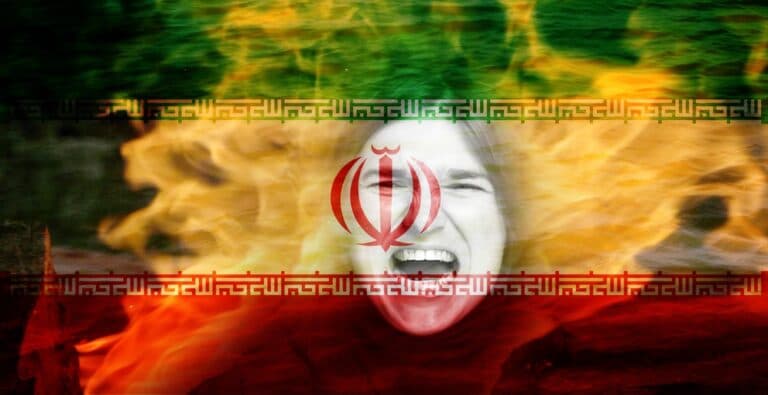
Nations, no less than individuals, face this moral choice as well. When it comes to the issue of the recent unrest in Iran, nations around the world have the choice to either stand by the people, who courageously poured out into the streets to fight for their freedom, or stand by the regime that slaughtered them by the thousands.
When Israeli President Isaac Herzog concluded his official visit to Australia with a major gathering of the Jewish community in Melbourne, he delivered a forceful rebuke of the Iranian regime. Despite Tehran’s denials and the recent attacks by Iranian Foreign Minister Abbas Araghchi against the Israel Hayom newspaper and its publisher Miriam Adelson over reporting on the executions in Iran, Herzog did not mince words. “They have killed and massacred tens of thousands of their own people,” he said, accusing the regime of operating “a full mechanism of an empire of evil.”
The President and his wife, Michal, had traveled to Australia on what he described as a mission of solidarity following the horrific terror attack in Bondi. “We came to be with you, to look into your eyes, to embrace and to remember together,” Herzog said. “We have cried much in recent days. But we return to Israel strengthened, because we have seen with our own eyes the beauty and resilience of this community.” He spoke of rediscovering the famed spirit of Australian Jewry, “a spirit that cannot be broken,” and offered heartfelt wishes for recovery to the wounded, including Geffen Biton, who ran toward the terrorists in Bondi, was critically injured, and is now recovering in Israel.
Throughout the week, Herzog met with Australia’s governor-general, prime minister, opposition leader, state governors, and other senior officials. He described the conversations as honest and respectful, adding that he found serious partners willing to confront vile rhetoric, disinformation, and shameful antisemitism head-on. He urged Jews in Australia and around the world: “Do not be afraid to show who you are. This is a struggle for Jewish identity no less than it is a struggle for the identity of Australia and the free world.”
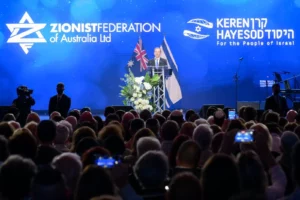
Addressing protesters, he added pointedly, “Go demonstrate in front of the Iranian embassy, or any other relevant embassy. For heaven’s sake, they have killed and massacred tens of thousands of their own people, operating a full mechanism of an empire of evil that works against us. And we, the State of Israel, are defending the free world, in practice defending the free world and its values through the struggle against this empire of evil.” He concluded by noting that although he and his wife had come to strengthen the community, they were leaving strengthened themselves, reminded once again that Israel remains the focus of Jewish prayer, love, and longing across generations.
In stark contrast to Herzog’s moral clarity, U.N. Secretary-General António Guterres drew sharp criticism this week after sending “warm congratulations” to Iran on the anniversary of the Islamic Revolution. In a letter to Iranian President Masoud Pezeshkian, Guterres wrote that national days provide an opportunity to reflect on a country’s path and its contributions to the international community.
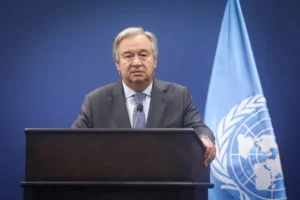
Critics of the Iranian regime called the gesture morally tone-deaf. Speaking to Fox News, analyst Banafsheh Zand described the move as “completely detached from reality,” noting that while the Iranian people continue to endure executions, repression, and systematic abuse at the hands of the Islamic Republic, official congratulations to those responsible are a profound moral failure. Such gestures, she argued, damage the credibility of the United Nations and deepen the injury to those inside Iran who continue to risk everything in their struggle for freedom.
In the end, the contrast could not be sharper. One leader calls out an “empire of evil” and urges the free world to stand firm against tyranny. Another extends diplomatic courtesies to the very regime accused of brutalizing its own people. The choice Moses urged upon us remains before us still: “You shall choose life.”
Discussion0
No comments yet — be the first to share your thoughts.