Ceasefire Undermined: Hamas Uses Aid Corridor for Assault, Prompting Israeli Retaliation
The Israeli Air Force carried out strikes in Gaza after a Hamas terrorist crossed the yellow line and opened fire on Israeli forces. In Lebanon, Hezbollah targets were attacked.

Strikes in Gaza After Terrorists Cross Humanitarian Corridor
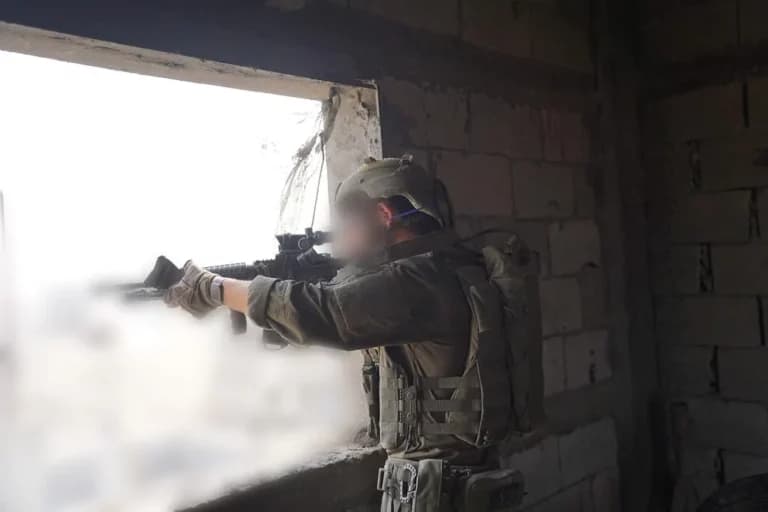
The Israeli Air Force launched strikes across the Gaza Strip on Saturday after a Hamas terrorist crossed the designated yellow line while driving along a humanitarian corridor intended to bring aid into the Strip. The assailant opened fire at IDF troops and was killed. In a separate event further north, two additional terrorists crossed the yellow line and were eliminated as they advanced toward Israeli forces.
In response, Israeli aircraft struck a vehicle in Gaza City’s Rimal neighborhood. Reports from within the Strip indicated that at least five individuals were killed, including Alaa Hadidi, a commander within the production division of Hamas’s military wing. Additional strikes were later reported in central Gaza and Gaza City.
Separately, a combat team from the Nahal Brigade identified and eliminated 11 terrorists inside a fortified terror pocket in the Rafah area. Six more were arrested and transferred to Shin Bet interrogation.
IDF Targets Hezbollah Positions in Southern Lebanon
Simultaneously, the IDF carried out strikes against several Hezbollah rocket launchers in southern Lebanon. In the Lebanese Beqaa Valley, Israeli aircraft attacked two military sites belonging to Hezbollah that included weapons depots, terrorist activity, and operational facilities.
Ceasefire Violations and Israel’s Security Imperatives
The events along the humanitarian corridor highlight a persistent challenge Israel faces during ceasefire periods: armed groups routinely exploit pauses in fighting to regroup, reposition, or launch attacks. A terrorist using an aid route—meant to protect civilians—to open fire on Israeli soldiers reinforces Jerusalem’s skepticism toward ceasefire arrangements lacking strict enforcement.
From Israel’s standpoint, every breach erodes trust in humanitarian mechanisms and increases danger for both Israeli forces and Gaza civilians. Similar violations in past ceasefires have prolonged conflict rather than reduced it.
The parallel activity in Lebanon underscores the broader regional picture. Hezbollah’s involvement, backed by Iran, creates a dual-front pressure that Israel must constantly manage. Precision airstrikes are intended to maintain deterrence and prevent Hezbollah from escalating into a wider confrontation.
Israel views these measures as necessary steps to ensure that ceasefires are not one-sided and that terror groups cannot weaponize humanitarian infrastructure.
Biblical Reflection
Moments when Israel must defend itself during fragile ceasefires echo themes deeply rooted in the Bible. Israel’s longing for peace is balanced by the sobering need to confront those who violate it.
Kohelet (Ecclesiastes) 3:8
“A time for war, and a time for peace.”
The challenge lies in discerning which moment has arrived—especially when adversaries mask aggression behind humanitarian structures.
Tehillim (Psalms) 144:1
“Blessed is the Lord, my Rock, who trains my hands for battle and my fingers for war.”
This verse does not glorify conflict; it recognizes the weighty moral responsibility on those tasked with protecting life and maintaining order when peace is broken.
Discussion0
No comments yet — be the first to share your thoughts.