Reforming Education: Palestinian Textbooks Must Stop Including Anti-Israel Incitement

By Ruthie Jaffe Lieberman
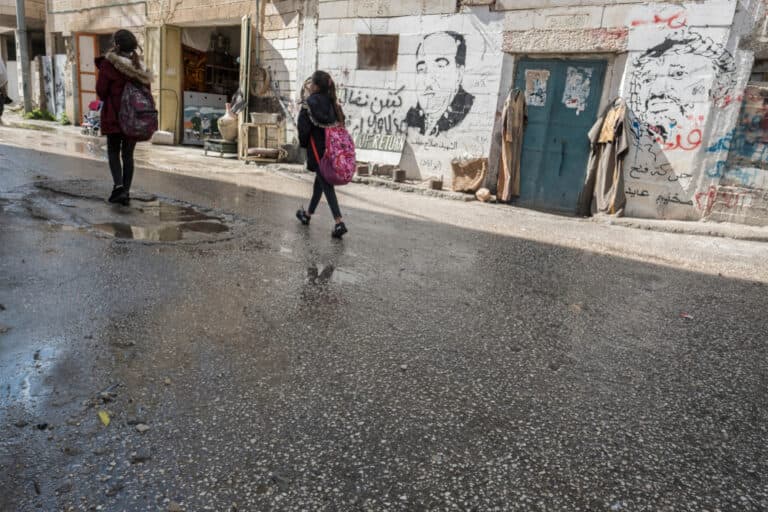
Palestinian children walk to school in Bethlehem beside political grafitti. | Photo: Edward Crawford / Shutterstock.com
The textbooks used by the Palestinian Authority (PA) in schools under their control have long been criticized for promoting a narrative of hatred toward Israel. These materials are not only educational but also ideological tools that deeply influence the perspectives of palestinian Arab children. Through their portrayal of history, geography, and culture, the textbooks often deny Israel’s legitimacy, glorify violence, and frame the Israeli-Arab conflict without factual basis. By examining these textbooks, we can see how they shape attitudes toward Israel and contribute to perpetuating hatred and even encouraging terror. We will examine these texts here, in the hope that there can be some light at the end of this deeply distressing path.
PA Textbooks Deny Israel’s Right to Exist
A core element of PA textbooks is their systematic denial of Israel’s right to exist. The textbooks consistently portray Israel as an illegitimate occupier of Palestinian land, often referring to the establishment of Israel in 1948 as the Nakba (‘The Catastrophe’), a term used to describe the suffering and displacement of the Arabs of the land of Israel, during the creation of the Jewish state. Rather than acknowledging the complexities of this historical event, the textbooks frame Israel’s creation as an unjust, traumatic event that displaced what they present as the rightful inhabitants of the land. As a result, students are taught to view Israel as an occupier and their own history as one of victimhood and dispossession. The textbooks rarely recognize Israel by name, and maps of the region are often presented with ‘Palestine’ labeled over all of Israel, erasing Israel from the narrative entirely, and thus suggesting it has no right to exist.

The glorification of violence and martyrdom is another alarming feature of PA textbooks. Students are frequently taught that resistance to Israel is a noble cause, and the act of dying for ‘freedom’ is presented as an act of heroism. References to ‘martyrs’ and ‘heroes’ abound, many of whom are glorified for their actions against Israel, with textbooks linking martyrdom to national pride. In these materials, violence is normalized as a form of legitimate resistance. The references to palestinian Arab terrorist groups, such as those associated with terrorism, are often framed as expressions of national struggle rather than acts of violence. Such portrayals reinforce the idea that martyrdom and violence are not only acceptable but honorable, instilling a culture of conflict rather than encouraging peace.
Palestinian Educational Materials Misrepresent Historical Connections
Palestinian Media Watch (PMW), a key organization that monitors Palestinian media and educational materials, has reported extensively on the content of PA textbooks. According to PMW, “The Palestinian Authority’s official school curriculum continues to promote a one-sided narrative of the Israeli-Palestinian conflict, omitting or misrepresenting the historical connection of Jews to the land of Israel and the legitimacy of the state of Israel.” PMW has documented how the PA textbooks encourage the idea of resistance as a moral imperative, while presenting Israeli Jews as an occupying force that is inherently illegitimate. The promotion of martyrdom, glorification of violence, and denial of Israel’s existence perpetuate a worldview that fosters hostility and prevents peace.
The textbooks fail to recognize the possibility of peaceful coexistence with Israel. Any notion of compromise or negotiation is downplayed, and peace efforts such as the Oslo Accords are depicted as concessions or betrayals. The focus is on the goal of “liberation” and the restoration of all Palestinian Arab land, excluding Israel from the equation and essentially wiping it off the map.
In addition to these troubling themes, the textbooks often dehumanize Israelis, presenting them as aggressors or oppressors rather than as a people with legitimate claims to the land. Jewish history, culture, and identity are largely ignored or misrepresented, contributing to a one-sided view of the conflict that breeds distrust and hostility. The portrayal of Jews as the enemy makes it more difficult for students to empathize with Israelis or to understand the broader historical and political realities that shape the conflict.
While these textbooks paint a grim picture of the current educational environment, there is hope for the future if we acknowledge the realities. The challenge of overcoming these deeply ingrained narratives requires the acceptance of responsibility by the PA and its educational leaders. If the Palestinian Authority is serious about peace and the well-being of its people, reforming the education system is a crucial step forward. And it something that the international community should demand as a confidence-building measure.
Curriculum Reforms Are Needed
One possible way to begin addressing this issue is by promoting curriculum reforms that focus on fostering mutual understanding, tolerance, and respect. Teaching Arab students about the history and culture of Israel, as well as the Jewish connection to the land, as in the Israeli educational system – among its Arab citizens as well – could create a more positive perspective. Encouraging critical thinking and dialogue about the conflict, rather than indoctrinating children with one-sided narratives, would be a significant step toward breaking their cycle of hatred.
Ruthie Jaffe Lieberman is a licensed tour guide with a political consulting firm on the side. Her passion is the Land of Israel and she’s completing a Masters in archaeology focused on the Israelite kingdom in the 8th century BCE. She can be reached at jaffestrategies@gmail.com.
Discussion0
No comments yet — be the first to share your thoughts.