“Be Strong and Have Courage”: Israel’s Civilians Stand Fast Under the Missiles
Since the outbreak of the war, Israelis have lived under a relentless rhythm of sirens, as Iran and its regional proxies attempt to strike the home front with missiles and drones. Data from the first days of Operation Lion’s Roar reveals the scale of the barrage: hundreds of alerts sounding across the country, entire metropolitan

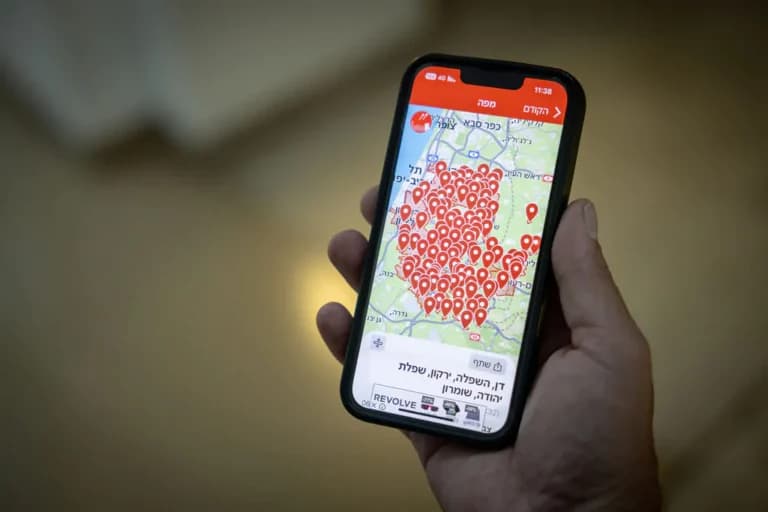
Since the outbreak of the war, Israelis have lived under a relentless rhythm of sirens, as Iran and its regional proxies attempt to strike the home front with missiles and drones. Data from the first days of Operation Lion’s Roar reveals the scale of the barrage: hundreds of alerts sounding across the country, entire metropolitan areas repeatedly rushing to shelters, and northern communities enduring waves of aerial threats. Yet even amid the constant alarms, the pattern of attacks tells a complex story of geography, escalation, and resilience.
Map of Sirens
Sirens data since the start of the war reveals a striking snapshot of how different Israeli communities have experienced the conflict. While some areas have heard only a handful of alerts, others – particularly in the densely populated center of the country – have endured dozens.
At the quietest end of the spectrum stands the desert town of Mitzpe Ramon, which has recorded only two sirens since the fighting began, making it the least targeted locality in Israel so far.
Southern Eilat and Sderot follow in second place with four alerts each, while Yeruham has experienced six. Several other towns have also seen relatively limited warning activity: Dimona has recorded around nine sirens, Netivot about ten, and Hadera between ten and eleven.
Harish and Beit She’an have reported roughly eleven alerts each, Pardes Hanna twelve, Ashkelon thirteen, and both Katzrin and Kiryat Arba fourteen.
At the other end of the scale are the communities facing the heaviest barrage. The most targeted zones since the war began are Western Ramat Gan and Givat Shmuel, where 75 siren alerts have been recorded.
Close behind, with 74 alerts, are eastern Tel Aviv, Petah Tikva, Kiryat Ono, eastern Ramat Gan, Savion, and Holon.
Third place includes central and southern Tel Aviv, Givatayim, Bat Yam, and Bnei Brak, each experiencing between 72 and 73 alerts since the start of the war.

A separate and volatile front continues to affect communities along Israel’s northern border with Lebanon, where Hezbollah has launched targeted attacks. Several towns along the confrontation line have endured between 40 and 50 sirens since the war began.
The data also reveals the most intense day of missile warnings since the fighting began: On February 28, the opening day of the war, Israel recorded a staggering 687 “Red Alert” sirens triggered by incoming missiles.
In recent days, the pace of warnings has increased once again. Comparing the three days between March 4 and March 6 with the following three days between March 7 and March 9 shows a sharp rise: the earlier period saw 385 alerts nationwide, while the next three days jumped to 543—an increase of more than 40 percent in a very short time.
Hostile drone incursions have also remained a significant threat, particularly in northern Israel. Between Thursday, March 7, and Friday, March 8, alerts related to aerial infiltrations surged from 62 to 105—nearly doubling within a single day.
Yet the following day brought a measure of relief. On March 9, drone alerts dropped dramatically to just 25, a decline of roughly 76 percent within 24 hours after an unprecedented spike.
(Note that the siren data presented in this report is based on estimates and may have been updated since its initial publication.)
The Human Toll
Beyond the constant wail of sirens, the missile barrage on Israel’s home front has carried a heavy human and social toll. Since the start of Operation Lion’s Roar, thousands of missiles and drones launched toward Israel have left civilians dead, hundreds injured, and entire neighborhoods disrupted. Health officials report that nearly 2,000 people have been evacuated to hospitals since the beginning of the fighting. As of early March 8, 122 people remained hospitalized or under treatment in emergency departments, including nine in serious condition and dozens more with moderate or light injuries.
The attacks have also claimed civilian lives in several tragic incidents. At least fifteen people have been killed during the barrage, many of them when a missile struck a residential building in Beit Shemesh. Others were killed in separate strikes in central Israel, including Tel Aviv and a construction site in Yehud, where two workers died after being struck by shrapnel from a cluster missile. In some cases, elderly victims collapsed and died while attempting to reach bomb shelters as sirens sounded.
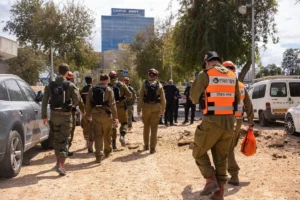
The destruction has forced many Israelis from their homes. Missile impacts and falling interceptor fragments have damaged residential buildings in multiple cities, leaving nearly 1,500 residents displaced as of the early days of the war. Municipal authorities relocated most of them to temporary housing, primarily in hotels funded by Israel’s Property Tax Compensation Fund, with the largest groups evacuated from Tel Aviv–Jaffa and Beit Shemesh. At the same time, Israel’s mental health support systems have been activated nationwide, receiving thousands of calls from citizens seeking emotional support as they navigate life under repeated missile fire.
“Be Strong and Have Courage”
As missiles streak across the sky and sirens echo through the streets, Israelis continue to run for shelter, return to their homes, and rise again the next morning. Yesterday, Home Front Command chief Maj. Gen. Shay Kalper visited one of the missile impact sites in central Israel, where he met with Amir Shahar, whose apartment was struck during the attack. Speaking from the damaged building, Kalper urged Israelis to remain vigilant and resilient in the face of continued threats.
Standing inside the apartment, he pointed to the damage caused by a cluster munition. “This apartment was hit by a cluster bomb. I know the volume of launches may be somewhat lower, and the number of alerts may even feel higher, but this apartment shows that even a cluster munition can cause enormous destruction. Thanks to following the instructions, and thanks to Amir’s family acting quickly, this incident ended without casualties.”
Shahar himself spoke from the ruins of the apartment his grandfather built nearly a century ago. “If I may add, from the ruins of my home -the house my grandfather built one hundred years ago -remaining calm and responding to the alerts and instructions truly saves lives. My son and granddaughters ran to the neighborhood shelter. The apartment will be rebuilt, the home will grow stronger, but no one was hurt. I am deeply grateful for the response of the authorities – Home Front Command, the police, and the municipality. They responded excellently, and we will do our part once the damage is repaired.”
In their quiet resolve, Israelis are acting on the words of God to Joshua, at another momentous moment of steadfast connection to the holy land – crossing over the Jordan and facing the fortified city of Jericho:
“Did I not command you, be strong and have courage, do not fear and do not be dismayed, for the Lord your God is with you wherever you go” (Joshua 1:9).
Discussion0
No comments yet — be the first to share your thoughts.