
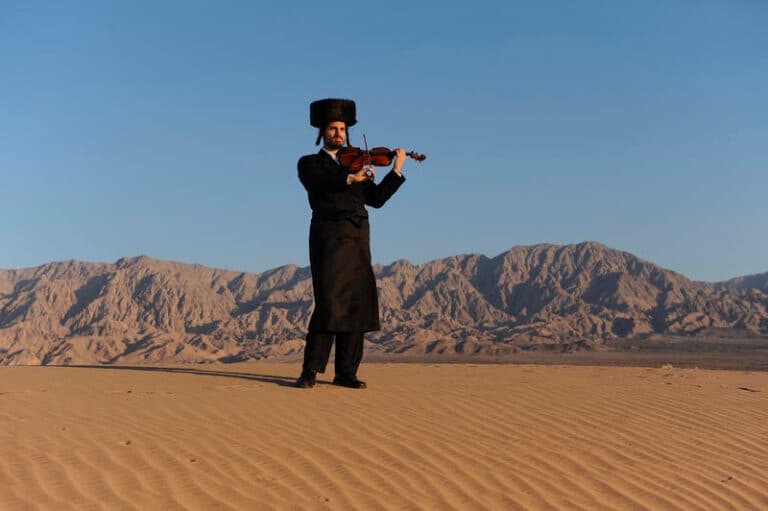

Portrait of ultra orthodox Jewish musician Simon Weitzhandler, wearing a ‘shtreimel’ (fur hat worn by many married haredi Jewish men, particularly members of Hasidic groups, on Shabbat and Jewish holidays and other festive occasions) as he plays the violin, in the Samar dunes, southern Negev desert | Photo by Mendy Hechtman/FLASH90
Takeaways
- The shtreimel is a fur crown worn by Chassidic Jews for Shabbat and festivals (not for warmth).
- Some versions use thirteen tails, echoing the thirteen attributes of divine mercy.
- Two head coverings are worn together because Jewish tradition sees this as doubly meritorious.
- The custom traces back to hardship, turned into a badge of honor.
- You can spot these hats in Brooklyn, Jerusalem, and Bnei Brak on any given Saturday.
I once stood on a Jerusalem sidewalk in August, watching a man in a towering fur hat walk calmly toward synagogue while I sweated through my shirt just standing still. He wasn’t rushing, wasn’t tugging at the collar, wasn’t in any hurry to get out of the sun. It hit me that I wasn’t watching someone endure the heat. I was watching someone who’d put on a crown and simply forgotten the temperature existed.
What Is a Shtreimel, Exactly?
A shtreimel is a wide, round fur hat, often made from thirteen (or more) sable or fox tails. The fur typically comes from Canadian or Russian sable, beech marten, baum marten, or gray fox, and a well-made shtreimel is almost always the most expensive piece in a Chassidic man’s wardrobe. It’s traditionally worn by Chassidic men on Shabbat, holidays, and at weddings. The thirteen tails aren’t random. Jewish tradition ties that number to the thirteen attributes of mercy described in the Torah.

Is It About the Weather?
No. The shtreimel has nothing to do with temperature. It’s tied to the holiness of Shabbat itself, worn as a crown fit for royalty, the kind of crown meant to enhance and beautify the day. Jewish law calls for special dress on holy days, and this hat is one way of answering that call. Some even connect it to the crown of Torah, since the Torah itself was given on Shabbat. Put a crown on your head, and you’re carrying both ideas at once. Shtreimels are usually worn by married men on shabbat, holidays, special occassions and weddings.

Why Wear Two Head Coverings at Once?
Most Chassidic men wear the shtreimel over a kippah. Two coverings, Jewish tradition teaches, carry more spiritual weight than one. It’s a small physical gesture that reflects a larger idea: layered devotion, visible from across the room.
📖 Ever wondered what the basics of kosher actually are? This article breaks it down.
Where Does This Custom Come From?
Some historians trace the shtreimel to an 18th century decree in Poland, designed to humiliate Jews by forcing them into animal-tail garments. Chassidic communities took that imposed shame and transformed it into majesty. What was meant to degrade became a crown.
Lifting Up What’s Usually Left Behind
Here’s a piece of the teaching most people never hear. Rabbi Pinchas of Koretz taught that part of our job in this world is to take ordinary, even lowly things and lift them up. On a regular weekday, some objects just stay where they are. Tails from an animal that isn’t kosher would normally sit at the bottom of that list.
Shabbat changes the math. The world itself rises to a higher plane on that day, and things that couldn’t be elevated on a Tuesday suddenly can be. That’s why the shtreimel is built from tails in the first place. It’s a physical reminder that holiness can reach even the parts of life we’d normally overlook.

Shtreimel Replaces What?
Some teach that the shtreimel (worn on Shabbat) stands in for the tefillin that aren’t worn on Shabbat. Rabbi Pinchas of Koretz even taught that the word Shabbat can be read as an acronym for Shtreimel Bimkom Tefillin, “the shtreimel in place of tefillin.”
Quick Trivia
What’s a spodik? A taller, narrower, black fur hat, common among Polish-descended Chassidic groups like Ger and Alexander.
Does every Chassidic group wear one? Chabad famously does not. Their focus rests on inner spiritual strength rather than external dress.
What does “shtreimel” mean in Hebrew? It loosely translates to a garment made from an animal’s tail, a humble material elevated into something holy.
Where You Might See One
Keep your eyes open in Crown Heights and Williamsburg in Brooklyn, in Mea Shearim in Jerusalem, or in Bnei Brak near Tel Aviv. Saturday mornings bring streets full of families walking to synagogue, fathers and sons in matching fur crowns, looking like something out of another century and somehow completely at home in this one.
A Hat That Tells a Story
What gets me every time is the confidence. A grown man in ninety-degree heat, walking like it’s the most natural thing in the world. That old Polish decree meant as a joke landed on us. Generations later, it’s an heirloom, passed from father to son at a wedding, worth more than most cars I know, and worn with majesty and pride.
Want to keep reading? Read here about why Jews have strings sticking out of their pants. Explore more on faith, values, and the Land of Israel at Sinai Project.
Discussion0
No comments yet — be the first to share your thoughts.