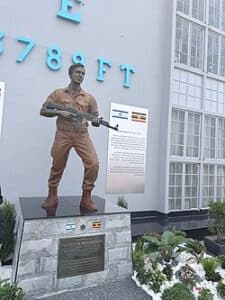

Bronze statue of Yonatan “Yoni” Netanyahu at the Entebbe International Airport | Photo: Wikipedia
Takeaways
- A bronze statue of Yoni Netanyahu now stands at the exact spot where he fell at Entebbe Airport.
- The 1976 hostage rescue remains one of the most daring military operations in modern history.
- Israeli commandos flew 2,500 miles into hostile territory to save 106 lives.
- Yoni Netanyahu was the only Israeli soldier killed in the entire mission.
- Uganda’s military chief says he built the statue after being instructed in a dream.
Fifty years ago, a hijacked plane sat on a runway in Entebbe, Uganda, and the world held its breath. Terrorists had separated Jewish passengers from the rest of the hostages, a chilling echo of history that made the stakes unmistakable. Today, a bronze figure stands on that same tarmac, rifle in hand, marking the spot where a young Israeli commander gave his life to end that nightmare.
The Hijacking That Shocked the World
On June 27, 1976, Air France Flight 139 left Tel Aviv bound for Paris. Terrorists from the Popular Front for the Liberation of Palestine and Germany’s Revolutionary Cells hijacked the plane and diverted it to Entebbe, where Ugandan dictator Idi Amin welcomed them. The hijackers held 106 hostages inside the airport’s old terminal and demanded the release of 53 imprisoned militants, setting a deadline that left little room for negotiation.
📖Read here about which countries are moving their embassies from Tel Aviv to Jerusalem and why it matters.
Operation Thunderbolt: A Mission Almost No One Believed Was Possible
On the night of July 3, 1976, four Israeli C-130 Hercules planes flew more than 2,500 miles into central Africa, carrying over 100 elite Sayeret Matkal commandos. The soldiers used a black Mercedes built to resemble Idi Amin’s own car, slipping past guards before storming the terminal. Within minutes, they killed all seven hijackers, destroyed eleven Soviet-supplied MiG jets, and rescued 102 of the 106 hostages.


The Hero Who Fell
Lt. Col. Yonatan “Yoni” Netanyahu led the assault force into the terminal. Yoni was Prime Minister Benjamin Netanyahu’s older brother by 3 years. A Harvard-educated veteran of the Six-Day War, Yoni was struck by gunfire, likely from the airport control tower, as his men pushed forward. He was the only Israeli soldier killed in the entire operation. The mission was later renamed Operation Yonatan in his memory.

A Monument Fifty Years in the Making
On August 1, 2026, Ugandan military chief Gen. Muhoozi Kainerugaba unveiled the statue outside Entebbe’s old terminal, on the precise spot where Yoni fell. The general said he was instructed in a dream by “My God Jesus Christ” to commission the tribute. He called it a sign of Uganda’s close blood relations with Israel.
Why Uganda Chose to Remember Him
A monument built by a former hijacking site, in a country once ruled by the man who sheltered the terrorists, signals a shift in how a nation once tied to Israel’s darkest hostage crisis now chooses to tell that story.

Gen. Kainerugaba frames his country’s support for Israel in explicitly Christian terms, saying plainly, “We stand with Israel because we are Christians.”
There’s also a debt being repaid. Through the 1980s and 1990s, when Uganda was isolated and fighting insurgencies, Israel supplied military training, intelligence, and counter-terrorism expertise, rebuilding Uganda’s air defenses and helping its special forces confront threats like the ISIS-linked Allied Democratic Forces. Uganda has not forgotten who showed up when few others would.
That gratitude has hardened into an active partnership. A 2022 defense cooperation agreement between the two nations expanded collaboration on security and technology, and Israel has since supplied Uganda with drones, cybersecurity tools, and precision munitions. In March 2026, Gen. Kainerugaba went further still, declaring that any move to destroy Israel would draw Uganda into the fight on Israel’s side.
Among Israel’s allies on the African continent, Uganda has become something rarer than a diplomatic partner. It has become a nation willing to say, in public and without hesitation, that it stands with Israel on faith, on history, and if necessary, on the battlefield.
A Bond Written in Stone
The plane that landed in Entebbe in 1976 carried fear and uncertainty into a hostile country. Fifty years later, a statue on that same ground carries something else entirely: memory, gratitude, and a quiet declaration that heroism is never forgotten. It’s a monument to courage that will continue to inspire faith and hope across generations.
Want to keep reading? Learn about why Honduras’ new President is staunchly pro-Israel. Explore more on faith, values, and the Land of Israel at Sinai Project.
Discussion0
No comments yet — be the first to share your thoughts.