
The Holiday That Took Root: Tu BiShvat and the Making of Modern Israel
How did an ancient Talmudic date become Israel’s national Tree-Planting Holiday? Read the fascinating historical journey from the 1,500 saplings of Yesוd HaMa’ala in 1884, through the educational revolution in Zichron Yaakov, to the birthday of the Knesset. Tu BiShvat, which falls today (Monday), February 2, is the date on which the New Year for

How did an ancient Talmudic date become Israel’s national Tree-Planting Holiday? Read the fascinating historical journey from the 1,500 saplings of Yesוd HaMa’ala in 1884, through the educational revolution in Zichron Yaakov, to the birthday of the Knesset.
Tu BiShvat, which falls today (Monday), February 2, is the date on which the New Year for the Trees is marked. Its origins are deeply agricultural and biblical. According to the Mishnah, this is the point when the main rainy season ends and fruits begin to grow under the influence of the new year. Because of its centrality in the Hebrew calendar, this day determines how commandments such as tithes are observed. The Torah establishes a seven-year farming cycle, culminating in a sabbatical year, during which land is left fallow and produce is ownerless. In the other years, farmers were required to set aside tithes from their crops, including a “second tithe” that was either eaten in Jerusalem or given to the poor, depending on the year. To determine which year a fruit belonged to, the sages fixed Tu BiShvat as the legal cutoff: fruit that blossomed before this date was considered part of the previous year’s harvest, while fruit that blossomed afterward belonged to the new one.
The timing reflects the Land of Israel’s climate—about four months after the rains begin at the holiday of Sukkot, the soil is fully saturated and new fruit begins to grow. The day also took on spiritual meaning, rooted in the biblical idea that “man is like the tree of the field” (Deuteronomy 20:19): just as trees need strong roots to bear fruit, so faith, faithfulness, and obedience are meant to yield lives of moral and spiritual fruitfulness.
Over the years, this holiday has also taken on another deeper meaning – an expression of love for the Land of Israel and its sanctity. When Jews lived in the Diaspora, the customs were mainly symbolic and included eating dried fruits in remembrance of the fruits of the Land of Israel. With the beginning of the Zionist immigrations, the holiday underwent a true transformation, becoming a day of renewal and national awakening. Today, the central custom is tree planting and reconnecting with nature.
Beginnings in the 19th Century
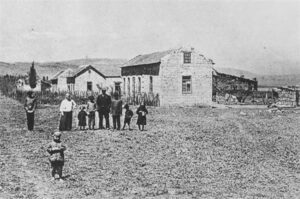
The practical story of planting in the Land of Israel begins in the year 5644 (1884). The residents of the community settlement Yesud HaMa’ala chose Tu BiShvat as the festive day for planting their fruit trees. That year, they planted about 1,500 saplings of citrons and pomegranates, and in the days that followed added another thousand olive, fig, and mulberry trees. One of the settlers described it this way:
“And we will plant more… for beyond the great profit that will come from the fruits… it is also necessary for health, for man and the tree of the field are of one fellowship, and without one another they do not have a good life. Therefore, our first occupation is planting, for so the Creator of the world instructed us—to engage first of all in planting, for so did He, as it is written: ‘And God planted a garden in Eden.’”
(From a letter by Fishel Solomon to his father-in-law, quoted in The Period of Hovevei Zion by Shmuel Yavne’eli)
Establishing the Holiday
In 1888, teacher and writer Ze’ev Yaavetz proposed a revolutionary educational program: to mark Tu BiShvat as a “Festival of the Trees.” He sent his proposal to the founders of Alliance Israélite Universelle and to Baron Rothschild, understanding that education for love of the land should pass tangibly through feet and hands.
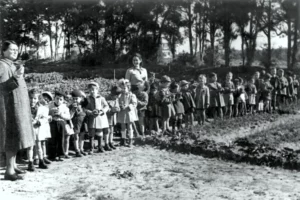
Two years later, in 1890, Yaavetz took his students in the northern town of Zichron Yaakov out for ceremonial plantings. This was the first time the day was observed as an organized educational activity. Yaavetz explained that the school must turn the “New Year for the Trees” into a festival of beauty and splendor, so that children would learn to love planting the land and to delight in its bounty.
At the beginning of the 20th century, the holiday received another important boost thanks to educator Chaim Aryeh Zuta. In 1906, he succeeded in persuading the Teachers’ Association to designate Tu BiShvat as the official “Nature Day,” defeating a competing proposal to set the date on Tu B’Av instead. Zuta drew inspiration from the American custom of “Arbor Day” and believed this was the precise moment to connect the nation to its soil.
The initiative quickly took root. On Tu BiShvat 5667 (1907), a large planting ceremony was held at the Mikveh Israel school with the participation of hundreds of students. A year later, the Teachers’ Federation declared Tu BiShvat the “Festival of Planting.” Even in young Tel Aviv, parades were held as early as its first year in 1910. That year was a sabbatical year, so the children carried flower wreaths instead of saplings—the main thing was to preserve the new-old tradition.
Tu Bishvat Goes Official
The first Tu BiShvat celebrations under British rule were held in 1919. Ronald Storrs, the Military Governor of Jerusalem, together with David Yellin, turned to Miss Annie Landau to organize a planting celebration on Mount Scopus, where the Hebrew University was destined to be established. About 3,000 students marched from Damascus Gate toward the mountain, accompanied by a British Army band.
The Jewish National Fund supplied the 500 saplings for the event and over time became the central partner of the education system and local authorities in organizing the ceremonies. To this day many schools participate each year in planting trees around the country in honor of Tu Bishvat.
Beginning in the 1920s, the community town of Motza became a central planting site. Ceremonies were held near a cypress tree planted by Theodor Herzl during his visit to the Land of Israel in 1898. In 1920, the head of the Zionist Commission, Menachem Ussishkin, and the British High Commissioner, Sir Herbert Samuel, arrived at the site together with thousands of children who planted hundreds of new saplings. This tradition continued even after the establishment of the state, as Israel’s presidents—from Zalman Shazar to Chaim Herzog—continued to plant symbolic trees there.
The connection between the holiday and growth expanded to academic institutions as well. In 1932, the first diploma ceremony of the Hebrew University was held around Tu BiShvat. This link has been preserved to this day in the education system, which traditionally distributes midyear report cards at this time—a moment of summing up the fruits of learning and effort.
On the eve of the establishment of the state, on Tu BiShvat 5708 (1948), the “Tree of the State” was planted at Degania A. It was a cypress chosen in memory of Herzl’s cypress, and at its roots a moving scroll was buried, expressing the spirit of the time. The scroll defined the tree as a symbol of the covenant with the land.
A year later, on Tu BiShvat 5709 (1949), the birthday of the Knesset was celebrated with the opening of the first session of the Constituent Assembly in Jerusalem. The first session itself did not take place in Jerusalem but in the “Kesem Cinema” building in Tel Aviv. On their way to the session, the elected representatives stopped at Sha’ar HaGai to plant trees. The first Speaker of the Knesset, Yosef Sprinzak, linked planting in the field with planting democracy: “We too, the elected representatives of Israel, planted today a new planting… today we planted the beautiful tree—the tree of Israel’s independence.” Since then, planting trees in Jerusalem has become an inseparable part of the Knesset’s birthday celebrations.
Tu Bishvat Today
Like many holidays, Tu BiShvat has changed its character since the early days of Zionism. Over the years, traditions such as an “Israeli seder” and special reciting for the day have emerged. In recent decades, the holiday has also become a symbol of environmental stewardship. The Sages remind us that the Holy One, blessed be He, showed Adam the trees of the Garden of Eden and warned him: “Take care that you do not corrupt and destroy My world, for if you destroy it, there will be no one to repair it after you.”
The war may not yet be over, but we are in a different stage . This Tu BiShvat is our first since the return of the last hostage, Rani Gvili, of blessed memory, last week. We will mark Tu BiShvat today in a renewed context: in order to protect the people of Israel, we are obligated to safeguard the expanses of the homeland. Jewish settlement on Jewish land means life and security.
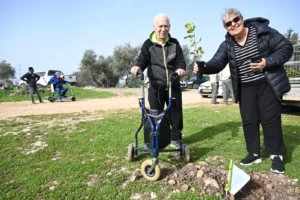
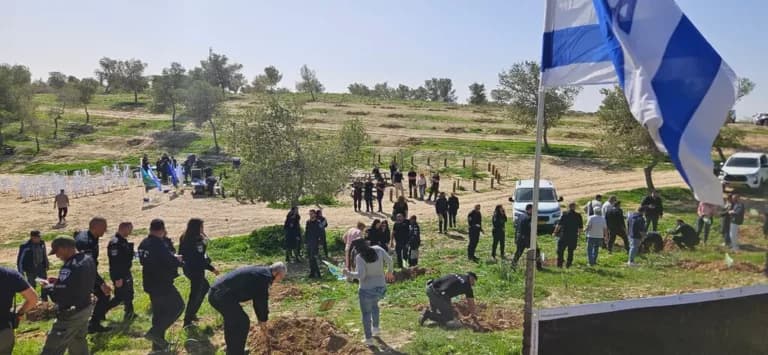
In this same spirit of remembrance and renewal, a tree-planting ceremony marking Tu BiShvat was held yesterday (Sunday) in the Ramot Forest in Be’er Sheva, with the participation of bereaved families of fallen officers from the Southern District of the Israel Police, in partnership with the Jewish National Fund (KKL).
During the event, the district rabbi, Rabbi Reuven Kamil, recited the traditional Planters’ Prayer, honoring the legacy and commemorating the fallen members of the Southern District.
He later delivered remarks addressing the meaning of the holiday and the connection between planting trees and remembrance. “Today we are planting saplings in memory of the fallen of the Southern District, policewomen and policemen who gave the most precious gift of all for the security of the citizens of the State of Israel. Like the tree, they too were rooted in values of mission, responsibility, and love of the land.”
The Rabbi added: “The tree symbolizes past, present, and future. We are fulfilling the most essential commandment – ‘When you come into the land’ – and today each of you has a sapling waiting to be planted in the soil.”
Discussion0
No comments yet — be the first to share your thoughts.