
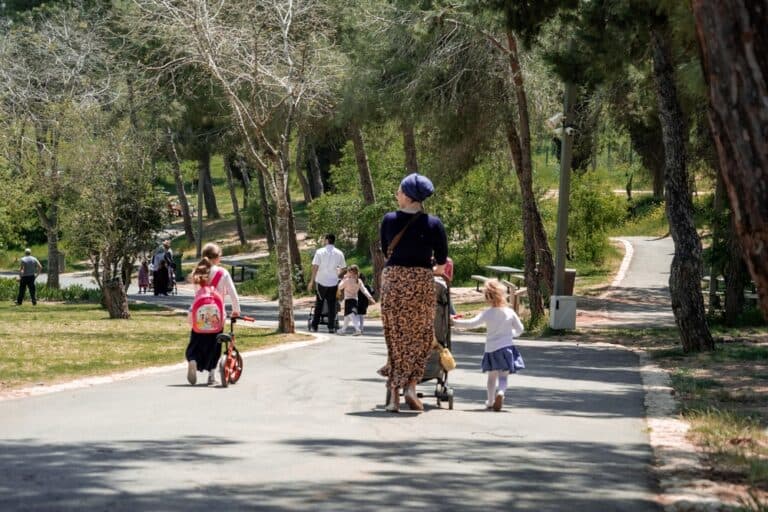

Jewish woman and children in Jerusalem. | Photo: Mayan Nemanov / Shutterstock
Two Loaves
After Kiddush, the blessing over the wine, we all get ready for the wonderful Challah bread loaves where we make the ‘motzi’ (blessing on the bread). Why do we first eat bread at the Shabbat meal? King David (Psalm 104) already taught us of the importance of bread when he said ‘bread satisfies the heart of man’. It is the staple of our meal and the main form of sustenance for humanity for thousands of years.
There is a custom that at every Shabbat meal (there are three) one ‘breaks bread’ over two whole loaves which are covered by a cloth. Why do we have two loaves and why do we cover them? The bread is a reminder of the miracle of the manna, which fell from heaven during the period when the Israelites were in the desert. It would be picked up in the morning dew by each family, one portion per day. However, as a test to the faith of the Israelites, God made it so that the manna would not fall on Shabbat. This way people would realize the holiness of Shabbat. What would they eat then on Shabbat? No fears! Two portions of manna would fall on Friday. Because of this extra miracle we always have two loaves for our Shabbat meals.
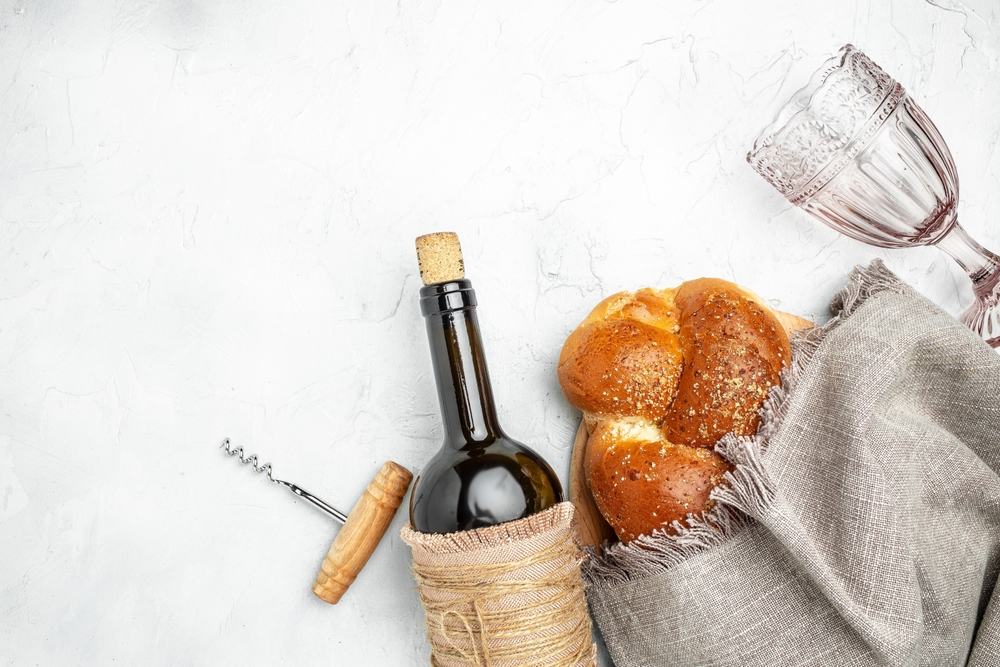
And why do we cover the loaves? Some say it relates to manna, while others say it relates to the value of bread and its primacy in the meal. By all rights, bread is the first thing we should eat at every meal, but on Shabbat we choose to begin our meal with wine. Why? Though bread ‘satiates the heart,’ wine ‘gladdens the heart of man,’ and on Shabbat we should begin with ‘simcha’—joy!
But if we are about to begin our meal and we see bread and wine, Halacha (Jewish law) dictates that we make a blessing on the bread. For this reason we cover the bread and ‘reveal’ it only after we make kiddush.
Birkat Habanim (Blessing the Children)
Another beautiful tradition which takes place in many Jewish homes on Friday night is the blessing over one’s children. This tradition, which is at least five hundred years old, takes place moments before the Kiddush is recited on Shabbat as well as on the eve of Yom Kippur. The procedure is that the child stands before the father, who rests his hand on the child’s head and recites the following biblical passage:
“May God Bless you and guard you. May God shine His light upon you and show you grace. May God lift his gaze upon you and give you peace.” He then recites a petition to God as he embraces the child. For a boy he says: “May God make you like Efraim and Menashe” (two sons of Joseph who received a blessing from Jacob). For a girl he says: “May God make you like Sarah, Rebecca, Rachel and Leah”
Today, in modern Orthodox circles both the father and the mother bless their children and embrace them at the beginning of Shabbat. This beautiful tradition sets the stage of a Shabbat of serenity, family joy and spirituality.
Eshet Chayil (Woman of Valor)
An interesting custom developed over the past few hundred years where the husband, and usually the entire family, sing a song to the mother called Eshet Chayil—a woman of valor or a woman soldier. The song is actually a chapter in the Bible, taken from the book of Proverbs, chapter 31. According to tradition the author of the book is none other than King Solomon, who wrote this book in the middle of his life, dispensing his wisdom to the world.
In the final chapter he asks ‘A woman of valor who can find?’ He then goes on to describe the wonderful qualities a woman of Israel possesses. She is a hard worker, providing for her family with food, clothing, even laboring in the fields with the vineyards. She is also compassionate to those who are less fortunate, providing for the poor and vulnerable.
She possesses an optimistic attitude all her life and never wastes time doing frivolous activities. Her children and husband see her amazing characteristics and praise her all her life.
The final verses speak to the essence of an incredible woman—someone who has inner beauty and one who fears God all their life. That is the true Eshet Chayil, she will forever be praised.

Discussion0
No comments yet — be the first to share your thoughts.