PM Netanyahu Visits the White House as Iran Tensions Escalate
As tensions mount over Iran’s nuclear and ballistic missile ambitions, Prime Minister Benjamin Netanyahu arrived in Washington this week for a high-stakes visit to the White House, where he is set to meet President Donald Trump amid delicate negotiations with Tehran and growing military preparations across the region. Netanyahu met overnight at Blair House with

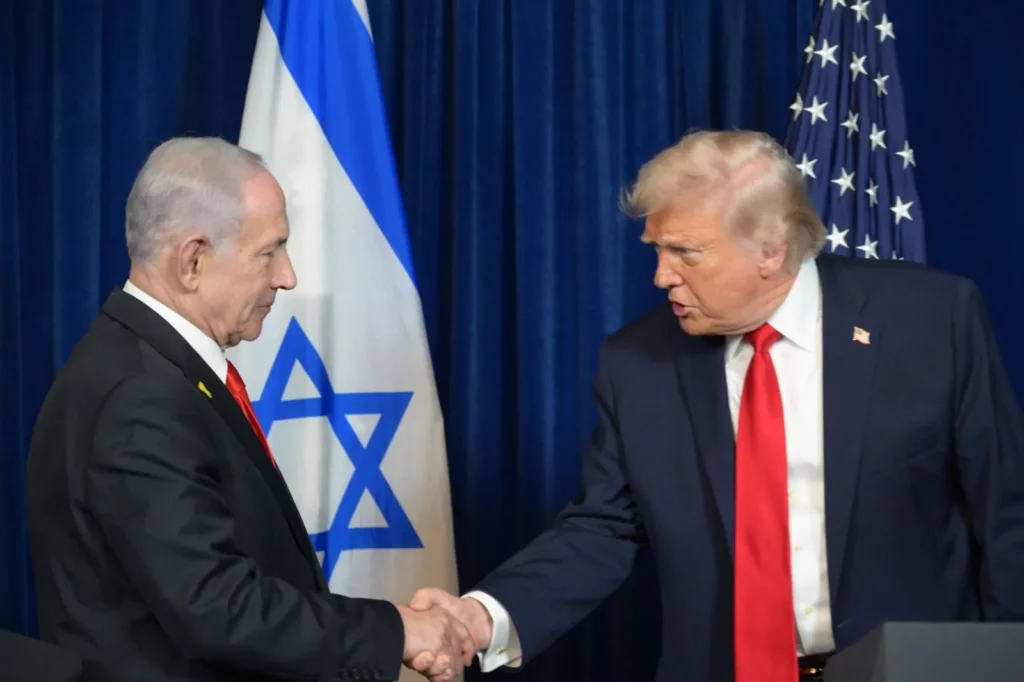
As tensions mount over Iran’s nuclear and ballistic missile ambitions, Prime Minister Benjamin Netanyahu arrived in Washington this week for a high-stakes visit to the White House, where he is set to meet President Donald Trump amid delicate negotiations with Tehran and growing military preparations across the region.
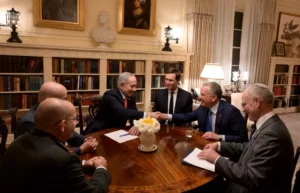
Netanyahu met overnight at Blair House with President Trump’s special envoys, Steve Witkoff and Jared Kushner, who briefed him on the first round of talks they held with Iranian officials last Friday. The discussions come at a pivotal moment, as Washington weighs whether diplomacy can curb Iran’s advancing capabilities or whether stronger measures will be required.
Before boarding the Wing of Zion aircraft for Washington, Netanyahu made clear that Iran would top the agenda. “On this trip we will discuss a series of issues, Gaza, the region, but of course first and foremost the negotiations with Iran,” he said. “I will present to the President our understanding of the essential principles in these negotiations. In my view, they are important not only for Israel, but for anyone in the world who seeks peace and security in the Middle East.”
Israel is reportedly insisting on three core principles in any agreement with Tehran: the complete dismantling of Iran’s nuclear weapons program, strict limits on its ballistic missile arsenal, and an end to Iranian support for terrorist organizations throughout the region.
While the focus remains on diplomatic and military strategy, the recent widespread protests inside Iran and their horrific suppression have added a volatile social dimension to the crisis. In cities across the country, demonstrators who began taking to the streets over economic hardship and political repression have increasingly voiced their hope for international pressure to save their lives and advance their dream of freedom. Interviews with Iranian citizens and activists describe a feeling among many that actions by the United States — and support from Israel — could strengthen their cause and hasten the end of the Islamic Republic’s oppressive rule.
President Trump, in an interview with journalist Barak Ravid, underscored his own red lines. “Iran will not have nuclear weapons and missiles,” he declared. He added that the Iranians “very much want to reach a deal,” and noted that “Bibi also wants to reach a good deal. Either we reach a deal, or we’ll have to do something very tough.” Trump said he is considering deploying an additional aircraft carrier and further U.S. forces to the region.
According to the President, the latest round of talks was “completely different” from negotiations that took place prior to Israel’s Operation “Rising Lion“. These are entirely different contacts,” he said. “The Iranians didn’t believe I would strike them. They took too big a gamble.”
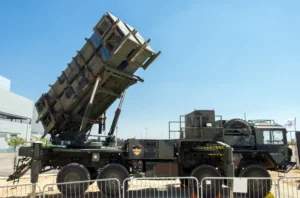
Even as diplomacy continues, military preparations are visibly underway. The U.S. military has deployed a Patriot air defense system to Al-Udeid Air Base in Qatar, placing the launchers on trucks to enable rapid mobility if needed, according to a Reuters report.
Meanwhile, two Israeli sources told CNN that Jerusalem is preparing contingency plans should the U.S.-Iran negotiations collapse. Israeli officials are said to be deeply concerned about Iran’s progress in rebuilding its ballistic missile stockpiles following the 12-day war. One source estimated that without intervention, Iran could possess between 1,800 and 2,000 ballistic missiles within months or even weeks.
Israeli officials reportedly remain skeptical about the prospects of a lasting agreement with the ayatollahs, and Netanyahu is expected to request full Israeli freedom of action against Iran, even in the event that Washington signs a deal with Tehran.
As Netanyahu prepares to meet President Trump at the White House, the stakes are high for both Israelis and Iranians. But whether the Middle East moves toward a fragile diplomatic breakthrough or braces for a far more decisive confrontation, Israel is protected from Above: “Behold the Guardian of Israel will neither slumber nor sleep” (Psalms 121:4).
Discussion0
No comments yet — be the first to share your thoughts.