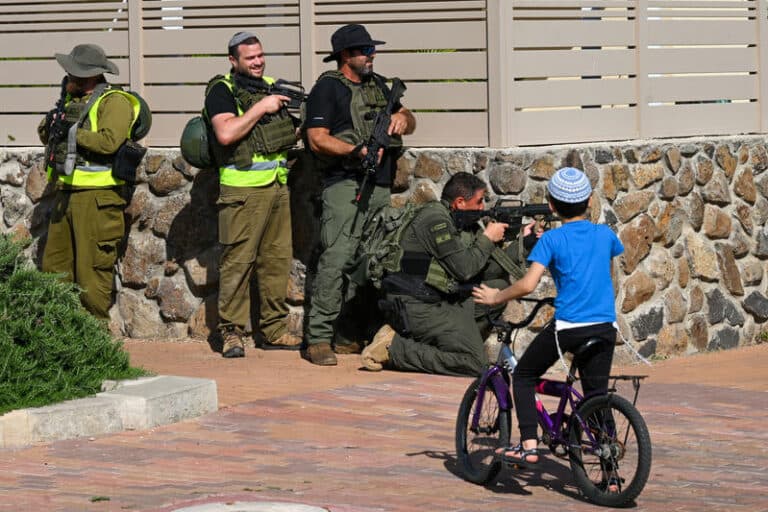

Members of a civilian Emergency Squad train in Urban Warfare in the Golan Heights | Photo: Michael Giladi/ Flash90
Takeaways:
- Over 9,200 new gun licenses were issued in Israel since October 7
- 900 armed civilian security squads now patrol cities and towns across the country
- Those squads are made up of 12,500 volunteers trained directly by police and the IDF
- Generator sales doubled among private households, municipalities, and medical centers
The Security Shift No One Saw Coming
October 7, 2023 rewired Israel. Ordinary Israelis, from families in Tel Aviv suburbs to retirees in the Galilee, made a collective decision: never again wait for someone else to save us.
On that Shabbat morning, many kibbutz residents along the Gaza border spent hours under attack before soldiers arrived. Hours. That fact alone changed the way Israelis think about personal safety. Israelis learned: the army may eventually come. But there’s no saying how much time we may be ‘on our own’ until help arrives.
That’s the reality that drove everything that followed.
Firearms: The Numbers Tell the Story
Before October 7th, gun ownership was always more tightly regulated in Israel than people assume. Getting a gun license took paperwork, training, and a genuine reason. After October 7, the reasons weren’t hard to come by. The criteria and bureaucracy needed to obtain a gun license have lessened considerably. As a result, police data confirms more than 9,200 new gun licenses have been issued since the attack. For many families, owning a firearm went from being a remote consideration to a practical necessity kept in a safe near the bedroom door.

Neighbor Watching Over Neighbor
The volunteer security movement is one of the most striking developments since the attack. Around 900 armed security squads were mobilized across Israeli cities and towns, the majority formed after October 7. These 12,500 trained volunteers, fathers, students, grandmothers, take rotating shifts patrolling the streets of their own communities.
These are simply neighbors who decided the covenant of community meant something tangible. The squads are trained by both police and army units, carrying licensed firearms and working in coordination with official security infrastructure.
📖 For a deeper look at how Israel took security matters into its own hands, read here about the self-reliance of Israel’s defense industry.

A Culture of Vigilance
One Israeli described it plainly: “After Oct. 7, I lost my attention for going to parties and bars and having fun. My whole life kind of shifted to being aware of the people around me.”
That shift is visible across Israeli society. Situational awareness, once associated with soldiers and security professionals, became a daily habit for ordinary people. Parents talk to their kids about what to do if something happens. Families have evacuation plans. People notice suspicious people, sounds, and occurrences now in a way they never paid attention before.
Alertness became an integral part of daily life, the same way carrying a phone or locking doors is part of daily life.
Emergency Preparedness at Home
Israeli households got serious about readiness in practical, unglamorous ways.
- Generator sales doubled to private customers, municipalities, and medical associations
- Families stocked dried food supplies for extended emergencies
- Mobile protective structures were purchased and installed outside residential buildings
In Rishpon, a moshav in Central Israel near Herzliya, the Kahan family bought a generator and began storing dried food specifically in anticipation of potential Hezbollah rocket strikes capable of knocking out the power grid.
Whereas some see this as maybe being extreme, in Israel, it’s considered the norm for just being prepared.
Technology Paired with Human Judgment
Post-October 7 analysis exposed a hard truth: the IDF’s observation and communication systems were actively paralyzed by Hamas during the attack. Technology failed. The lesson was to stop relying on military and technology alone.
The response has been to pair AI-assisted threat detection and sensor systems with trained human judgment.
Civilian security solutions now integrate real-time analysis, passive sensors, communication redundancies, and physical delay mechanisms for potential attackers. Behind every security screen, there’s a trained human, staying alert and on top of things.
Scripture put it plainly thousands of years ago: “Be strong and courageous. Do not be afraid or terrified because of them, for the Lord your God goes with you” (Deuteronomy 31:6).
Israel’s security transformation since October 7 is a study in what a society looks like when it takes responsibility for its own protection. It’s self-reliance, volunteer commitment, and practical preparedness, lived daily.
After October 7, the people of Israel never cowered in fear or stagnated. They were resilient and adaptive. And the world is watching in awe.
Want to keep reading? Learn about how the Shin Bet admitted their own failings on October 7th. Explore more on faith, values, and the Land of Israel at Sinai Project.
Discussion0
No comments yet — be the first to share your thoughts.