Esther’s Fast 2026: A Day of Prayer, Resolve and National Grief After Hit on Beit Shemesh
Today, (Monday) the Jewish people observe the Fast of Esther, the day of fasting held on the eve of the holiday of Purim. Known in Hebrew as Ta’anit Esther, the fast falls on the 13th of the month of Adar and commemorates the three days of fasting and prayer undertaken by Queen Esther and the


Today, (Monday) the Jewish people observe the Fast of Esther, the day of fasting held on the eve of the holiday of Purim. Known in Hebrew as Ta’anit Esther, the fast falls on the 13th of the month of Adar and commemorates the three days of fasting and prayer undertaken by Queen Esther and the Jewish people of Persia before she risked her life by entering the court of King Ahasuerus unbidden.
This year, the fast arrives under a heavy cloud in Israel. Just one day earlier, an Iranian missile struck the city of Beit Shemesh, killing nine people, including three teenage siblings, and left the nation reeling.
This is what terror that targets civilians looks like: pic.twitter.com/8vUcoORNIw
— Israel Defense Forces (@IDF) March 1, 2026
A Fast for Courage and Deliverance
The Fast of Esther recalls the dramatic events recorded in the Book of Esther. In the days of the Persian Empire, Haman the Agagite persuaded King Ahasuerus to issue a decree calling for the annihilation of the Jewish people. Mordechai, one of the Jewish community’s leaders, urged Queen Esther to intercede, even though approaching the king without being summoned could result in death, unless he extended his golden scepter.
Before taking that step, Esther sent word to Mordechai: “Go, gather all the Jews… and fast for me.” For three days, the Jewish people fasted and prayed. Esther herself joined in the fast with her maidens. What followed was a stunning reversal. Haman was hanged on the very gallows he had prepared for Mordechai, and the Jews were granted permission to defend themselves. On the 13th of Adar, the date originally designated for their destruction, they fought back against their enemies and were saved.
Unlike the four major public fasts established by the prophets, the Fast of Esther is a later custom. As such, Jewish law is somewhat more lenient in its observance, especially for pregnant women, nursing mothers, and those who are physically weak. Still, for many, it is a solemn day of introspection, gathering courage, and communal solidarity before the joy of Purim begins.

Nine Lives Lost in Beit Shemesh
This year, the themes of vulnerability, prayer, and deliverance are no abstraction. They are painfully immediate.
On Sunday afternoon, a missile struck a residential area in Beit Shemesh. Nine people were killed in the attack. Among them were three teenage siblings from the Biton family: Yaakov, 16, Avigail, 15, and Sarah, 13. The three were killed when the missile hit their home. Their funeral is scheduled to take place on the Mount of Olives in Jerusalem.

The siblings join six other victims whose names were previously released: Gloria Cohen and her son Yosef, young Gabriel Revaḥ, Ronit Elimelech and her mother Sarah Elimelech, and father of four Oren Katz.
Gabriel Baruch Revaḥ was a resident of the city and a student at Amit State Technological High School. The school mourned him publicly, describing their grief over the loss of a beloved student.

Ronit Elimelech and her mother Sarah were killed together, unseparated in life as in death. Ronit, whose children who also injured in the strike and are now hospitalized, was a dedicated volunteer with emergency service United Hatzalah in the city. Her mother, Sarah, was from one of Beit Shemesh’s founding families, remembered as warm, gracious, and deeply connected to the community.

Oren Katz was a resident of Bet-Shemesh. He left behind a widow and four orphans. His son remembered the way he had always taken care of the family, showering them with good food. At the funeral he said: “I hope the blood you spilled will not be in vain, and those monsters will be destroyed.”
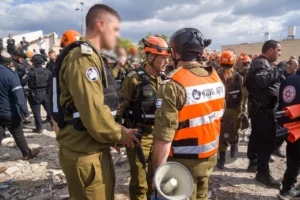
A preliminary investigation into the disaster has raised serious concerns about emergency response coordination. Rescue vehicles reportedly encountered significant traffic congestion. Some firefighters were forced to carry heavy equipment on foot for hundreds of meters. Heavy engineering equipment was delayed by approximately two hours.
The timeline released from the scene details early confusion about the scope of the strike, blocked access routes despite a declared mass casualty incident, and delays in the arrival of cranes and tractors needed to clear rubble. The findings underscore the need for improved emergency logistics and coordination in the face of ongoing missile threats.
Fasting in a Time of War
As Israel began the Fast of Esther, the ancient words “Go, gather all the Jews” carried renewed urgency. In the Persian Empire, the Jewish people faced annihilation through decree. Today, Israel confronts enemies who seek its destruction through missiles and terror.
Yet the fast is not only about danger. It is about response. It is about turning to God in humility and unity before stepping forward in courage. It is about the interplay between human initiative and divine providence.
On the very date that once marked a threatened annihilation and ultimately a miraculous reversal, Israelis now mourn fresh graves. And still, as Purim approaches, they prepare to read once more the story of hidden salvation, trusting that even in moments of darkness, the Author of history has not abandoned His people.
Discussion0
No comments yet — be the first to share your thoughts.