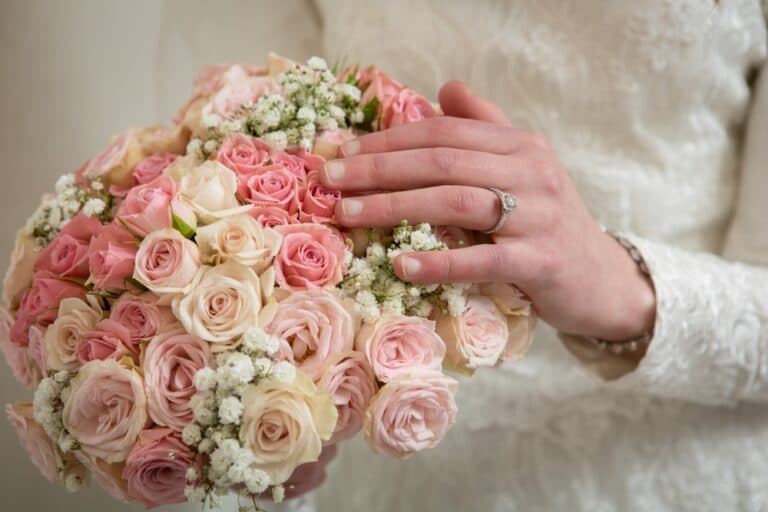

Bride holding flowers. | Photo: Shutterstock
The World Endures on Judgement, Truth, and Peace
Among the many laws of how to treat our neighbors and friends, the Torah reminds us several times of the dangers of lying. Truth is a fundamental principle and it serves as one of the foundations upon which the world exists. Our Sages, in the Mishna in Pirkei Avot (1:18), present Rabbi Shimon ben Gamliel who maintains that the world exists on three pillars: judgment, truth and peace.
An educator in our time, Rabbi Melamed in his book Peninei Halacha counts many separate prohibitions in the Torah concerning lying. The first relates to the verse which states, “medevar sheker tirchak” (“stay far away from words of falsehood”). This involves all types of statements which are not true, big and little lies, as in general they warp one’s sense of reality and change the world in which we live. A second type of lying is called ‘geneivat daat’ (‘theft of the mind’). The verse of ‘don’t steal’ in Leviticus relates not only to physical items one takes but also to misleading people, giving them the wrong impression of you. It is a form of stealing and lying if you invite someone to your home knowing full well they have other plans that night.

The Torah also prohibits against ‘fake flattery’, telling someone something to their face while at the same time believing the opposite. This once again gives them a wrong impression of you and the entire endeavor is slanderous. Lying is mentioned in the Ten Commandments—the ninth—in which in a courtroom setting one is prohibited from giving false testimony.
We learn that there are two types of lying—those which cause damage directly to another person and those that are unrelated to other people but are lies nonetheless. In the first category there is no allowance to lie ever, unless one’s life is in danger; in the second category the rabbis recognized that while that form of exaggeration or word misuse is prohibited, under certain conditions it is permitted.
Is it OK to Lie in Order to Make Peace?
In order to make peace between two people one is permitted to change the truth. For example, if someone asked you whether a friend spoke ill of you one should not say yes; rather, one should change the truth to make peace between friends. Another time one would be permitted to not disclose the truth is in cases of modesty—if someone were asked personal, potentially embarrassing, questions one may choose to lie. A third time would be if the truth would cause you to brag about your accomplishments, in such a case the rabbis permit one to change the truth. All these cases are under the condition that the lie does not cause damage to someone else; rather, it is just about the individual.
One of the most famous cases mentioned in the Talmud is about a wedding and the bride is sitting there at the happiest moment in her life. What do you say when you see her? ‘Beit Shamai,’ a group of scholars in the first and second centuries in Israel, suggest that one describe her exactly as she is—if pretty then pretty, if ugly then so be it! ‘Beit Hillel,’ another group at the same time, rejects that and says ‘the bride is lovely and beautiful’ regardless of her looks. Beit Hillel believed one should bend the truth in order to make the bride happy—and in the end the majority of rabbis followed the House of Hillel, as on that day, in those circumstances, she truly is lovely and beautiful.

Discussion0
No comments yet — be the first to share your thoughts.