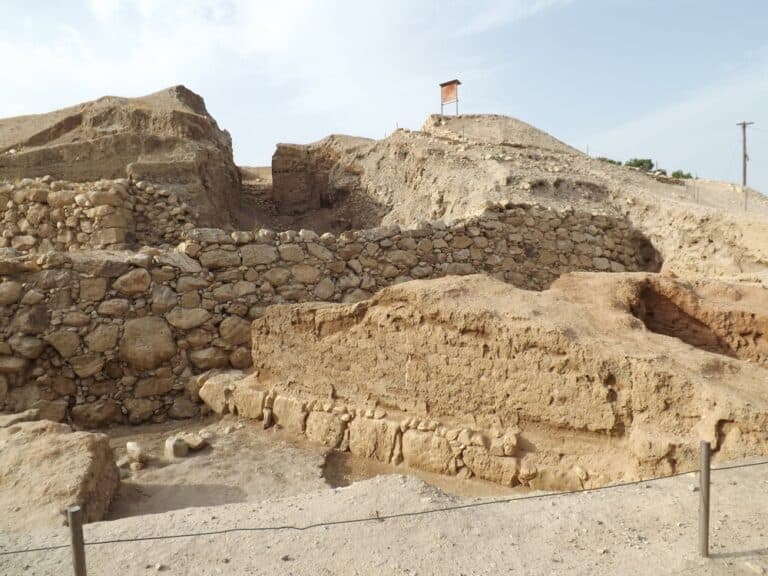

Ruins of Ancient Jericho. | Photo: Shutterstock
Takeaways
- Jericho is one of the oldest continuously inhabited cities on earth.
- Modern Jericho is a living city today, not a roped-off ruin.
- Jericho’s walls fell without a single battering ram, just a shout and a trumpet blast.
- Rahab the outsider became part of Israel’s own story through one act of courage.
- The Jericho of Joshua and the Jericho of later centuries are not even in the same spot.
I stood at the edge of Tel es-Sultan with my hand shielding my eyes from the sun, staring down at a mound of packed earth and stone that didn’t look like much of anything. My guide had just told me something that stopped me mid-step: somewhere under that dirt sat the remains of a wall that fell without a single weapon touching it. I’d heard the story a hundred times before. I’d never stood on top of it.
Jericho in the Bible
Jericho shows up early in the biblical record, right as Israel crosses the Jordan River and enters the land promised to their ancestors. It’s the first fortified city the nation faces, and the story around it (Joshua marching his army in silence for six days, then shouting on the seventh) has become one of the most retold scenes in scripture.
The walls came down through obedience and timing, without battering rams to smash the gates or towers built to scale them, exactly as the text describes it: six days of silent marching, then one shout and one trumpet blast on the seventh.
That detail matters. Ancient warfare depended on strategy, weapons, and manpower. Jericho’s fall depended on none of those things, which is exactly why the story has stuck around for thousands of years.
The text itself is almost cinematic: “And it came to pass, when the people heard the sound of the trumpet, and the people shouted with a great shout, that the wall fell down flat” (Joshua 6:20).
📖 Ever wondered what the ancient City of the Tabernacle, Shiloh, is like nowadays? Read here to learn about this extraordinary archaeological site.

Rahab and the Story Inside the Story
Buried inside the conquest account is a smaller, sharper story about a woman named Rahab. She hides two Israelite spies, lies to protect them, and asks for mercy in return. Her household is spared when the city falls.
Rahab wasn’t part of Israel. She became part of its story anyway, and her presence in the account adds a layer of mercy to what could easily read as a purely military tale.
Her own words explain why she took the risk in the first place: “I know that the Lord hath given you the land, and that your terror is fallen upon us” (Joshua 2:9). She’d heard the reports. She believed them before the walls ever came down.
Why Jericho Mattered on the Map
Long before anyone cared about its biblical fame, Jericho mattered because of geography. It sits in the Jordan Valley, near a natural desert oasis fed by a freshwater spring, at a crossroads connecting routes running north to south and east to west.
Fertile land in the middle of a desert is rare enough on its own to guarantee people would keep fighting over it. That’s part of why the city has been rebuilt, destroyed, and rebuilt again across thousands of years.
The Same Name, Different Cities
Here’s a detail most people miss: the Jericho of Joshua’s era and the Jericho that existed centuries later aren’t built on the same footprint. A later ruler named Herod constructed a newer city south of the original biblical site. Later events tied to the region, including a well-known account of a blind beggar regaining his sight, happened in that Herodian city rather than the older one Joshua encountered.
Modern Jericho today includes traces of both. It’s a layered city, stacked like sediment, one era on top of another.
The Jewish Historical Connection
Jericho isn’t only a conquest story. Jewish sources have long recognized it as a significant site connected to Israel’s own history, referenced across biblical and rabbinic literature well beyond the Joshua narrative. It’s part of the land’s story from the very beginning, tied to Israel’s return to its own territory rather than serving as background scenery for someone else’s tale.
That context matters for anyone reading these accounts as friends of Israel. Jericho belongs first to Israel’s own history. Everything else builds on top of that.
Fun Facts Almost Nobody Knows
- Jericho is regularly cited as one of the oldest cities on earth, with evidence of settlement stretching back roughly 10,000 years.
- It’s nicknamed the “City of Palms” thanks to the oasis that made it livable in the middle of a desert.
- The prophet Elisha is credited with purifying Jericho’s water spring, a story that still gets tied to the site’s freshwater source today. His words at the time were simple: “I have healed these waters; there shall not be from thence any more death or barren land” (2 Kings 2:21).
- Jericho sits below sea level, one of the lowest inhabited spots on the planet.
- The Herodian-era Jericho and the Joshua-era Jericho are close neighbors on the map but separated by centuries of rebuilding.

Panoramic View of modern Jericho from the nearby Mount of Temptations | Photo: Shutterstock
Standing Where the Walls Fell
By the time I made it back to the group, most of them had already wandered off toward the cable car that runs up to the Mount of Temptation. I stayed behind a little longer than I should have.
There’s no wall left to see. There’s just dirt, stone, and a spring still running nearby, the same spring that’s kept people alive in this valley for thousands of years. I put my hand on a rock that had no business meaning anything to me, and it did anyway. Some places don’t need proof. They just need you to show up and pay attention.
Want to keep reading? Click here for a fascinating article on the mystery of the Ark of the Covenant. Explore more on faith, values, and the Land of Israel at Sinai Project.
Discussion0
No comments yet — be the first to share your thoughts.